Host–Guest Inversion Engineering Induced Superionic Composite Solid Electrolytes for High‑Rate Solid‑State Alkali Metal Batteries
Published in Bioengineering & Biotechnology, Chemistry, and Materials
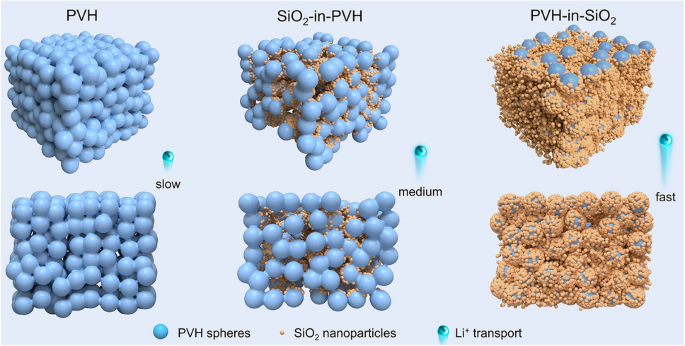

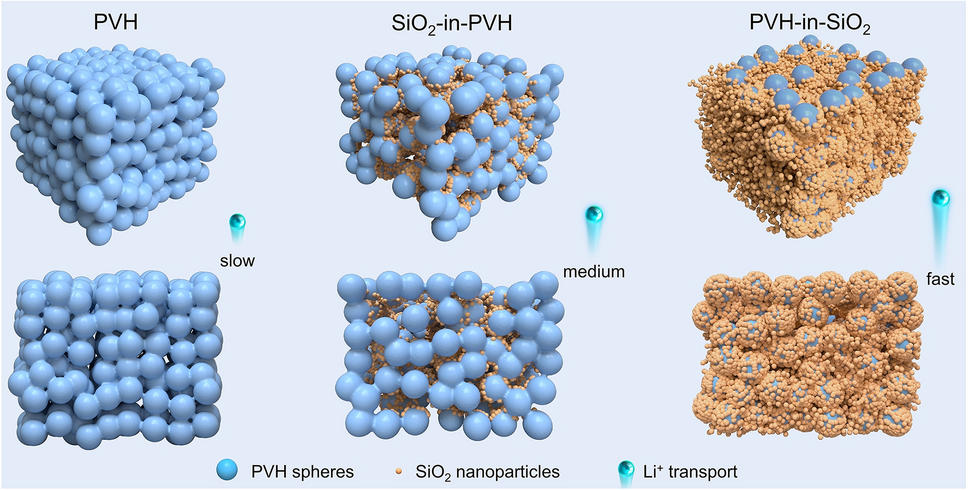

Composite solid electrolytes (CSEs) promise safer, energy-dense batteries, yet room-temperature conductivities ≥1 mS cm-1 still rely on costly, moisture-sensitive active ceramics. Now, researchers at Southeast University (China), led by Prof. Long Pan and Prof. Zheng-Ming Sun, overturn the conventional “ceramic-guest-in-polymer-host” paradigm through host–guest inversion engineering, creating a “PVH-in-SiO2” architecture that delivers 1.32 × 10⁻³ S cm-1 at 25 °C with only 2.9 wt % residual solvent—a 10× leap over passive-ceramic CSEs and competitive with best-in-class oxides/sulfides.
Why This Electrolyte Matters
- Superionic Highways: 158 nm SiO2 nanoparticles densely wrap interconnected PVDF-HFP micro-spheres, maximizing continuous SiO2/PVH interfaces where DFT shows Li+ diffusion barriers as low as 0.26 eV (vs 0.51 eV for SiO2/SiO2).
- Solvent-Lite: 2.9 wt % residual solvent (8–15 wt % typical) suppresses Li-metal side reactions while 87 % free-TFSI- (Raman) ensures high mobile-ion concentration.
- Universal Alkali-Ion: Identical protocol yields 3.0 × 10⁻⁴ S cm-1 (Na+) and 2.6 × 10⁻⁴ S cm-1 (K+)—14× & 64× boosts versus polymer-only analogues.
- Scalable & Flexible: 11 cm-diameter, foldable films cast from water/acetone in minutes; provisional patent filed (CN202310061247.3).
Electrochemical Performance
-
LiFePO4|PVH-in-SiO2|Li (25 °C)
– 157 mAh g-1@ 0.1C; 92.9 % retention after 300 cycles at 3C (capacity fade <0.025 % per cycle).
– High-loading (9.2 mg cm-2) cathode: 136 mAh g-1, 92 % retention/100 cycles. -
NCM622|PVH-in-SiO2|Li (4.3 V cut-off)
– 147 mAh g-1@ 0.2C, >100 cycles with 99.9 % CE. -
Na & K Full-Cells
– NVP|PVH-in-SiO2-Na|Na: 95 mAh g-1, 86 % retention/500 cycles @ 0.5C.
– KPB|PVH-in-SiO2-K|K: 84 % retention/500 cycles; PVH-K cells fail within 5 cycles.
Mechanistic Insights
SS-NMR tracking of 6Li shows 53 % of Li+ resides at SiO2/PVH interfaces after cycling (vs 2 % initially). MD simulations give Li+ diffusion coefficient 3.3 × 10⁻⁹ cm2 s-1 in PVH-in-SiO2, 3× steeper MSD slope than SiO2-in-PVH. Finite-element modeling visualizes current density 102–103 mA cm-2 localized along interfacial highways, confirming they dominate bulk transport.
Challenges & Next Steps
Thickness reduction to ≤25 µm and ceramic volume fraction optimization (currently 41 %) are underway to push areal capacity >3 mAh cm-2 with Ni-rich cathodes. Roll-to-roll coating trials with industry partners target pilot-scale pouch cells (2 Ah) by late-2025.
This host–guest inversion strategy turns low-cost, passive SiO2 into a superionic scaffold, offering a universal, solvent-lean platform for solid-state Li, Na and K batteries without the price or moisture penalties of active ceramics.

Editor of Nano-Micro Letters, which is an Open-Access, peer-reviewed journal reported papers that have at least one dimension ranging from a few sub-nanometers to a few hundreds of micrometers. The journal is published by Springer Nature and indexed by SCI, EI, SCOPUS, Pubmed, etc. The 2025 JCR Impact Factor is 38.5. The 2025 CiteScore is 58.9.
Follow the Topic
-
Nano-Micro Letters
Nano-Micro Letters is a peer-reviewed, international, interdisciplinary and open-access journal that focus on science, experiments, engineering, technologies and applications of nano- or microscale structure and system in physics, chemistry, biology, material science, and pharmacy.