Immunotherapy for Early-Stage Triple-Negative Breast Cancer: The NSABP B-59/GeparDouze trial
Published in Cancer, Biomedical Research, and General & Internal Medicine


Triple-negative breast cancer (TNBC) is an aggressive breast cancer subtype that lacks oestrogen receptor, progesterone receptor and HER2 expression, and is associated with a higher risk of recurrence than other breast cancer subtypes. As TNBC often shows immune activation and tumour-infiltrating lymphocytes (TILs), immune checkpoint inhibition has become an important therapeutic strategy in this disease setting.
To explore this strategy, we present the NSABP B-59/GeparDouze trial, an academic collaboration funded by grants from Genentech/Roche. This international, multicentre, randomised, double-blind, placebo-controlled phase III study evaluates whether adding the anti-PD-L1 immune checkpoint inhibitor atezolizumab to neoadjuvant chemotherapy could improve outcomes in patients with early-stage TNBC. In addition to the primary clinical results, this publication also presents extensive exploratory translational analyses from the study. The evaluation of TILs and mRNA-based molecular subtyping sheds light on the tumour immune microenvironment and its prognostic value in TNBC treatment.
The NSABP B-59/GeparDouze trial: primary results
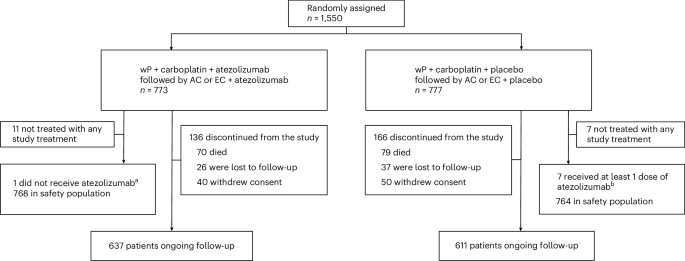
The trial enrolled 1,550 patients with centrally confirmed stage II–III TNBC across 353 sites in the United States, Germany, Canada and Spain. Patients were randomised to receive either atezolizumab or placebo in combination with a contemporary neoadjuvant chemotherapy regimen. After surgery, patients continued atezolizumab or placebo as adjuvant therapy to complete one year of study treatment. The primary endpoint was event-free survival (EFS); secondary endpoints included pathological complete response (pCR), distant disease-free survival (DDFS), overall survival (OS) and safety.
At the primary analysis, with a median follow-up of 46.9 months, 243 EFS events had occurred. The addition of atezolizumab produced a numerically favourable but statistically non-significant improvement in EFS. The 4-year EFS rate was 85.2% in the atezolizumab arm compared with 81.9% in the placebo arm, corresponding to a hazard ratio of 0.80 and a stratified log-rank p-value of 0.083, not meeting the pre-specified threshold for statistical significance. Therefore, the study did not demonstrate superiority of atezolizumab for the primary endpoint.
Subgroup analysis
Despite not meeting the primary endpoint, several findings suggested that atezolizumab may benefit selected patient subgroups. Prespecified subgroup analyses indicated heterogeneity according to clinical risk and immune features. Patients with clinically node-positive disease appeared to derive greater benefit from atezolizumab, with an EFS hazard ratio of 0.623, whereas node-negative patients did not show benefit. Patients with larger tumours and those with high TILs also showed signals of improved outcomes with atezolizumab, although interaction tests were not consistently statistically significant. A particularly notable exploratory finding was that node-positive patients with high TILs had a pronounced apparent benefit, with a 3-year EFS of 92.2% in the atezolizumab arm compared with 77.1% in the placebo arm.
Secondary endpoints
The trial showed a statistically significant improvement in the secondary endpoint of pathological complete response. The pCR rate was 63.3% with atezolizumab and 57.0% with placebo, an absolute improvement of 6.3%. Patients with pCR had excellent outcomes regardless of treatment arm, with 4-year EFS rates above 90%. In contrast, patients without pCR had lower EFS rates, but atezolizumab did not appear to improve outcomes in the non-pCR group overall. About half of patients with non-pCR received adjuvant capecitabine after a protocol amendment, but no clear atezolizumab treatment effect was seen among patients who did or did not receive capecitabine.
Secondary survival endpoints were also not statistically significant. The 4-year DDFS rate was 87.2% with atezolizumab and 85.2% with placebo, with a hazard ratio of 0.834. OS was similar between treatment arms: 90.2% with atezolizumab and 89.5% with placebo at 4 years, with a hazard ratio of 0.86. These findings indicate that, while atezolizumab modestly increased pCR, this did not translate into a statistically significant improvement in EFS, DDFS or OS in the overall study population.
Safety
Atezolizumab added immune-related toxicity and increased treatment discontinuation. Grade 3 or higher treatment-emergent adverse events occurred in 75.3% of patients receiving atezolizumab and 73.4% receiving placebo. Serious adverse events were somewhat more frequent with atezolizumab. Immune-related adverse events occurred in 27.6% of atezolizumab-treated patients compared with 11.4% of placebo-treated patients, with hypothyroidism, hyperthyroidism and infusion-related reactions among the most common. Discontinuation of study therapy during the neoadjuvant phase occurred in 25.5% of patients receiving atezolizumab compared with 18.8% receiving placebo, reflecting the additional tolerability burden of immunotherapy.
Exploratory mRNA-based biomarker analysis
A major strength of the study was the extensive biomarker programme. Central TIL evaluation was prospectively included in the trial with results available for nearly all patients. High TIL levels were strongly prognostic: patients with TILs ≥30% had higher pCR rates and better EFS than those with intermediate or low TILs. Patients with high-TIL tumours also appeared more likely to benefit from atezolizumab, supporting the idea that an immune-activated tumour microenvironment may be necessary for a meaningful response to immune checkpoint inhibition.
The exploratory mRNA-based biomarker analysis provided further biological insight. In a subset of 482 samples, tumours were classified into TNBC4-IR molecular subtypes: basal-like immune-activated (BLIA), basal-like immunosuppressed (BLIS), luminal androgen receptor (LAR) and mesenchymal (MES). BLIA was the most common subtype and was associated with higher pCR rates and better EFS than BLIS. Importantly, atezolizumab appeared to improve EFS in patients with BLIA tumours, whereas no clear benefit was seen in BLIS tumours. The intermediate TIL group was molecularly heterogeneous, containing both BLIA and BLIS tumours, which may explain why intermediate TILs alone did not identify patients likely to benefit from atezolizumab.
What have we learned?
- The phase III clinical trial demonstrated that atezolizumab, a PD-L1 inhibitor, did not significantly improve EFS in stage IIA and higher primary TNBC. However, the subgroup of patients with nodal involvement appeared to derive benefit. It also seemed that the group with high TILs did better.
- The translational research demonstrated that TNBC should not be treated as a single biological entity. Instead, molecular subtype and immune contexture may be critical for selecting patients most likely to benefit from immunotherapy. Combining TIL quantification with gene expression-based TNBC subtyping could help identify tumours with an immune-activated, ‘hot’ microenvironment, particularly BLIA tumours and high-TIL tumours, that may be more responsive to atezolizumab or potentially other checkpoint inhibitors.

Follow the Topic
-
Nature Medicine
This journal encompasses original research ranging from new concepts in human biology and disease pathogenesis to new therapeutic modalities and drug development, to all phases of clinical work, as well as innovative technologies aimed at improving human health.

Related Collections
With Collections, you can get published faster and increase your visibility.
Clinical Research in Respiratory Medicine
Publishing Model: Hybrid
Deadline: Feb 18, 2027
Cancer Prevention and Control
Publishing Model: Hybrid
Deadline: Feb 19, 2027