In Situ Partial‑Cyclized Polymerized Acrylonitrile‑Coated NCM811 Cathode for High‑Temperature≥100 °C Stable Solid‑State Lithium Metal Batteries
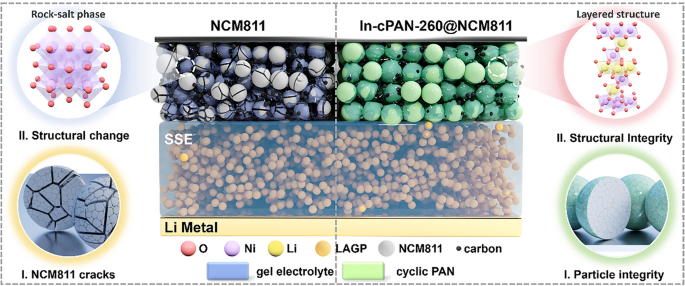

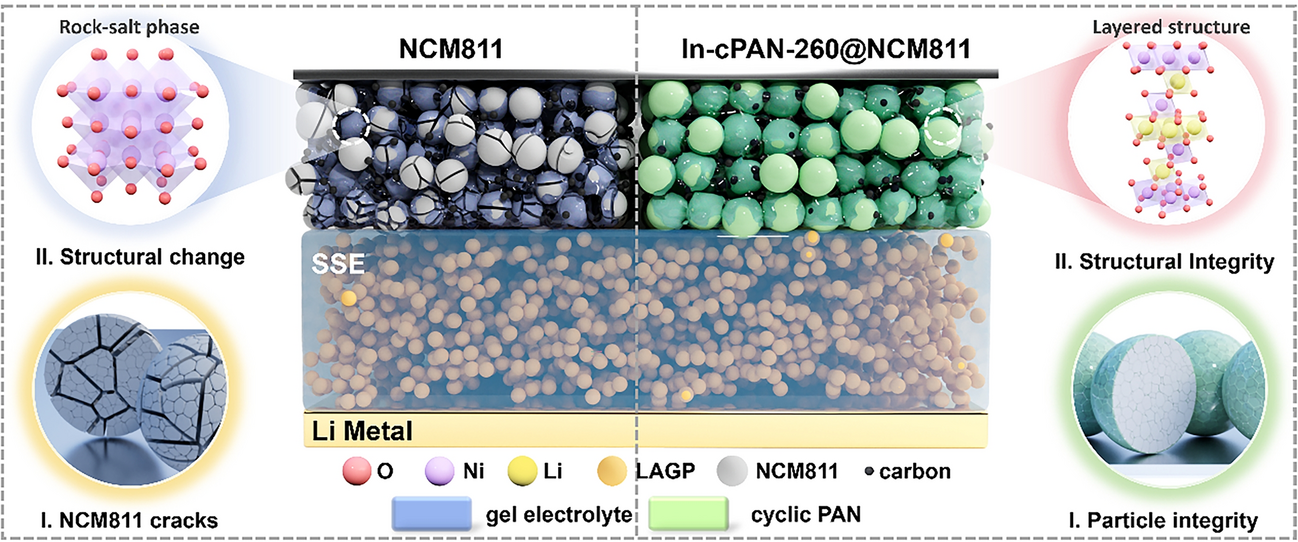

As electric vehicles, aerospace and underground instruments demand energy-dense power that survives extreme heat, the cathode–electrolyte interface in solid-state lithium metal batteries (SSLMBs) becomes the weakest link. Now, a National University of Defense Technology team led by Prof. Qingpeng Guo and Prof. Chunman Zheng unveils an ultrathin, ion-electron dual-conductive skin that keeps Ni-rich NCM811 stable even at 100 °C. Their work, published in Nano-Micro Letters, offers a scalable polymerization-cyclization recipe ready for roll-to-roll production.
Why the New Coating Matters
• High-Temperature Resilience: In-cPAN-260@NCM811 retains 86.8 % capacity after 300 cycles at 60 °C and 75 % after 100 cycles at 100 °C—far above the failure point of conventional oxide cathodes.
• Dendrite & Cracking Shield: A 12–15 nm cPAN network coordinates with surface Ni, raising the Ni-migration barrier from 2.83 eV to 3.36 eV and suppressing intergranular fracture under 4.3 V.
• Mixed Conduction: Partially graphitized cPAN delivers 0.14 S cm-1 electronic and 1.22 × 10⁻⁴ S cm-1 ionic conductivity, cutting charge-transfer resistance by 40 %.
Innovative Design & Features
• In-situ Polymerization: Acrylonitrile polymerizes directly on NCM811 in LiFSI-containing solvent, ensuring conformal coverage without extra binders.
• Controlled Cyclization: 260 °C air treatment converts 80 % of –CN into C=N/C=C conjugated rings, proven by FTIR, Raman and N 1s XPS.
• PVDF-HFP/LAGP Composite Electrolyte: The 50 µm membrane provides 0.78 mS cm-1 at 60 °C and stable Li plating for 3000 h.
Applications & Safety Validation
• Pouch-Cell Abuse Tests: LED arrays stay lit after folding, cutting and nail penetration; volume expansion <1 % versus 570 % for liquid cells during 90 °C storage.
• ARC Calorimetry: Self-heating onset rises from 160.9 °C (liquid) to 255.6 °C (solid), with peak runaway temperature dropping 60 %.
• Rate Capability: 163 mAh g-1 at 0.1 C, 140 mAh g-1 at 1 C, and only 15.7 mV polarization shift after 50 cycles.
Challenges & Outlook
The team highlights the need for thinner coatings (<5 nm) to push energy density above 400 Wh kg-1 and for continuous coating lines compatible with dry-electrode calendaring. Future research will couple real-time impedance monitoring with AI-driven cyclization control to extend cycle life beyond 1 000 at 120 °C.
This facile surface-engineering strategy opens a commercially viable route for thermally robust, high-energy SSLMBs in extreme-environment applications.

Editor of Nano-Micro Letters, which is an Open-Access, peer-reviewed journal reported papers that have at least one dimension ranging from a few sub-nanometers to a few hundreds of micrometers. The journal is published by Springer Nature and indexed by SCI, EI, SCOPUS, Pubmed, etc. The 2025 JCR Impact Factor is 38.5. The 2025 CiteScore is 58.9.
Follow the Topic
-
Nano-Micro Letters
Nano-Micro Letters is a peer-reviewed, international, interdisciplinary and open-access journal that focus on science, experiments, engineering, technologies and applications of nano- or microscale structure and system in physics, chemistry, biology, material science, and pharmacy.