Inflation, food insecurity, and mental health: Generation Z’s burden in emerging Europe
Published in Research Data, Behavioural Sciences & Psychology, and Economics


More than Rising Prices
When we hear the word “inflation,” we typically think about prices going up. Groceries cost more, energy bills climb, and our wallets feel lighter. What often goes unnoticed, however, is the psychological burden of inflation for many young people today, especially in emerging European economies. For members of Gen Z, inflation isn’t just about spending more at the checkout counter. It is a force capable of reshaping their sense of security, stability, and even their mental health.
In Hungary, where food prices rose by nearly 45% between 2021 and 2022, the crisis has been particularly severe. Some students told us that they were skipping meals, eating less, or feeling constant stress about whether they could afford fresh and healthy food. For young people who are just beginning to shape their futures, these pressures weigh heavily and can have serious consequences.
Our recently published open access article in Humanities and Social Sciences Communications explores the reality of how inflation, food insecurity, and mental health are deeply interconnected in the lives of young adults.
Read the full study here: https://doi.org/10.1057/s41599-025-05858-w.
The Story Behind the Research
This project began close to home with our own families and the growing cost of healthy, accessible food. We also noticed that many university students on fixed budgets were increasingly substituting healthy foods for cheaper, less nutritious alternatives. Some even skipped meals entirely to save money.
At the same time, headlines reported inflation rates that seemed never to peak. But what wasn’t being reported was the ripple effect on the mental health of university students. As lecturers and researchers working closely with students, we wanted to understand:
- How is inflation changing the daily lives of Gen Z?
- What does it mean for their access to food?
- And crucially, how does it affect their well-being?
What We Did
We surveyed 517 Hungarian university students in late 2023 using two well-established tools:
- Food Insecurity Experience Scale (FIES):Used to measure how often students worried about or struggled to get enough food.
- Patient Health Questionnaire (PHQ-9):Used to assess levels of depression.
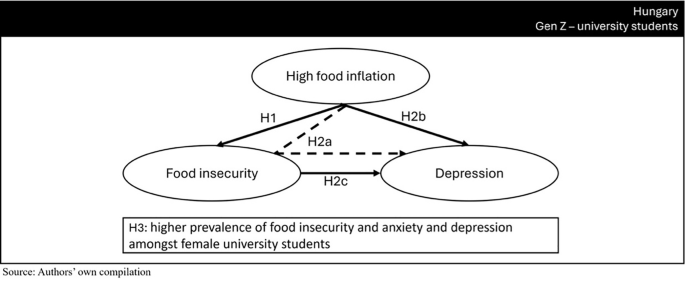
We then applied advanced statistical modeling (PLS-SEM) to trace the chain reaction of Inflation to Food Insecurity to Mental Health.
Key Findings
- Nearly half (45.6%)of students experienced some form of food insecurity.
- Three-quarters (77%) showed signs of moderate to severe depression.
- Women were disproportionately affected, reporting higher levels of both food insecurity and depressive symptoms.
- Food insecurity mediates the relationship between inflation and depression, meaning inflation increases food insecurity, which in turn worsens mental health.
When prices rise and food becomes uncertain, it’s not just stomachs that suffer, but also minds and futures.
|
Article |
Country |
Date |
n |
Moderate |
Severe |
|
|
Inflation, food insecurity, and mental health: Generation Z’s burden in emerging Europe |
Hungary |
2024 |
517 |
45.6% |
12.66% |
2.6% |
|
Prevalence and Predictors of Food Insecurity among Students of a Spanish University during the COVID-19 Pandemic: FINESCOP Project at the UPV/EHU |
Spain |
2023 |
422 |
22.9% |
2.6% |
0.7% |
|
Prevalence and predictors of food insecurity among university students – Results from the Justus Liebig University Giessen, Germany
|
Germany |
2023 |
626 |
27.5% |
9.5% |
0.9% |
|
Evaluation of food insecurity and its association with food consumption and some variables among college students |
Turkey |
2023 |
1149 |
35.5% |
13% |
9.4% |
|
Food Insecurity Levels among University Students: A Cross-Sectional Study |
Portugal |
2022 |
284 |
17.3% |
2.1% |
1.1% |
Why This Matters
For policymakers, these findings highlight that tackling inflation cannot just mean stabilizing prices. The effects ripple through young people’s lives, influencing mental health, academic success, and long-term opportunities. For universities, the results show the urgent need for on-campus support such as subsidized cafeterias, emergency food programs, and accessible mental health services. For all of us, it is a reminder that economic headlines translate into deeply personal struggles for young people.
Looking Forward
Our study focused on Hungary, but similar dynamics are playing out across Central and Eastern Europe and beyond. We hope to see more cross-national research comparing how different governments and universities are supporting students through inflation.
Future studies should also explore the long-term impact regaridng how these struggles affect career paths, health outcomes, and resilience in adulthood.
Closing Thoughts
The impact of inflation transcends mere economics economics. For Gen Z in emerging Europe, rising prices extend beyond tighter budgets to skipped meals, sleepless nights, and heavy emotional burdens. If we want future generations to thrive, we must think about economic and mental health together. Supporting students isn’t just about financial aid, but rather about ensuring that their well-being in the broadest sense.
Read the full open access article here: https://doi.org/10.1057/s41599-025-05858-w

I am a long time entrepreneur turned academic. Becoming a university professor and researcher has given me the opportunity to apply my experience and skills in a totally new setting while also pushing me learn a whole set of new skills in the process.
While the world cannot speak a sentence without including a mention of AI, I am concerned about its side effects (cogntive offloading), particularly on digital natives .
Follow the Topic
-
Humanities and Social Sciences Communications
A fully open-access, online journal publishing peer-reviewed research from across—and between—all areas of the humanities, behavioral and social sciences.

Related Collections
With Collections, you can get published faster and increase your visibility.
Environmental advocacy: psychological and behavioural dynamics
Publishing Model: Open Access
Deadline: Nov 25, 2026
Tourists, go home? Sustainable tourism in popular destinations
Publishing Model: Open Access
Deadline: Dec 18, 2026