Influence of breast density on performance of 3D mammography versus 2D mammography in breast cancer screening
Published in Cancer



The Known
An emerging technology, 3D mammography, provides reconstructed three-dimensional mammographic images of the breast. It has been proposed to improve cancer detection in screening via better visualisation of cancer lesions that may be obscured by dense or overlapping breast tissues on conventional 2D mammography [1]. Our previous research has compared 3D and 2D mammography in breast cancer screening using conventional screening measures such as cancer detection and recall rates, and it reported that detection measures favoured 3D mammography [2].
Breast density reflects the proportion of fibroglandular tissue in the breast, as determined from a mammographic image. High breast density is associated with increased risk of breast cancer, and can obscure cancer on standard 2D mammography where breast tissue could be superimposed [3]. There is a suggestion that 3D mammography may be more for [2]. However, although studies have shown that 3D mammography detects more cancers than conventional 2D mammography, it is unclear whether this is particularly so for women with dense breasts. We are interested to know if screening performance measures for 3D compared to 2D mammography differ by breast density.
The New
Our study ‘Differential detection by breast density for digital breast tomosynthesis versus digital mammography population screening: a systematic review and meta-analysis’ estimated changes in breast cancer detection and recall rates associated with screening by 3D mammography versus 2D mammography according to breast density.
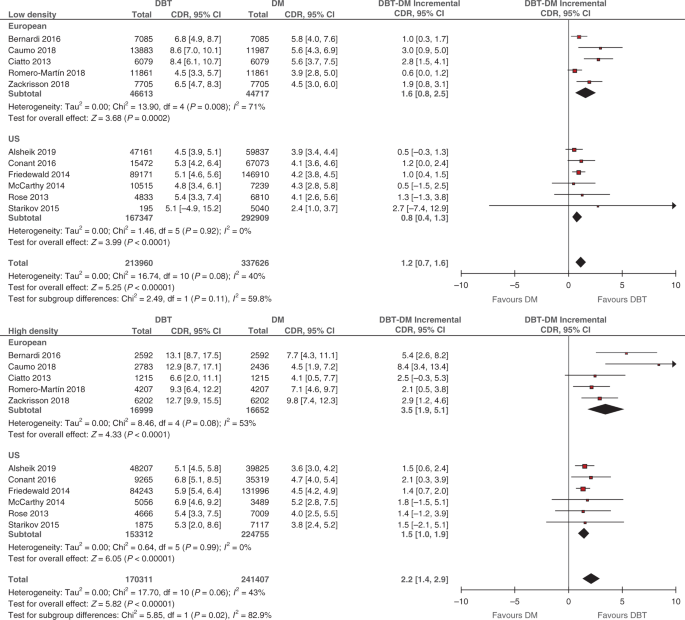
Our meta-analysis provides evidence that 3D mammography detects more cancers than 2D mammography in both low- and high-density screening examinations. Importantly, we found that the increase in cancer detection rate is greater in high (vs low) density screens, and that this was the case in both European and US screening settings (Figure 1).
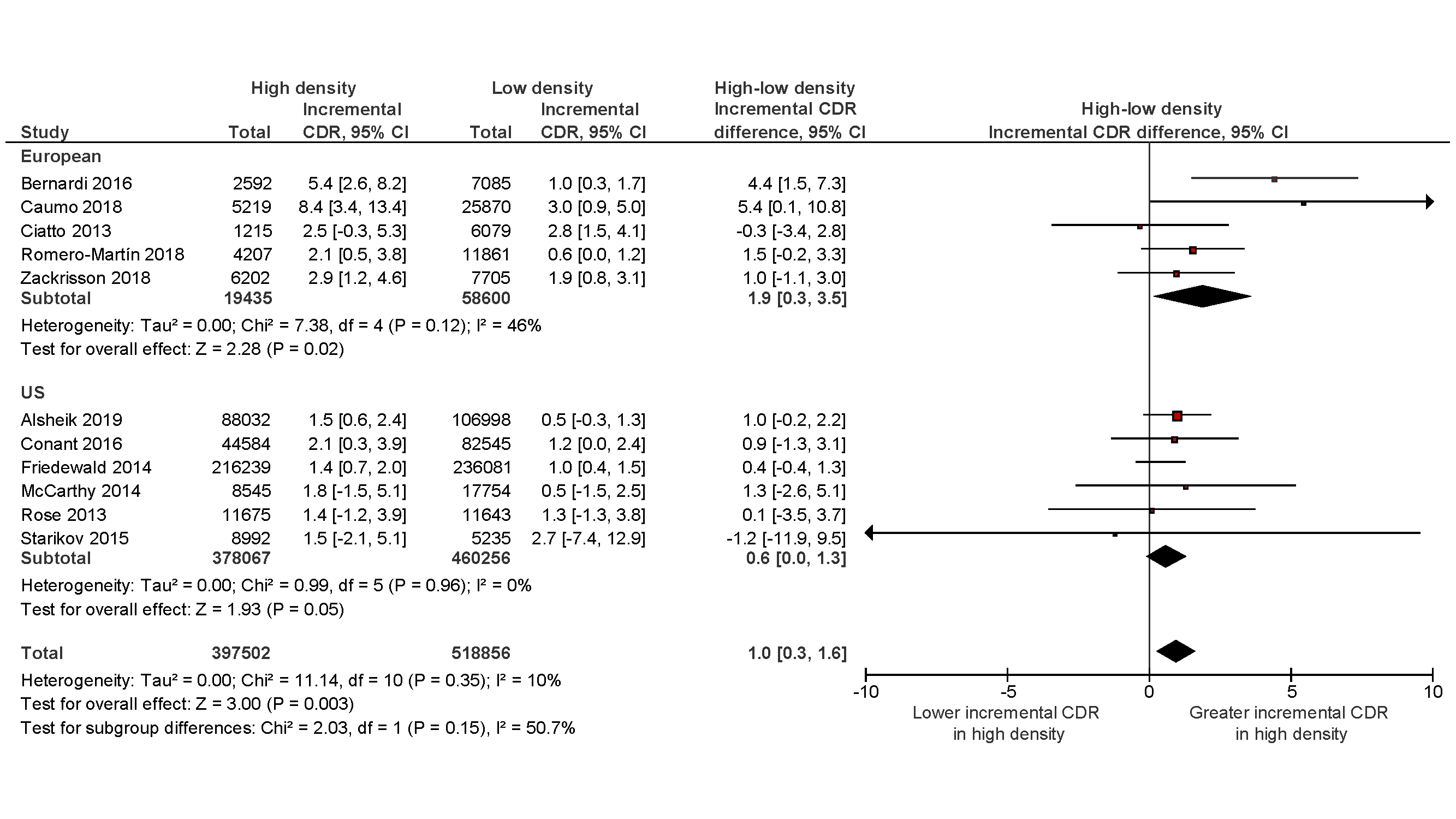
Figure 1: Difference in cancer detection rate (incremental CDR) between 3D mammography and 2D mammography stratified by breast density and study setting.
Conversely, the difference in recall rates by breast density varied by screening setting subgroups. This result to some extent suggests that DBT has a benefit in reducing recalls in US screening practice and particularly in women with dense breasts, but may lead to more recalled cases for such women in European screening programs.
Although we found that 3D mammography increased the cancer detection rate more in high-density than low-density screens, it is important to consider that screening populations are likely to include large numbers of low-density examinations. This means that even the smaller increase in cancer detection in low-density screens can potentially translate to many additional cancers detected. When low-density screens represent the majority of the screening population (e.g. Australian and many European breast screening programs), it is possible that most of the additional cancers detected by 3D mammography would be in the low-density group.
The Implications
Our study is the first meta-analysis reporting comparative estimates for 3D and 2D mammography screening according to breast density. The adoption of 3D mammography in place of the standard 2D mammography for population breast cancer screening has progressed rapidly. Breast density, a long-established independent risk factor for breast cancer, has gained increased attention since the introduction of breast density legislation in the US [4]. The evidence is timely and relevant in the developing landscape of breast screening that includes discussions of 3D mammography adoption, breast density notification, and tailored breast screening.
References:
- Li T, Marinovich ML, et al., Digital breast tomosynthesis (3D mammography) for breast cancer screening and for assessment of screen-recalled findings: review of the evidence. Expert review of anticancer therapy, 2018. 18(8): p. 785-91.
- Marinovich ML, Hunter KE, et al., Breast cancer screening using tomosynthesis or mammography: a meta-analysis of cancer detection and recall. Journal of the National Cancer Institute, 2018. 110(9): p. 942-9.
- Huo CW, Chew GL, et al., Mammographic density—a review on the current understanding of its association with breast cancer. Breast Cancer Research and Treatment, 2014. 144(3): p. 479-502.
- Kyanko KA, Hoag J, et al., Dense breast notification laws, education, and women’s awareness and knowledge of breast density: a nationally representative survey. Journal of General Internal Medicine, 2020. 35(7): p. 1940-5.
Follow the Topic
-
British Journal of Cancer
This journal is devoted to publishing cutting edge discovery, translational and clinical cancer research across the broad spectrum of oncology.