Inorganic Interface Engineering for Stabilizing Zn Metal Anode
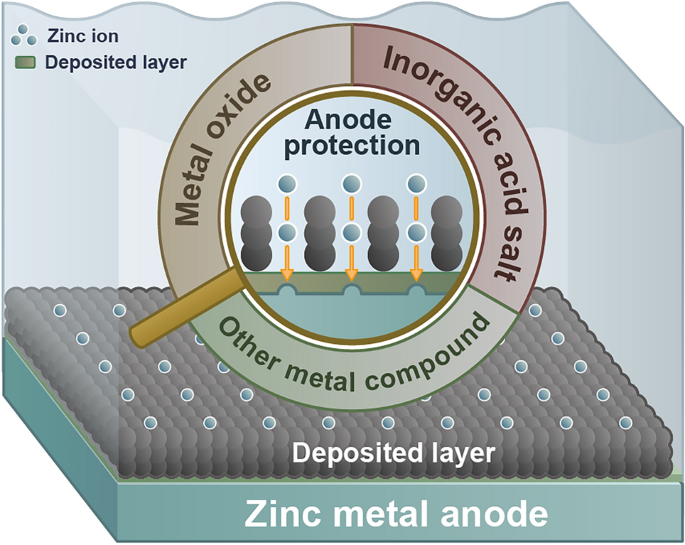
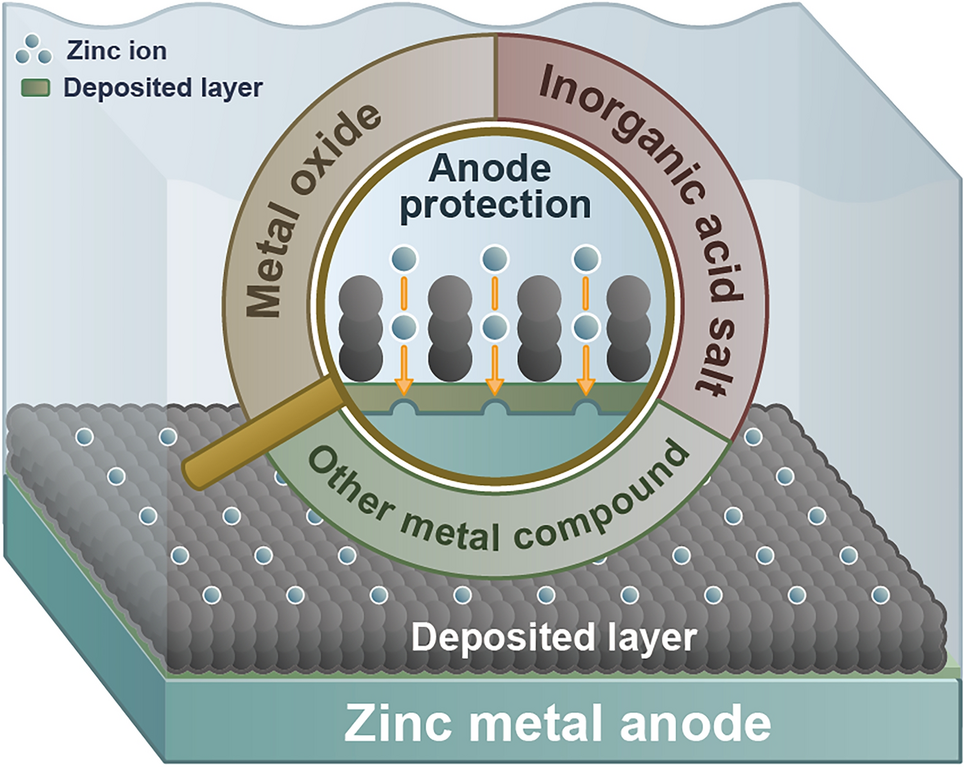

As lithium costs soar and safety incidents mount, aqueous zinc-ion batteries (AZMBs) promise a cheap, non-flammable alternative—yet zinc anodes still rot from within, sprouting dendrites that short-circuit cells in days while hydrogen bubbles swell the pack. Now, a multi-institute team led by Prof. Qingli Zou (Beijing University of Chemical Technology) and Prof. Hongjin Fan (Nanyang Technological University) has delivered a design manual in Nano-Micro Letters that turns commercial Zn foil into an ultra-stable anode through simple, low-cost inorganic coatings, pushing symmetric cells beyond 6500 h and pouch cells past 200 cycles at 10 mAh cm-2.
Why Inorganic Interface Engineering Matters
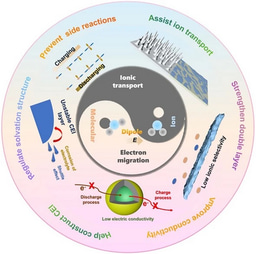
- Dendrite Suppression: Dense Al2O3, ZnO or TiO2 layers homogenize surface charge and provide zincophilic nucleation sites, forcing lateral (002)-textured growth instead of mossy filaments.
- Hydrogen Evolution Blockade: Phosphate, silicate or MXene barriers physically isolate water from the metal, cutting HER to <0.1 % per cycle and eliminating cell swelling.
- High Areal Capacity: Non-consumable, corrosion-resistant coatings tolerate >10 mAh cm-2 and 50 mA cm-2—meeting practical targets for grid storage and e-mobility.
Innovative Design & Features
- Material Palette: Metal oxides (TiO2, ZrO2, Nb2O5), nitrides (TiN, CrN), sulfides/selenides (ZnS, ZnSe), MXenes (Ti3C2Cl2) and acid salts (Zn3(PO4)2, sepiolite) are compared for ionic conductivity, adsorption energy and mechanical strength.
- Structure Engineering: Atomic-layer-deposited 10 nm Al2O3, micro-concave ZnO, hollow ZnSnO3 cubes and 45 nm zinc-phosphate SEI each demonstrate specific pathways to guide Zn2+ flux and suppress side reactions.
- Scale-Up Compatibility: All coatings are deposited by spray, dip, ALD or simple chemical bath—compatible with roll-to-roll processing of commercial Zn foil.
Applications & Future Outlook
- Grid-Scale Storage: A 1 Ah Zn||V2O5 pouch cell with Zn-phosphate interface retains 80 % capacity after 200 cycles at 10 mAh cm-2, projecting <$60 kWh-1 system cost.
- Flexible Devices: 10 nm MXene-coated Zn anodes survive 1500 bends in Zn-I2 thread batteries, enabling wearable e-textiles.
- Next Steps: Team is integrating AI-guided lattice-matching models and in-line thickness monitoring to transfer the technology to 100 Ah modules by 2026.
This roadmap converts the zinc anode from a liability into a long-lived, high-energy asset, positioning AZMBs as the front-runner for safe, sustainable and low-cost energy storage.

Editor of Nano-Micro Letters, which is an Open-Access, peer-reviewed journal reported papers that have at least one dimension ranging from a few sub-nanometers to a few hundreds of micrometers. The journal is published by Springer Nature and indexed by SCI, EI, SCOPUS, Pubmed, etc. The 2024 JCR Impact Factor is 36.3. The 2024 CiteScore is 53.1.
Follow the Topic
-
Nano-Micro Letters

Nano-Micro Letters is a peer-reviewed, international, interdisciplinary and open-access journal that focus on science, experiments, engineering, technologies and applications of nano- or microscale structure and system in physics, chemistry, biology, material science, and pharmacy.
Please sign in or register for FREE
If you are a registered user on Research Communities by Springer Nature, please sign in