International Markets are not the Only Driver of Deforestation
Published in Earth & Environment



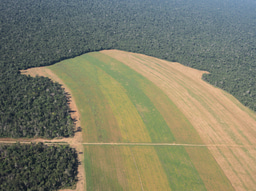
Resume: In this study we found that municipalities in the Brazilian state of Mato Grosso that send their soybean production to domestic markets (which tend to be located in the Amazon biome) are more associated with deforestation compared to municipalities that send most of their soybean production to international markets. In addition, municipalities sending their soybean to domestic markets also exhibit the highest expansion of cattle ranching activities, indicating a higher association between soybean, pasture, and deforestation in agricultural frontiers. These finds are of crucial importance since over the last few decades sustainability supply chain efforts were concentrated on the international flows of soybean (e.g., Soy Moratorium), which represent more than 60% of the Brazilian production. In our study we also call attention to cases where soybean production that are considered as “not exported” may be incorporated into international markets through soybean “washing”, in which producers and trading companies “clean” soybean produced in deforestation areas in the Amazon before sending it to international markets. We argue that supply chain agreements should expand their attention to a more comprehensive understanding of agricultural frontiers in tropical regions, where sustainability agreements should not just focus on single-commodities but envision production systems as a whole.
The increased connectivity of supply chains worldwide has allowed coupled human and natural systems around the world to share common goods - such as food, energy or qualified labor, among others. However, as goods move from production to consumption areas, many negative effects of consumption often remain in the production areas. The soybean supply chain - with Brazil, China, US and European Union as major players - is no different. Brazil is the major global supplier of soybeans to global markets, while it is also experiencing major negative environmental consequences of soybean production (notably deforestation).
In Brazil, over 60% of soybean production is destined for international markets. This metric has been used as an indicator of the intensity and pressure of international supply chains on deforestation and other negative environmental consequences (e.g., water contamination, increased forest fragmentation, climate change). Over the last few decades, European Union countries and international companies, have implemented new standards for what they understand as sustainable supply chains. Thus, the world has observed the growth of a number of certifications and sustainability agreements that aim to push production systems toward sustainability. Since the end of the 2000s, Brazil started a trajectory of deforestation control, with reasonably successful national policies, such as the Plan of Prevention and Control of Deforestation in the Amazon (PPCDAm), and sustainability agreements, such as the Soy Moratorium. Although these plans and agreements have been associated with a decreasing trend in natural vegetation cover loss, deforestation has, nonetheless, continued.
Using data from multiple sources (e.g., TRASE, IBGE, Mapbiomas) we assessed, on an annual basis (2004-2017), the amount of soybean produced in each municipality of the state of Mato Grosso (a major soybean producer in Brazil), the proportion of this production that was sent to international and to domestic markets, the stability of these proportions, and deforestation. Our results show that municipalities exhibiting the lowest participation in international soybean exports (which are mainly concentrated in the Amazon biome) exhibited higher deforestation rates. Furthermore, we found that the higher the stability in a given municipality, the higher the proportion of soybean produced that was not exported. In addition, considering other spatial and temporal dynamics associated with deforestation and soybean production, we observed higher increases in cattle activity and pasture expansion in the municipalities producing more for domestic markets. These results indicate that soybean producers may be capitalizing on active agricultural frontiers (where intense deforestation is found) to expand production regardless of international supply chain sustainability agreements. Thus, in these high deforestation areas producers are more likely to be supplying domestic markets, which tend to be less committed to sustainability agreements. In our study we also call attention to cases where soybean production considered “not exported” may make its way into international markets through soybean “washing”, a process in which producers and trading companies “clean” soybean from deforestation areas in the Amazon before delivering it to international markets.
Our study reveals that although there is great attention of national and international players on the international soybean supply chain, deforestation associated with this commodity is still active and mainly due to production that is not exported internationally. Therefore, supply chain agreements should expand their scope and attention to a more comprehensive understanding of the agricultural frontiers in tropical regions, such that sustainability agreements do not focus on single-commodities but envision production systems as fully integrated systems.
Follow the Topic
-
Scientific Reports
An open access journal publishing original research from across all areas of the natural sciences, psychology, medicine and engineering.

Related Collections
With Collections, you can get published faster and increase your visibility.
Cancer Prevention and Control
Publishing Model: Hybrid
Deadline: Feb 19, 2027
Healthy Aging
Publishing Model: Open Access
Deadline: Dec 31, 2026