January 2026 Highlights from Mathematics, Physical and Applied Sciences Communities
Published in Astronomy, Earth & Environment, and Materials






Across the Mathematics, Physical and Applied Sciences Communities, researchers are pushing boundaries by recreating the chemistry of deep space, reimagining how we sense our environment, probing quantum materials, forecasting climate risks in fragile ecosystems, and more.
In this January roundup, we highlight five recent Behind the Paper stories that reveal not only key scientific findings, but also the curiosity, setbacks, and creative thinking behind them. Together, they showcase how fundamental research, innovative methods, and interdisciplinary collaboration are reshaping our understanding of the natural and technological world.
Alongside these research highlights, we also spotlight conversations shaping the future of the field, including upcoming events and an interview with an Editor-in-Chief of Clean Planet. We invite you to explore these pieces, join the discussions, and share your thoughts on these works in the comments. Your insights, questions, and participation help drive science forward.
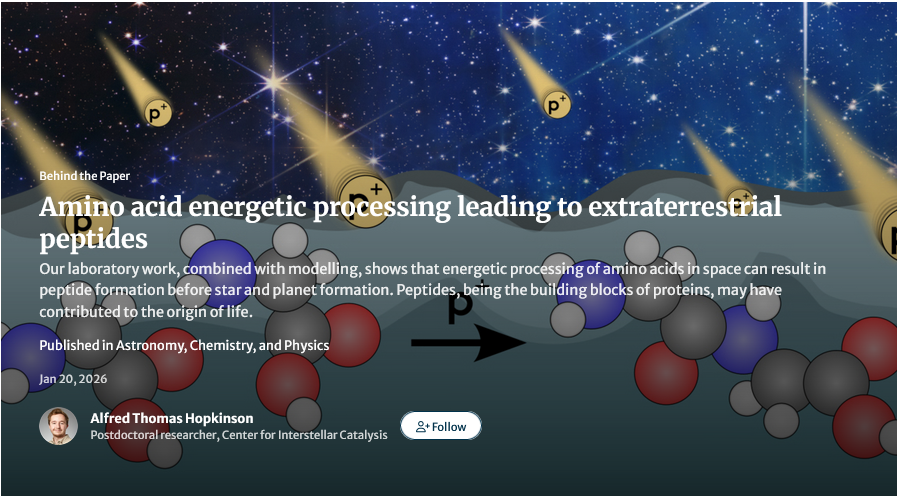
Turning amino acids into peptides under space-like conditions
Could the basic ingredients of life be assembled before planets even form? In this Behind the Paper story, @Alfred Thomas Hopkinson explains how he recreated space-like conditions in ultra-high vacuum chambers to investigate what happens to amino acids such as glycine when they are struck by energetic particles.
Published in Nature Astronomy, results suggest that interstellar clouds and protoplanetary environments may actively contribute to the creation of complex, biologically relevant molecules that could later be delivered to young planets like Earth.
Want to discover how this three-year experimental journey unfolded and what it means for our understanding of life’s origins? Read the full Behind the Paper post to find out.
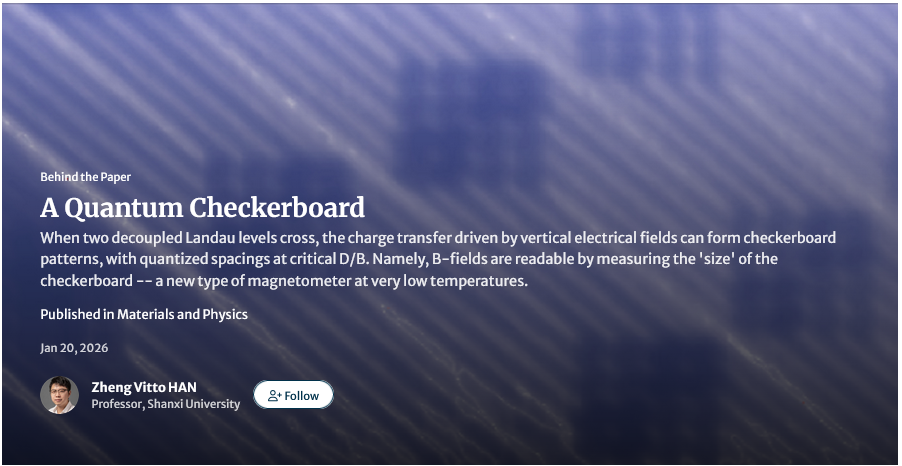
From Quantum Patterns to Practical Sensing
A Behind the Paper story shared by @Zheng Vitto HAN takes readers behind an unexpected discovery in large-angle twisted bilayer graphene, where a striking quantum “checkerboard” emerges when Landau levels cross under a vertical electric field. What began as a peculiar transport phenomenon revealed itself to have precise, quantized spacing governed by fundamental constants, effectively turning the material into a built-in quantum ruler capable of reading magnetic fields in extreme conditions.
This research translates a basic quantum-physics insight into a promising new magnetometer for cryogenic and high-magnetic-field environments, with potential advantages in range and spatial resolution over existing methods, published in Nature Sensors. Discover how this concept grew from fundamental experiments into a practical sensing proposal in the full Behind the Paper post.
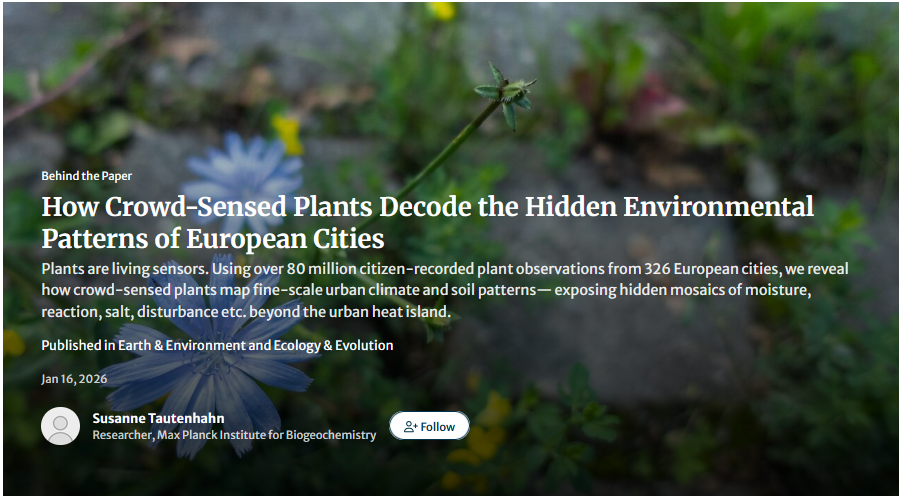
Listening to cities through their plants
Cities don’t just have a climate, they grow one! @Susanne Tautenhahn explained how her team turned millions of citizen-recorded plant observations into a new way of “reading” urban environments. Instead of relying only on satellites or fixed sensors, they used over 80 million observations from 326 European cities to let plants act as living recorders of temperature, moisture, soil chemistry, and disturbance. The result, published in Nature Cities, is a strikingly detailed picture of urban environmental mosaics that were previously difficult to detect.
The post shows how citizen science, automated plant identification, and ecological theory can come together to rethink environmental monitoring in rapidly urbanizing landscapes. To learn how this idea developed and what it could mean for the future of urban planning and resilience, read the full Behind the Paper post.

Beyond the diffraction limit: a new route to dense nanopatterning
Can we break the density–fidelity trade-off without changing the hardware? In this Behind the Paper post, @Yuan-yuan Zhao reflects on how his team rethought digital projection lithography through multi-exposure strategies. By decomposing dense layouts into multiple uniform, optically compatible sub-patterns and letting the photoresist “integrate” them over time, the work shows that digital micromirror device (DMD) systems can print far denser nanopatterns than previously believed without sacrificing process stability.
Published in Microsystems & Nanoengineering, this study reframes what the “diffraction limit” means in practice and highlights how algorithm-driven layout design can become a powerful process lever in nanofabrication. Discover how this idea developed from frustration to breakthrough and what it means for future chip manufacturing in the full Behind the Paper post.
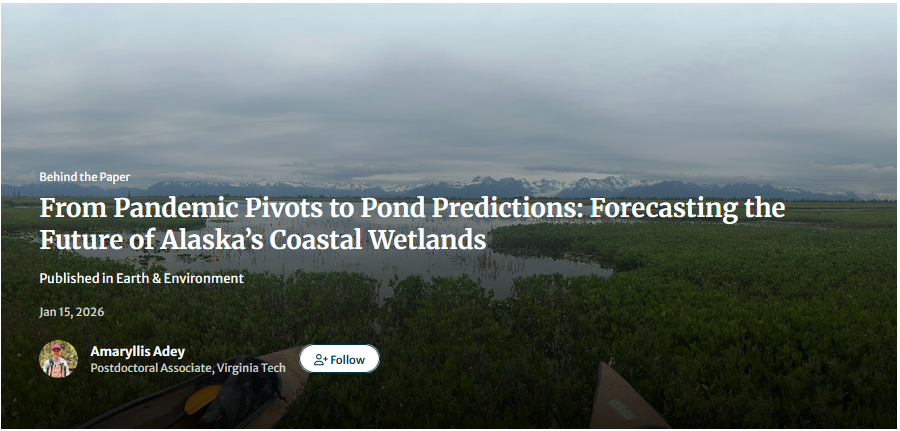
From empty field seasons to clearer forecasts for Alaska’s ponds
When the pandemic halted fieldwork, @Amaryllis Adey turned back to years of water-temperature records from remote coastal wetlands in Alaska. By combining these observations with climate models, her team revealed how tightly shallow ponds track surrounding air temperatures and how vulnerable that makes them to rapid warming. What started as a practical workaround became a powerful lens into the future of salmon nursery habitats.
The study published in Communications Earth & Environment indicates that many similar Arctic and subarctic wetlands may face comparable thermal stress, with consequences that could cascade through local ecosystems. To hear how this project evolved from disrupted plans into long-term climate insights, explore the full Behind the Paper post.
Looking for more reading? Here are some further highlights to explore:
Upcoming Events: Nature Forum: The Future of Sensing Technologies
The upcoming Nature Forum on The Future of Sensing Technologies shared by @Andres Perez will take place in Seoul, South Korea, on 13 April 2026. The meeting will convene leading researchers to explore emerging trends, key challenges, and new opportunities shaping next-generation sensing and measurement.
Meet the Editor-in-Chief: Why Clean Planet?
In Why Clean Planet? shared by @Jess Xia , Editor-in-Chief Prof. Lin Wang reflects on the journal’s mission, its interdisciplinary scope, and the importance of research that contributes to a cleaner and more sustainable future.
A Call to the Geoscience Community
A News and Opinions post written by @Javier N. Gelfo and @Carolina Acosta Hospitaleche outlines why the geoscience community needs a more coordinated approach to recognizing, protecting, and communicating the geological value of Antarctica and invites researchers and practitioners to join this collective effort.
These stories offer just a glimpse of the vibrant discussions taking place across our Communities, where authors openly share their research journeys and invite readers into the process of discovery. Whether your interests lie in quantum physics, urban ecology, nanofabrication, astrochemistry, or climate science, there is much more to explore and engage with. We hope these highlights spark your curiosity and we look forward to continuing the conversation with you in the Research Communities.
Further readings:
Passionate about connecting researchers and amplifying their voices through digital engagement. As Manager for the Research Communities by Springer Nature, I work with researchers to showcase their discoveries and experiences.
With a strong interest in public engagement and creative science communication, I’m dedicated to making research more accessible and inspiring wider conversations around scientific discovery and innovation.
Follow the Topic
-
Nature Cities
This journal aims to deepen and integrate basic and applied understanding of the character and dynamics of cities, including their roles, impacts and influences — past, present and future.
-
Nature Astronomy
This journal welcomes research across astronomy, astrophysics and planetary science, with the aim of fostering closer interaction between the researchers in each of these areas.
-
Microsystems & Nanoengineering
This journal, with a target for a high-end journal for years to come, seeks to promote research on all aspects of microsystems and nanoengineering from fundamental to applied research.
-
Clean Planet
This journal provides a platform for the dissemination of high-quality research and advancements in the field of pollution formation mechanisms and pollution’s impact on the environment, human health, and sustainability.
-
Nature Sensors
Publishing fundamental, applied, and engineering research across the full spectrum of sensing technologies, spanning biological, computational, engineering, and systems domains.




Related Collections
With Collections, you can get published faster and increase your visibility.
Micro- and Nanoplastics and Contaminants of Emerging Concern: From Environmental Fate to Sustainable Solutions
This collection focuses on the occurrence, transformation, and fate of microplastics, nanoplastics, PFAS, and contaminants of emerging concern (CECs) in freshwater, estuarine, and marine environments. It aims to improve understanding of their environmental behaviour and associated risks within integrated chemical–toxicological frameworks.
This Collection is part of several Collection series, in collaboration with npj Clean Water and npj Emerging Contaminants.
Here are the participating Collections across these Collection series:
- Micro- and Nanoplastics and Contaminants of Emerging Concern: From Environmental Fate to Sustainable Solutions
- Reducing Uncertainty in the Environmental Fate and Behavior of Plastics
- PFAS in the Context of Planetary Health: Fate, Exposure, and Risks
- Advanced Sensing and Data-Driven Approaches for Water Quality Monitoring
Submissions are encouraged across environmental chemistry, toxicology, and environmental engineering, with emphasis on approaches that connect exposure characterization with ecological and human health effects. The collection particularly welcomes studies that advance analytical capability, mechanistic understanding, and mitigation strategies for contaminant mixtures in aquatic ecosystems.
Interdisciplinary and multidisciplinary contributions linking environmental exposure, risk assessment, and sustainable management strategies are particularly encouraged.
This collection supports and amplify research related to Sustainable Development Goals: SDG 3 (Good Health and Well-being), SDG 14 (Life Below Water), and SDG 15 (Life on Land).
Topics of Interest
Contaminants and Environmental Processes
- Occurrence, distribution, and environmental fate of MPs, NPs, PFAS, and CECs.
- Transformation processes and formation of degradation products in aquatic environments
- Wastewater, urban, agricultural, and industrial pathways of contamination
Monitoring, Analysis and AI-assisted data interpretation
- Advanced analytical methodologies including high-resolution and non-target/suspect screening
- Standardised and comparable workflows for MPs and NPs, including validated protocols, reference materials, QA/QC criteria, contamination control, and harmonised reporting
- Artificial intelligence (AI)-assisted data interpretation and data-science tools for environmental assessment
- Innovative monitoring and modelling approaches for aquatic pollution dynamics
Exposure, Ecotoxicology and Risk Assessment
- Exposome-based approaches linking environmental contamination to ecological and human health effects
- Ecotoxicological impacts and mechanistic understanding of contaminant effects
- Interactions among contaminants and microbial communities
- Mixture effects and cumulative risk assessment of complex contaminant mixtures
- Environmental risk assessment and policy-relevant mitigation approaches
Sustainable Mitigation and Remediation Strategies
- Nature-based solutions (NBS) and engineered remediation technologies for contaminant removal
- Sustainable materials, circular-economy approaches, and pollution prevention strategies
- Policy-relevant mitigation and management approaches
Publishing Model: Open Access
Deadline: Mar 16, 2027