January 2026 Highlights from the Medicine and Life Sciences Research Communities: Cervical Cancer Awareness Month
Published in Healthcare & Nursing, Bioengineering & Biotechnology, and Cancer

January marked Cervical Cancer Awareness Month, a time to highlight ongoing efforts in prevention, early detection, innovative diagnostics and treatment research. Across the Medicine and Life Sciences Communities, researchers and editors shared important insights into the biology of cervical cancer, advances in diagnostic technologies, and the development of more ethical and accessible preclinical tools.
In this round‑up, we spotlight five posts that captured particular interest from the community this month.
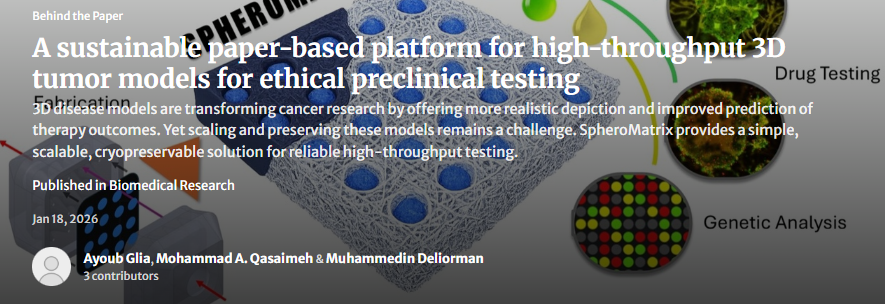
Reliable and sustainable paper‑based platform for 3D tumour models
Ethical and scalable preclinical models are essential for cervical cancer research, enabling scientists to study tumour behaviour without reliance on traditional animal‑based methods.
In this Behind the Paper post drawn from their article in Microsystems & Nanoengineering, @Ayoub Glia, @Mohammad A. Qasaimeh & @Muhammedin Deliorman introduce a sustainable paper‑based platform capable of generating high‑throughput 3D tumour models. They outline how this low‑cost, eco‑friendly system supports more reproducible experiments and reduces the need for animal testing while maintaining physiological relevance.
Read the full post to see how this platform could accelerate cervical cancer research and improve preclinical testing.
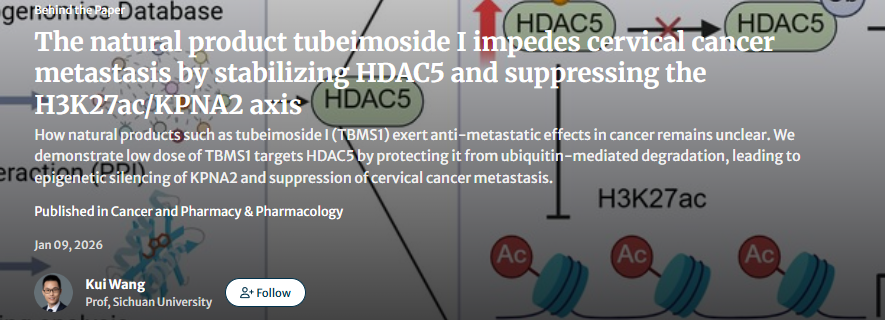
The natural product Tubeimoside‑I impedes cervical cancer metastasis
Metastasis remains one of the most challenging aspects of cervical cancer treatment, driving poorer prognoses and limiting therapeutic success. Identifying compounds that can disrupt metastatic mechanisms is therefore vital.
In this Behind the Paper post based on their article in the British Journal of Cancer, @Kui Wang explores how the natural product Tubeimoside‑I (TBMS‑I) suppresses cervical cancer metastasis at the molecular level. The team’s findings show that TBMS‑I stabilises HDAC5 and downregulates the H3K27ac–KPNA2 axis, ultimately reducing cancer cell migration and invasion.
Read the full post to learn how natural‑product‑based therapeutics may offer new avenues for combating cervical cancer spread.
Diagnostic evaluation of viral persistence in cervical cancer
Persistent high‑risk HPV infection is a central driver of cervical cancer development, yet understanding the dynamics of viral persistence and progression remains a key research challenge.
In this Life in Research post, @Naylya Djumaeva reflects on her team’s recent work, examining how different diagnostic approaches can more accurately detect and monitor viral persistence. They discuss the limitations of existing methods, the value of molecular assays, and how improved detection can help identify patients at higher risk of progression to malignancy.
Read the full post for insights into how refining viral diagnostics may improve cervical cancer prevention pathways.
Can AI‑supported digital microscopy bridge the diagnostic gap in primary healthcare?
Limited access to quality diagnostic services remains a major barrier to cervical cancer screening and early treatment, particularly in low‑resource settings.
In this timely Behind the Paper post, @Joar von Bahr explores the potential of AI‑assisted digital microscopy to support primary care providers in cervical cancer screening. The post explains how AI‑driven image analysis can improve accuracy, reduce workload, and make timely screening more widely accessible.
Read the full post to discover how digital innovation may help close diagnostic gaps and strengthen health systems.
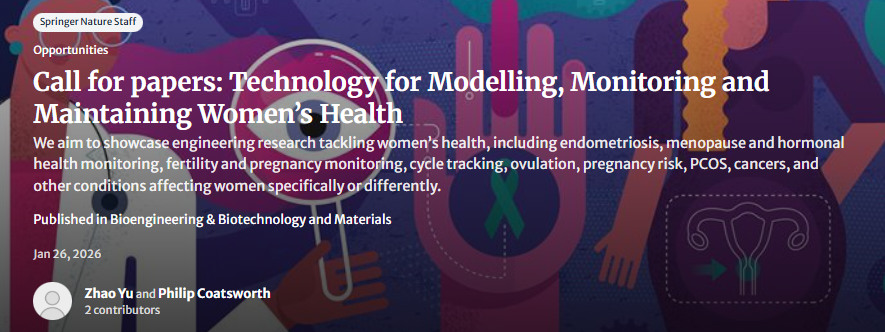
Call for papers: Technology for modelling, monitoring, and maintaining women’s health
Advancing cervical cancer research also requires progress in the technologies underpinning diagnostics, monitoring and treatment.
In this call‑for‑papers announcement, Zhao Yu and @Philip Coatsworth from Communications Engineering invite submissions focusing on innovations that enhance how researchers model women’s health, track disease progression, and support clinical care. The collection seeks contributions spanning biomedical engineering, computational methods, device development and more.
Read the full announcement to learn how you can contribute to this growing research area.
These posts offer a snapshot of the research, innovations and reflections shared across the Medicine and Life Sciences Communities for Cervical Cancer Awareness Month. Together, they highlight the collective effort to improve diagnostics, better understand disease mechanisms, and create more equitable and ethical pathways in cervical cancer research.
I hope you enjoy exploring these contributions as much as I did.
Further readings:
- Top Posts from the Research Communities in 2025: A Year in Review
- January 2026 Highlights from the Humanities and Social Sciences Communities
- Quarterly Highlights (Oct-Dec 2025) from Medicine and Life Sciences Research Communities
- Quarterly Highlights (Oct-Dec 2025) from the Mathematics, Physical & Applied Sciences Communities

Helping researchers connect, collaborate, and communicate their work. Specialising in Medicine and Life Science and passionate about making science more visible and accessible.
Follow the Topic
-
British Journal of Cancer
This journal is devoted to publishing cutting edge discovery, translational and clinical cancer research across the broad spectrum of oncology.
-
Communications Engineering
A selective open access journal from Nature Portfolio publishing high-quality research, reviews and commentary in all areas of engineering.
-
Microsystems & Nanoengineering
This journal, with a target for a high-end journal for years to come, seeks to promote research on all aspects of microsystems and nanoengineering from fundamental to applied research.



Related Collections
With Collections, you can get published faster and increase your visibility.
Generative AI for mechanical engineering design and optimization
Publishing Model: Open Access
Deadline: Dec 31, 2026
NeuroAI and Embodied Intelligence
Publishing Model: Open Access
Deadline: Dec 31, 2026