January Highlights from the Humanities & Social Sciences Communities
Published in Social Sciences and Behavioural Sciences & Psychology

As we stepped into 2026, January brought a rich mix of research and perspectives in the Humanities & Social Sciences Communities, from philosophical heritage and lived cognition to global health awareness and psychological interventions. In this round-up, I’d like to share some standout posts that sparked conversation this month.
If a piece resonates with you, don’t forget to like and share your thoughts in the comments – your voice helps keep the conversation going!
Rethinking Elements, Memory, and Migration in Social Thought
In this Social Science Matters blog post, @Elaine Stratford introduces her book The Drowned: Elements of Loss and Repair. She explains how water has played a role in human violence and suffering, from drownings in the past to refugees dying at sea today. Through these examples, she shows that water is not neutral – it is often linked to power, injustice, and forgetting. Using an “elemental thinking” approach, the post shows how social science can help us remember these histories and think about care, responsibility, and justice, especially in the context of climate change and forced migration. Read the full blog post here.

Social Science Matters blogs offer a window into the diversity of social science research today, bringing together reflections on society, culture, and change from researchers and editors across disciplines. If you’re interested in reading more, explore all Social Science Matters blogs here.
Philosophical Legacy and Public Memory
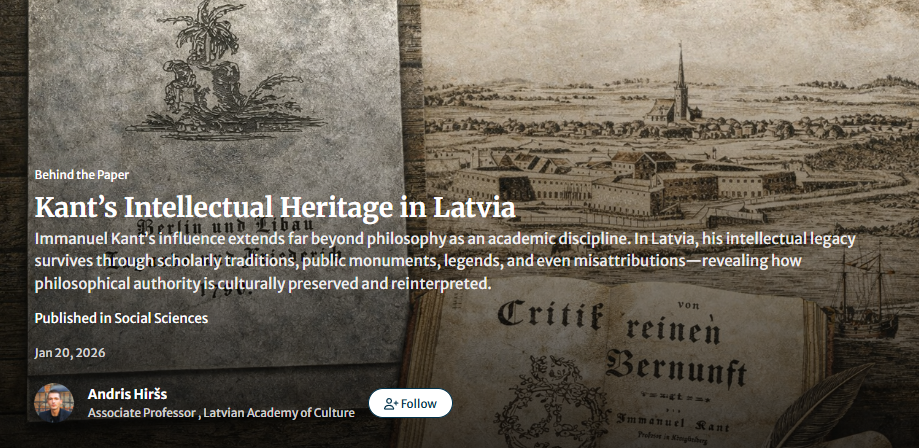
In this Behind the Paper blog post, @Andris Hiršs explores how Immanuel Kant’s legacy is remembered and reshaped in Latvia – not only in academic philosophy, but also in public spaces and cultural stories. The author discusses monuments, library records, public debates, and even false attributions that connect Kant to Latvia, showing how philosophical authority can take symbolic and sometimes unexpected forms. The post argues that a philosopher’s influence lives not only in texts and ideas, but also in memory, myth, and everyday public life. Read the full blog post.
World Cancer Day 2026: Research & Advocacy
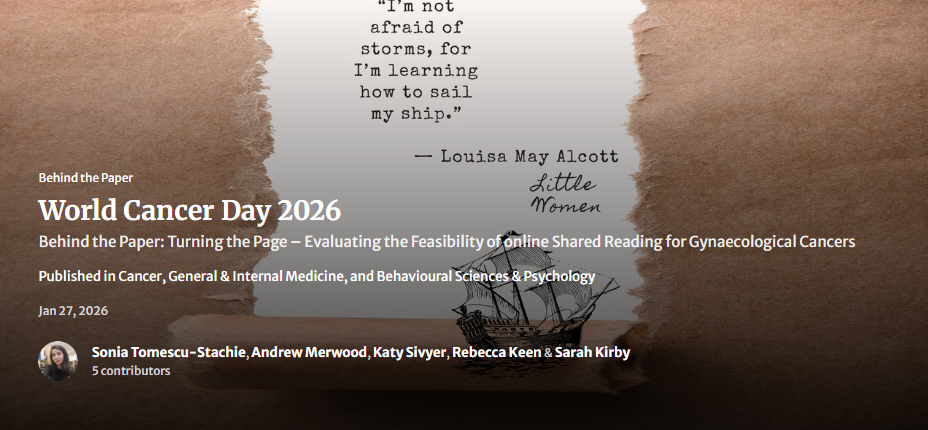
Marking World Cancer Day, @Sonia Tomescu-Stachie and colleagues introduce ‘Turning the Page’, a pilot study exploring whether online shared reading can support people affected by gynaecological cancers. The authors describe how small, online reading groups – guided by a trained facilitator and focused on shared discussion rather than therapy – may offer a gentle and accessible way to support wellbeing, connection, and reflection. The post highlights the potential of creative, low‑cost interventions to complement medical care and improve quality of life during and after cancer. Read the full blog post.
Personality Change Across the Life Span
In this Behind the Paper blog post, @Cornelia Wrzus discusses a study on whether personality traits can change through intervention at different ages. The research followed younger and older adults who wanted to become more emotionally stable and more socially confident during an eight‑week training. The results show that both age groups changed in similar ways, challenging the idea that personality is harder to change later in life. The post highlights that motivation and engagement played an important role, especially among older adults, and shows that meaningful personality change is possible across the human lifespan. Read the full blog post.
Animal Cognition & Winter Survival
.png)
In this Behind the Paper post, @Ai Ana Hein Richmond introduces research on chickadees and their remarkable memory. Living through the harsh winters of the eastern Sierra Nevada, these small birds survive by hiding and later retrieving thousands of seeds, making them an important model for studying memory and cognitive flexibility. Alongside the blog, the author also shares a short video that walks you through the research process and methods, offering a clear and engaging look at how scientists study animal cognition in the field. Dive into the post!
Together, these posts reflect the breadth of Humanities and Social Sciences research, from intellectual histories and cultural memory to psychological science, animal cognition, and global health advocacy. I hope they spark your curiosity and invite further reading and discussion.
Further readings:

Supporting Humanities and Social Sciences research area on the Research Communities platform. I’d love to hear from you and connect!
Follow the Topic
-
Communications Psychology
An open-access journal from Nature Portfolio publishing high-quality research, reviews and commentary. The scope of the journal includes all of the psychological sciences.
-
ISRCTN: The UK’s Clinical Study Registry
A primary clinical trial registry recognised by WHO and ICMJE that accepts studies involving human subjects or populations with outcome measures assessing effects on human health and well-being, including studies in healthcare, social care, education, workplace safety and economic development.
-
Animal Cognition
Animal Cognition is an interdisciplinary journal offering current research on all aspects of animal (and human) cognition in an evolutionary framework.
-
Studies in East European Thought
This is a scholarly platform focusing on the philosophical thought and intellectual history of East and Central Europe, Russia, and post-Soviet states.
-
Palgrave Macmillan
Palgrave Macmillan is a world-class publisher of books and journals with more than 175 years’ experience in the Humanities and Social Sciences.





Related Collections
With Collections, you can get published faster and increase your visibility.
Stress and Health
Publishing Model: Open Access
Deadline: Nov 30, 2026
War and Contemporary Philosophy
This Special Issue examines the profound impact of twenty-first-century warfare on contemporary philosophical thought, exploring transformations across diverse philosophical schools and traditions, with particular attention to Eastern European thought and Russia. From historical, theoretical, and comparative perspectives, the contributors analyze how new forms of conflict challenge and reshape philosophical paradigms and practices.
Central to this issue is an inquiry into the boundary between philosophies of war and anti-war positions. The papers address themes such as propaganda and public discourse, the commodification of war in consumer societies, loneliness and existential political theory, and the role of philosophers in war-torn contexts. The issue also investigates tensions within global philosophical discourse amid shifting civilizational boundaries and escalating armed conflicts—developments that raise pressing questions about humanitarian ethics, personal responsibility, bioethical implications, and the crisis facing international humanitarian law.
Taken together, these contributions offer a comprehensive and nuanced exploration of how contemporary philosophy navigates, critiques, and evolves in response to the stark realities of war, while providing critical insights into philosophical responses to ongoing global conflicts.
Publishing Model: Hybrid
Deadline: Ongoing