Kant’s Intellectual Heritage in Latvia
Published in Social Sciences

When we speak about a philosopher’s influence, we usually measure it in terms of doctrines, schools, and followers. Yet in the case of figures such as Immanuel Kant, their influence extends beyond philosophy as an academic discipline. It takes shape in collective memory through legends, monuments, and public narratives that reveal how philosophical authority is culturally preserved and reinterpreted.
At the international forum "Reason in Riga" in 2024, which commemorated the 300th anniversary of Kant in Riga, I delivered a speech focused on the subject of my monograph, the Tartu School of Personalism (Hiršs 2022). I revisited the intricate and often contradictory connection between Kant's philosophy and late German Idealism. I spoke about Gustav Teichmüller (1832–1888), who played a key role in transmitting Kant’s thought in the Baltic states. Teichmüller harshly criticized Kant and Neo-Kantianism; yet, during his time as a professor at the University of Tartu, he conducted seminars on Kant’s works. He mentored Jēkabs Osis (1860–1910), the first Latvian philosopher, who continued the tradition of reading and discussing Kant's works with students after his teacher's passing (Hiršs 2024).
Kant’s presence in Latvia includes curious and revealing distortions. In my presentation at the forum, I mentioned as a curiosity the fact that the catalogue of the National Library of Latvia lists Kant as the author of “A Truthful Account of My Journey to Heaven” (Wahrheitsgetreuer Bericht über meine Reise in den Himmel), a satirical work describing Kant’s imagined journey to heaven and his debates with ancient Greek philosophers. The text was in fact anonymously published by Teichmüller in 1877, with authorship deliberately attributed to Kant. The Library of the Deutsches Historisches Museum (Bibliothek des Deutschen Historischen Museums) included it in an exhibition on historical Fake News a few years ago (Lenz). Teichmüller’s ruse found its way into the catalogues of several libraries, including the National Library of Latvia.
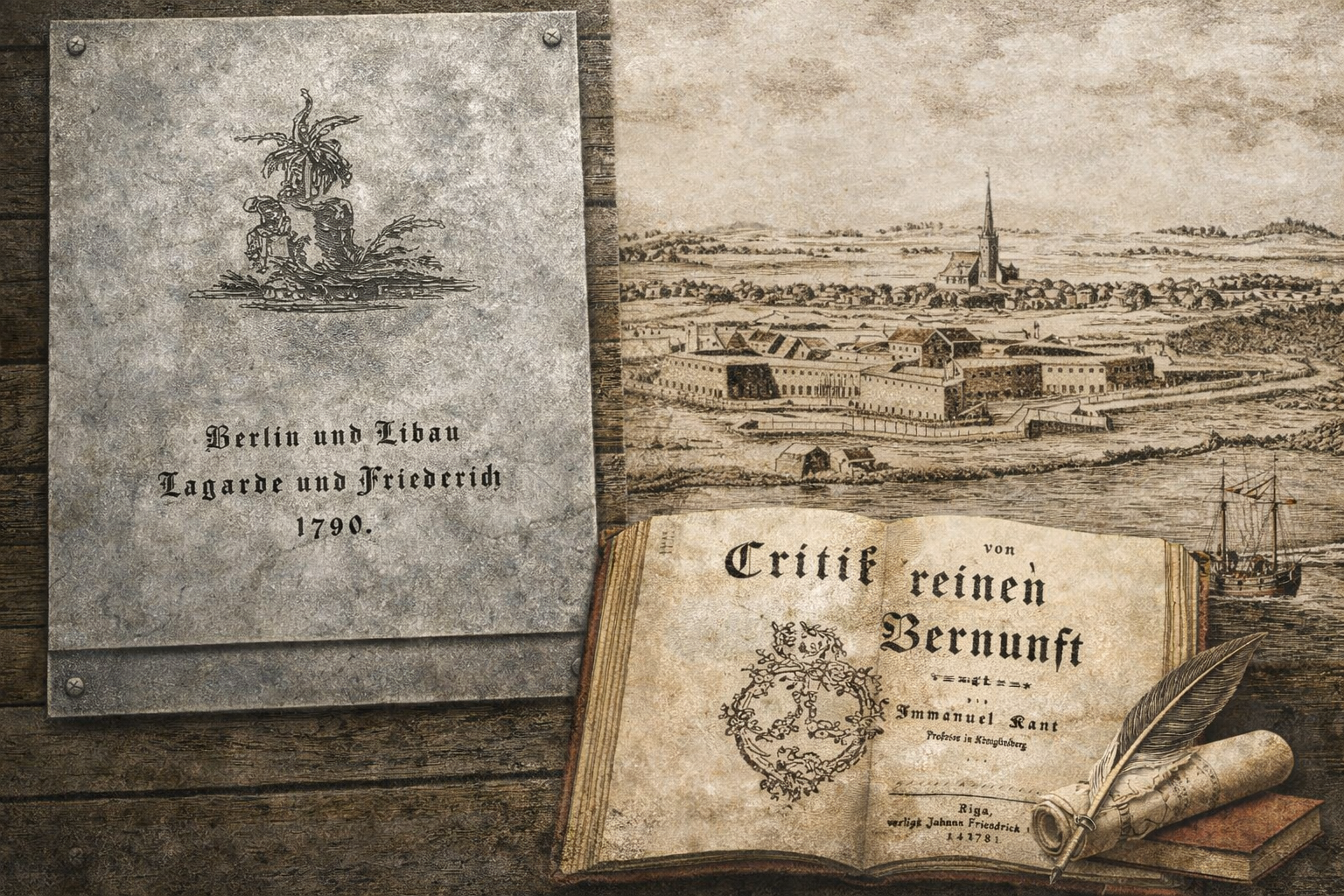
False attribution of authorship is not the only oddity revealed by Kant’s current presence in the Latvian public space. For years, a legend has circulated that Kant personally visited Latvia. According to one version, he came to visit his brother, Johann Heinrich Kant, a Lutheran pastor in Vecsaule (Altrahden), a small village in southern Latvia. Another claims that Kant travelled to Liepāja (Libau) to supervise the final corrections of “Critique of the Power of Judgment”, published there in 1790 by the firm “Lagarde und Friedrich”. In 2011, a commemorative plaque was installed at the site where the publishing house once stood.
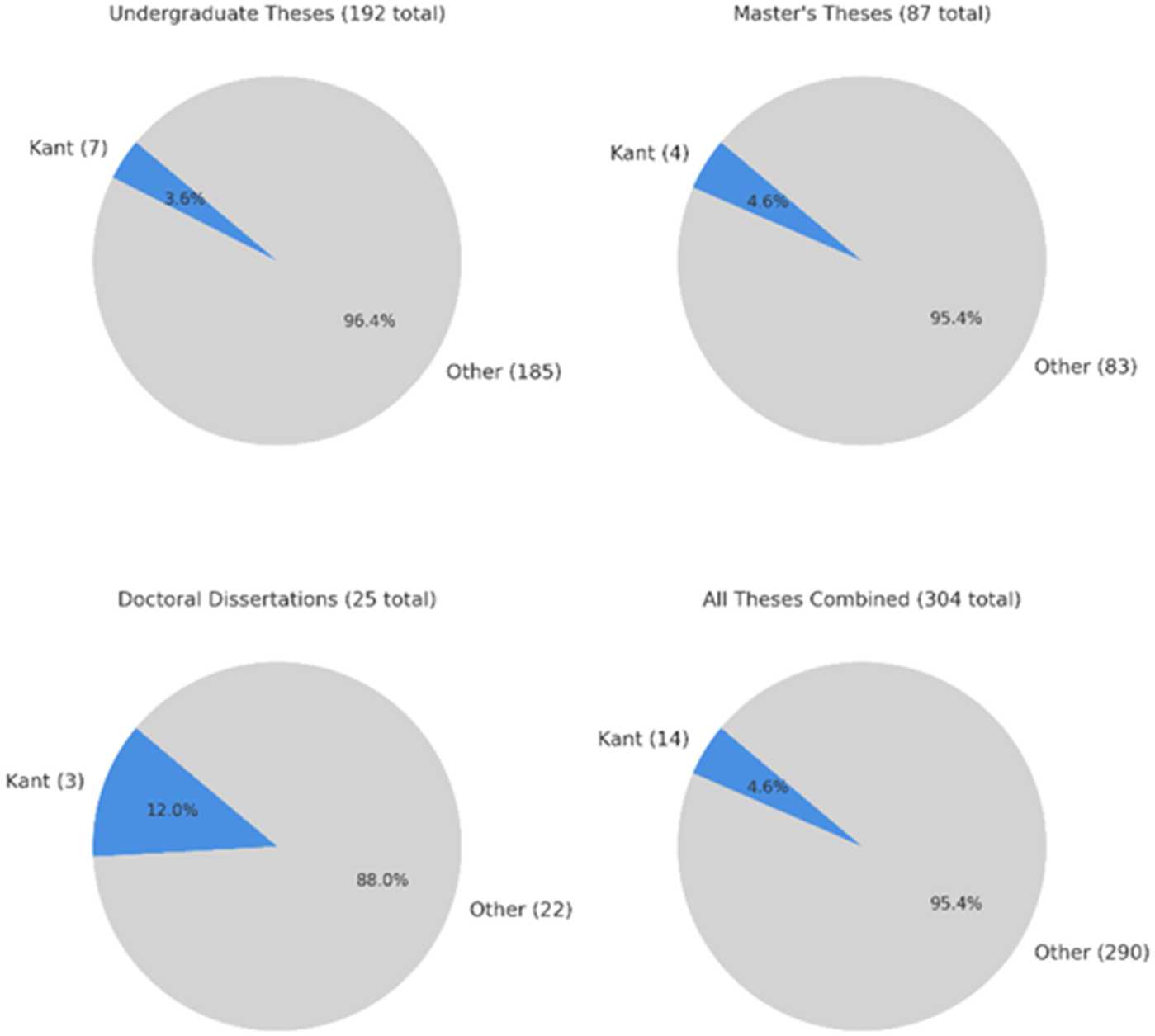
In our article “Kant’s intellectual heritage in the public spaces of Latvia”, my co-authors and I examine these stories as expressions of symbolic meaning. Drawing on Pierre Bourdieu’s concept of symbolic capital, we analyze how Kant’s name has functioned as a marker of prestige and cultural legitimacy across academic research, public monuments, media discourse, and literature over the past two decades.
Assessing the influence of a philosopher is never straightforward. By shifting attention from doctrines to public memory, this article shows how Kant’s authority continues to circulate, transform, and acquire new meanings beyond philosophy as an academic discipline.
Lenz, Charlotte „Von Kriegern, Kosmos und Krabbeltieren“ Eine Ausstellung zu historischen Fake News in der DHM-Bibliothek https://www.dhm.de/sammlung/bibliothek/virtrinenausstellung-archiv/von-kriegern-kosmos-und-krabbeltieren/
Hiršs, Andris 2022. Person and Personalism: Enduring the Collapse of Idealism. The First Latvian Philosopher Jēkabs Osis. Rīga: LU Akadēmiskais apgāds.
https://www.google.lv/books/edition/Persona_un_person%C4%81lisms/NdUI0AEACAAJ?hl=lv
Hiršs, Andris (2024). Influence of personalism on Latvian theory up to the early twentieth century: substantiality and panentheism. Studies in East European Thought. doi:10.1007/s11212-024-09678-7
Teichmüller, Gustav 1877. Wahrheitsgetreuer Bericht über meine Reise in den Himmel: verfaßt von Immanuel Kant. Gotha: Friedrich Andreas Perthes.

Andris Hiršs is a philosopher and intellectual historian specializing in Latvian philosophy, personalism, Soviet philosophy, and the history of ideas. He is Associate Professor and Leading Researcher at the Latvian Academy of Culture. His research focuses on how philosophical traditions emerge, develop, and transform under changing intellectual and political conditions, with particular attention to the Baltic region and the reception of European philosophy.
He is Principal Investigator of the project Conversions and Ruptures: Epistemic Strategies in Latvian Philosophy during the Soviet Period (1944–1991).
Follow the Topic
-
Studies in East European Thought
This is a scholarly platform focusing on the philosophical thought and intellectual history of East and Central Europe, Russia, and post-Soviet states.

Related Collections
With Collections, you can get published faster and increase your visibility.
War and Contemporary Philosophy
This Special Issue examines the profound impact of twenty-first-century warfare on contemporary philosophical thought, exploring transformations across diverse philosophical schools and traditions, with particular attention to Eastern European thought and Russia. From historical, theoretical, and comparative perspectives, the contributors analyze how new forms of conflict challenge and reshape philosophical paradigms and practices.
Central to this issue is an inquiry into the boundary between philosophies of war and anti-war positions. The papers address themes such as propaganda and public discourse, the commodification of war in consumer societies, loneliness and existential political theory, and the role of philosophers in war-torn contexts. The issue also investigates tensions within global philosophical discourse amid shifting civilizational boundaries and escalating armed conflicts—developments that raise pressing questions about humanitarian ethics, personal responsibility, bioethical implications, and the crisis facing international humanitarian law.
Taken together, these contributions offer a comprehensive and nuanced exploration of how contemporary philosophy navigates, critiques, and evolves in response to the stark realities of war, while providing critical insights into philosophical responses to ongoing global conflicts.
Publishing Model: Hybrid
Deadline: Ongoing
A Life that Spanned an Epoch: Commemorating the Legacy of Aza Takho-Godi
The special issue will consist of essays by an international group of scholars devoted to the achievements and legacy of Aza Alibekovna Takho-Godi. In addition to being a remarkably productive classicist in her own right, Takho-Godi, who passed away in September 2025 in her 103rd year, was the widow and collaborator of Aleksei Losev (1893—1988). After Losev’s death she dedicated her extraordinary energies and expertise to promoting his legacy and became his biographer. The special issue will include reminiscences by her former students, reflections on her scholarly accomplishments from her former colleagues, and commentary on her role as the keeper and promulgator of Losev’s massive legacy. The aim is to lay the initial foundation for assessing Takho-Godi’s contribution to the evolution of Russian philosophical, theological, and literary culture in the late twentieth and early twenty-first centuries.
Publishing Model: Hybrid
Deadline: Ongoing
