LLMs must not only be accurate - they must be efficient enough to operate where it matters

Our latest publication in Complex & Intelligent Systems presents a structured and up-to-date overview of model compression strategies tailored to large language models (LLMs): https://lnkd.in/eZjwgUF6.

Published in Statistics

LLMs must not only be accurate - they must be efficient enough to operate where it matters
Like

Share this post

Choose a social network to share with, or copy the URL to share elsewhere

This is a representation of how your post may appear on social media. The actual post will vary between social networks

Explore the Research

SpringerLink
SpringerLink SpringerLink

A review of state-of-the-art techniques for large language model compression - Complex & Intelligent Systems

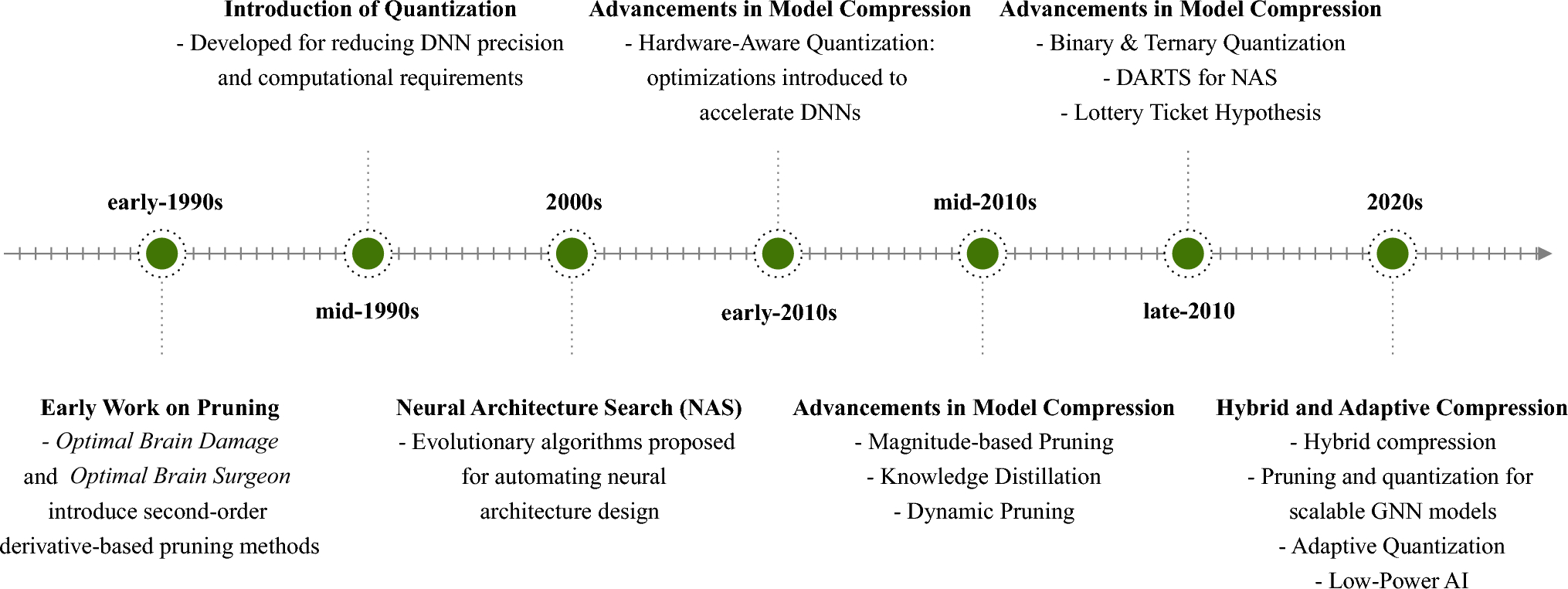
The rapid advancement of large language models (LLMs) has driven significant progress in natural language processing (NLP) and related domains. However, their deployment remains constrained by challenges related to computation, memory, and energy efficiency—particularly in real-world applications. This work presents a comprehensive review of state-of-the-art compression techniques, including pruning, quantization, knowledge distillation, and neural architecture search (NAS), which collectively aim to reduce model size, enhance inference speed, and lower energy consumption while maintaining performance. A robust evaluation framework is introduced, incorporating traditional metrics, such as accuracy and perplexity (PPL), alongside advanced criteria including latency-accuracy trade-offs, parameter efficiency, multi-objective Pareto optimization, and fairness considerations. This study further highlights trends and challenges, such as fairness-aware compression, robustness against adversarial attacks, and hardware-specific optimizations. Additionally, NAS-driven strategies are explored as a means to design task-aware, hardware-adaptive architectures that enhance LLM compression efficiency. Hybrid and adaptive methods are also examined to dynamically optimize computational efficiency across diverse deployment scenarios. This work not only synthesizes recent advancements and identifies open problems but also proposes a structured research roadmap to guide the development of efficient, scalable, and equitable LLMs. By bridging the gap between compression research and real-world deployment, this study offers actionable insights for optimizing LLMs across a range of environments, including mobile devices and large-scale cloud infrastructures.

Our latest publication in Complex & Intelligent Systems presents a structured and up-to-date overview of model compression strategies tailored to large language models (LLMs): https://lnkd.in/eZjwgUF6.

This work is particularly valuable for researchers and practitioners aiming to:
- Understand the landscape of compression methods (pruning, quantization, distillation, NAS).
- Explore hardware-aware and fairness-driven design trade-offs.
- Apply a multi-objective evaluation framework (latency, energy, accuracy, robustness).
- Gain insight into hybrid and adaptive approaches for real-world deployment.
- Navigate open challenges and research directions through a detailed roadmap.

Readers looking for practical guidance and theoretical depth will find this review a useful reference point for both academic study and applied development.

Special thanks to my advisor and co-authors, Prof. Waldir Sabino and Prof. Lucas Cordeiro, for their guidance and collaboration throughout this project. Research group and contributors: https://lnkd.in/exKf_wFP

In upcoming work, we will delve into spectral analysis of LLMs, aiming to uncover new compression and interpretability methods rooted in frequency-domain representations.

We also invite you to explore our previous publication on hybrid adaptive compression methods: https://lnkd.in/eyuirZ6R

Please sign in or register for FREE

If you are a registered user on Research Communities by Springer Nature, please sign in