Magnonic Klein and acausal tunneling enabled by breaking the anti-parity-time symmetry in antiferromagnets
Published in Physics

Klein tunneling was first pointed out by Swedish theoretical physicist, Oskar Klein as a paradox. He calculated the reflection and transmission coefficients for an energetic electron incident on a step potential and found from the Dirac equation that the electron transmits to a high step potential without exponential decay [1]. This phenomenon was interpreted by the quantum field theory as a particle-antiparticle pair production across the potential barrier. However, a direct experimental observation of Klein tunneling is difficult due to the large rest mass and high potential energy of fermions. Here, Yuan et al. show that for non-Hermitian antiferromagnets (AFM), chiral magnons serve as a bosonic platform to demonstrate Klein paradox and chiral tunneling in meV regime [2]. In a Feynman’s picture for antiparticles, the tunneling time of an incident AFM magnon-wave packet across a supercritical barrier is negative. The study illustrates the usefulness of chiral magnons to emulate settings of conceptual relevance and their potential for chirality-based magnonic computing.
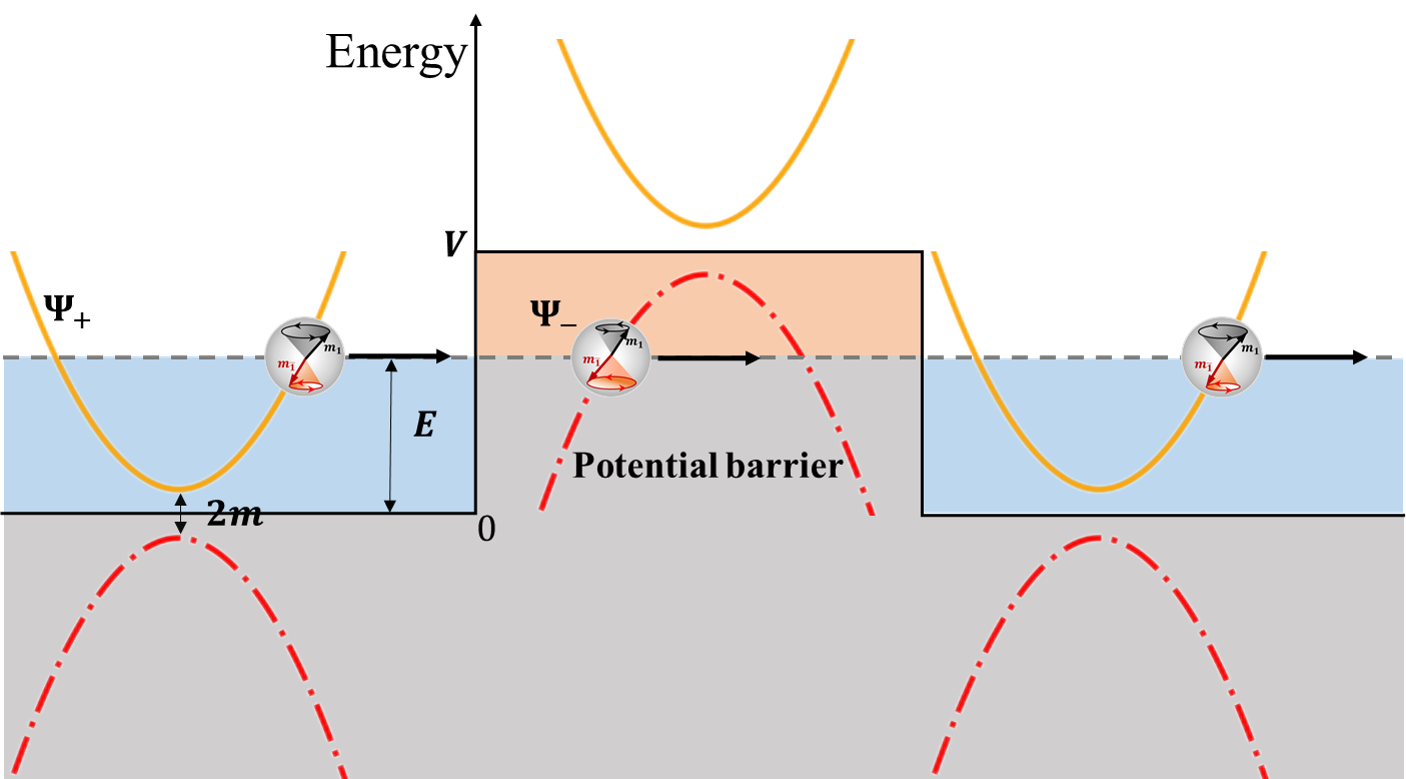
Figure 1: Klein tunneling through a supercritical potential barrier. Ψ± are the right-handed and left-handed magnons in antiferromagnets and can be viewed as particle and antiparticle, respectively. The yellow and red curves are the parabolic energy spectrum of chiral magnons in synthetic antiferromagnets. E is the incident energy located at the region m < E <V-m.
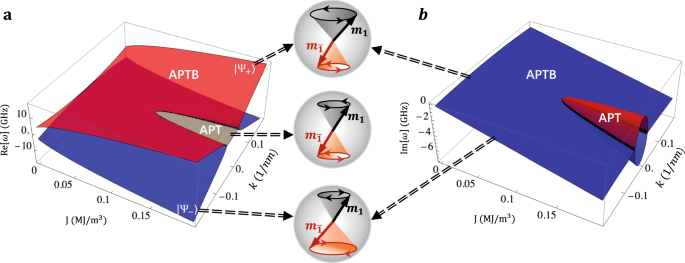
Different from the ferromagnetic (FM) systems that have right-handed magnon chirality, magnons in AFM have both right-handed and left-handed chirality. For realistic materials, the spin wave Hamiltonian of AFMs is anti-parity-time (anti-PT) symmetric and non-Hermitian. In the anti-PT symmetry-preserved phase, spin excitations in the two sublattices are equator modes with a maximally coherent superposition. In the anti-PT symmetry-broken phase, two types of magnons with opposite chirality Ψ± exist in the different sublattices and can be distinguished by the opposite spin precession. While Ψ+ represent the right-handed magnons with a positive energy, Ψ- is associated with the left-handed magnons which have a negative energy. The chirality of magnons develops a positive or negative dispersion, and thus the chiral magnon can be viewed as a particle or antiparticle. Hence, the AFM magnons are suitable objects to test relativistic effects.
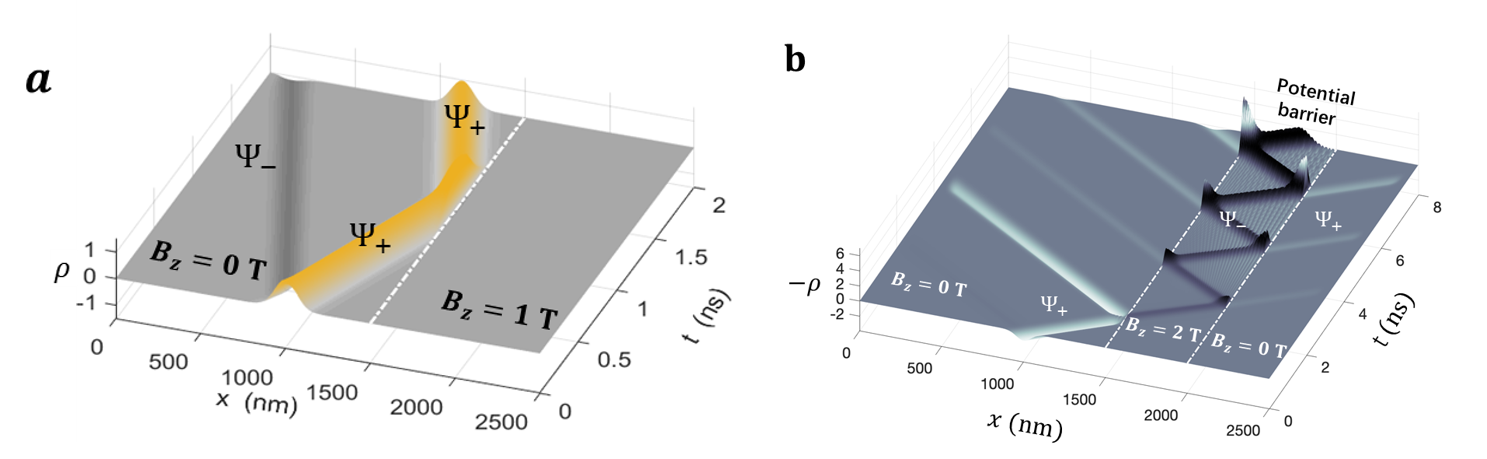
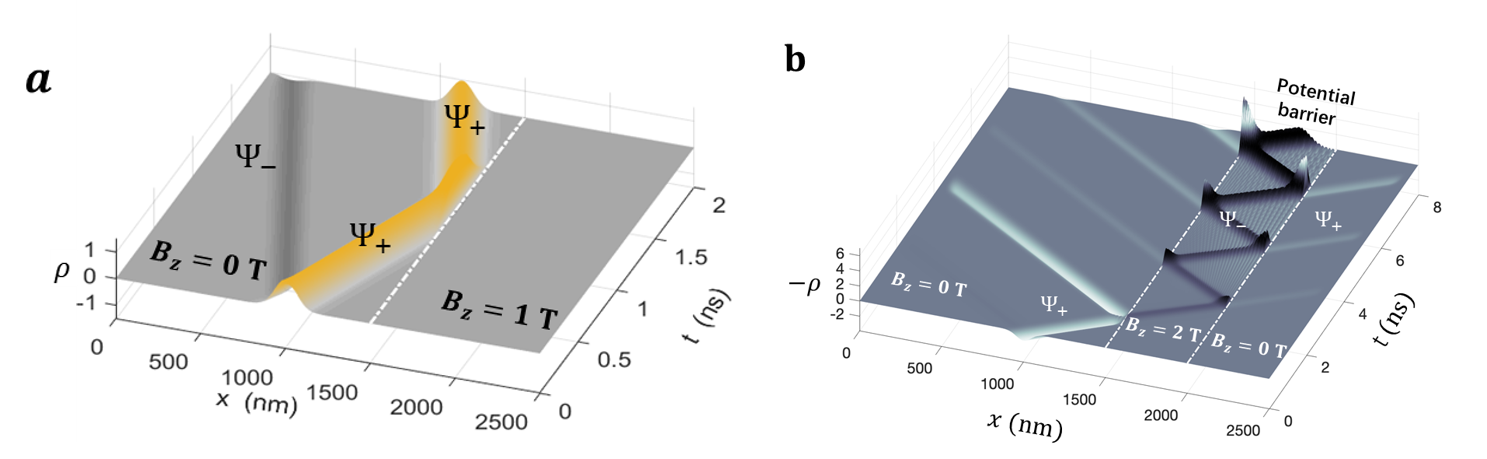
Figure 2: Time evolution of Ψ+ magnon incident into defferent potential barrier. (a) A totally reflection occors when V - m < E < V + m and (b) Klein tunelling apears when the potential barrier increase, satisfying m < E < V - m. Abundance of pairs are produced upon reflection at the barrier’s edges.
An external magnetic field parallel to the easy z-axis act as a potential barrier for the Ψ± magnons. An incident Ψ+ magnon with specific frequency will be completely reflected by a low barrier, as shown in Figure 2(a). However, as the applied magnetic field is increased, an effective energy overlap between the Ψ+ (particle) and Ψ- (antiparticle) state develops at the edge of the potential step. More than 100% of the Ψ+ magnons are reflected back and, at the same time, the Ψ- magnons are spontaneously produced in the interior of the barrier (Figure 2b) which resembles the results of quantum field theory showing that particle-antiparticle pairs can be spontaneously produced in the presence of strong fields. Adopting Feynman’s picture for antiparticles, the Ψ± pair production at the edge of the barrier hints on a negative tunneling time of incoming magnon wave packet across a supercritical barrier.
A strong magnetic field may destabilize the initial Neel ground state resulting in a spin-flop transition in AFM structures. Numerical simulations under initial Neel order indicate that the spin-flop time depends inversely on the Gilbert damping. For a weak Gilbert damping, the spin-flop time can span several tens of nanoseconds at low temperature. Such a time window is large enough to investigate the magnon scattering off the potential step generated by a local magnetic field.
References
[1] Dombey, N. & Calogeracos, A. Seventy years of the Klein paradox. Phys. Reports 315, 41-58 (1999).
[2] Yuan, S., Sui, C., Fan, Z. et al. Magnonic Klein and acausal tunneling enabled by breaking the anti parity-time symmetry in antiferromagnets. Commun Phys 6, 95 (2023).

Follow the Topic
-
Communications Physics
An open access journal from Nature Portfolio publishing high-quality research, reviews and commentary in all areas of the physical sciences.

Related Collections
With Collections, you can get published faster and increase your visibility.
Nonlinear dynamics of living systems
Publishing Model: Open Access
Deadline: Nov 09, 2026
Active, Entangled or Confined: Polymer Physics Across Synthetic and Living Matter
Publishing Model: Open Access
Deadline: Dec 31, 2026