Micro/Nano‑Reconfigurable Robots for Intelligent Carbon Management in Confined‑Space Life‑Support Systems
Published in Electrical & Electronic Engineering and Materials
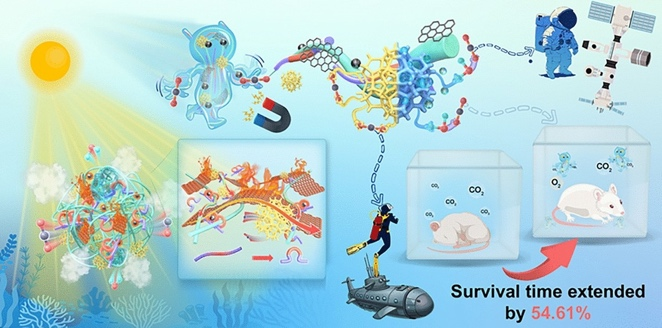

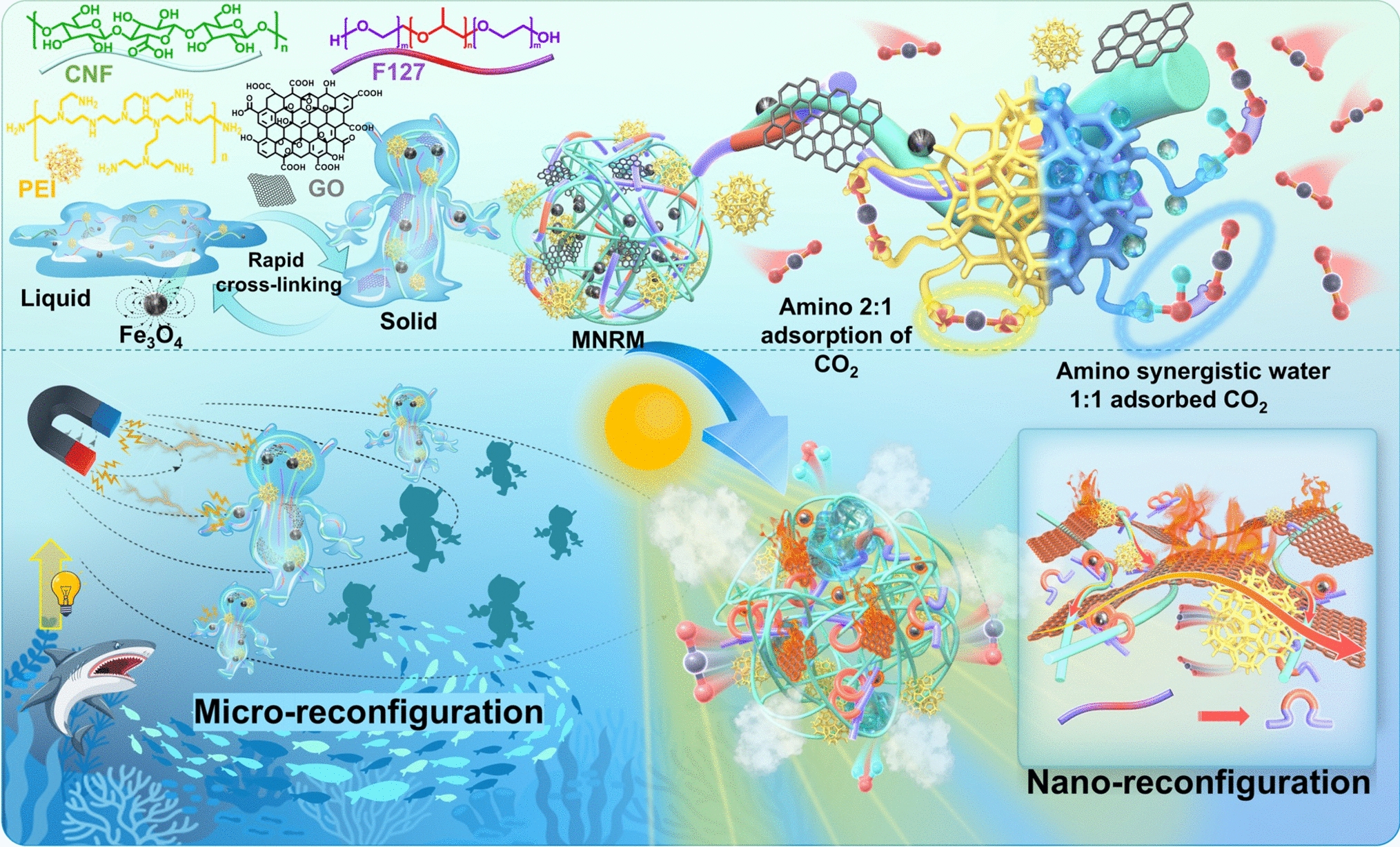

As CO2 accumulates in crewed spacecraft, submarines and disaster shelters, life-support systems demand sorbents that combine high capacity, ultralow regeneration energy and compact form factors. Now, researchers from Guangxi University, led by Prof. Hui He, unveil micro/nano-reconfigurable robots (MNRM) that harvest sunlight to capture 6.19 mmol g-1 CO2 and release it at only 55 °C—while actively swimming to prevent overheating. In a sealed-mouse model the robots prolonged survival by 54.61 %, offering a self-powered route to carbon-metabolism control in extreme environments.
Why MNRM Matters
- Lowest-Ever Regeneration: 55 °C beats all amino-based sorbents by ≥25 °C, cutting thermal energy 33 %.
- Solar-Only Operation: 0.7 sun (700 W m-2) suffices; magnetic micro-reconfiguration averts hot-spots.
- Life-Support Verified: CO2 inside chamber kept below 2 %; mouse lungs remain grade-1 intact.
Innovative Design & Features
- School-of-Fish Motion: Super-paramagnetic Fe3O4 NPs enable remote magnetic steering for uniform light harvesting.
- Thermo-Molecular Switch: Pluronic F127 cross-linked to cellulose nano-fibers curls at 45–55 °C, raising amino surface potential and blunting urea-forming side reactions.
- GO Heat Bridge: Graphene-oxide layer spreads photothermal heat (78 °C under 1 sun) across 3-D robot framework.
Applications & Outlook
- 10-Cycle Durability: 94 % capacity retained under 55 °C hydrothermal or 91.6 % under 0.7-sun light.
- Antimicrobial Bonus: >98 % inhibition of E. coli, S. aureus and A. flavus—vital for long-term storage.
- Scale-up Path: Team is integrating robots into modular cartridges for next-generation extravehicular-activity backpacks and mini-sub life-support loops.
This work translates nano-reconfiguration into a ready-to-deploy robotic carbon metabolism, promising energy-frugal CO2 control for both space exploration and terrestrial emergency shelters. Stay tuned for more advances from Prof. Hui He’s group!

Editor of Nano-Micro Letters, which is an Open-Access, peer-reviewed journal reported papers that have at least one dimension ranging from a few sub-nanometers to a few hundreds of micrometers. The journal is published by Springer Nature and indexed by SCI, EI, SCOPUS, Pubmed, etc. The 2025 JCR Impact Factor is 38.5. The 2025 CiteScore is 58.9.
Follow the Topic
-
Nano-Micro Letters
Nano-Micro Letters is a peer-reviewed, international, interdisciplinary and open-access journal that focus on science, experiments, engineering, technologies and applications of nano- or microscale structure and system in physics, chemistry, biology, material science, and pharmacy.