Omnidirectional-total-reflection metagratings: A compact strategy for guiding mechanical waves
Published in Physics




The concept of metamaterial has catalyzed fruitful sophisticated artificial structure, giving rise to unprecedented strength in controlling electromagnetic, acoustic and elastic waves. Categorized by functionalities, metamaterials can be saddled with passing band design and stopping band design. From the former perspective, most current metamaterials available on tailoring the wavefront can be classified into passing-band strategy, like double-negative metamaterial for negative refraction, focusing lens and invisible cloak based on transformation method. On the other hand, photonic or phononic crystals exhibiting stop band in a certain frequency range have propel waveguide device into new height. Another advanced waveguide paradigm deploying the stopping-band character is topological insulator which features defects and backscattering immune. However, further advancements of metamaterial have been hindered by fundamental limitations including narrow bandwidth, rigorously exquisite complexity and bulky footprint.
Fortunately, the advent of metasurface has opened a new avenue to efficient wave manipulation. Composed by two-dimensional scattering array, metasurface featured with sub-wavelength size has exhibit versatile flexibility in modulating phase, amplitude and polarization for various types of waves. A plenty of nontrivial wave manipulation phenomena like perfect transmission/reflection, source illusion, mode conversion, have been realized by engineering diverse functional metasurfaces. These applications can be classified into the first function of metamaterials. Namely, metasurface has reshaped the wavefront within the passing band. However, up to now, few research has applied the stopping-band character of metasurface into wave manipulation.
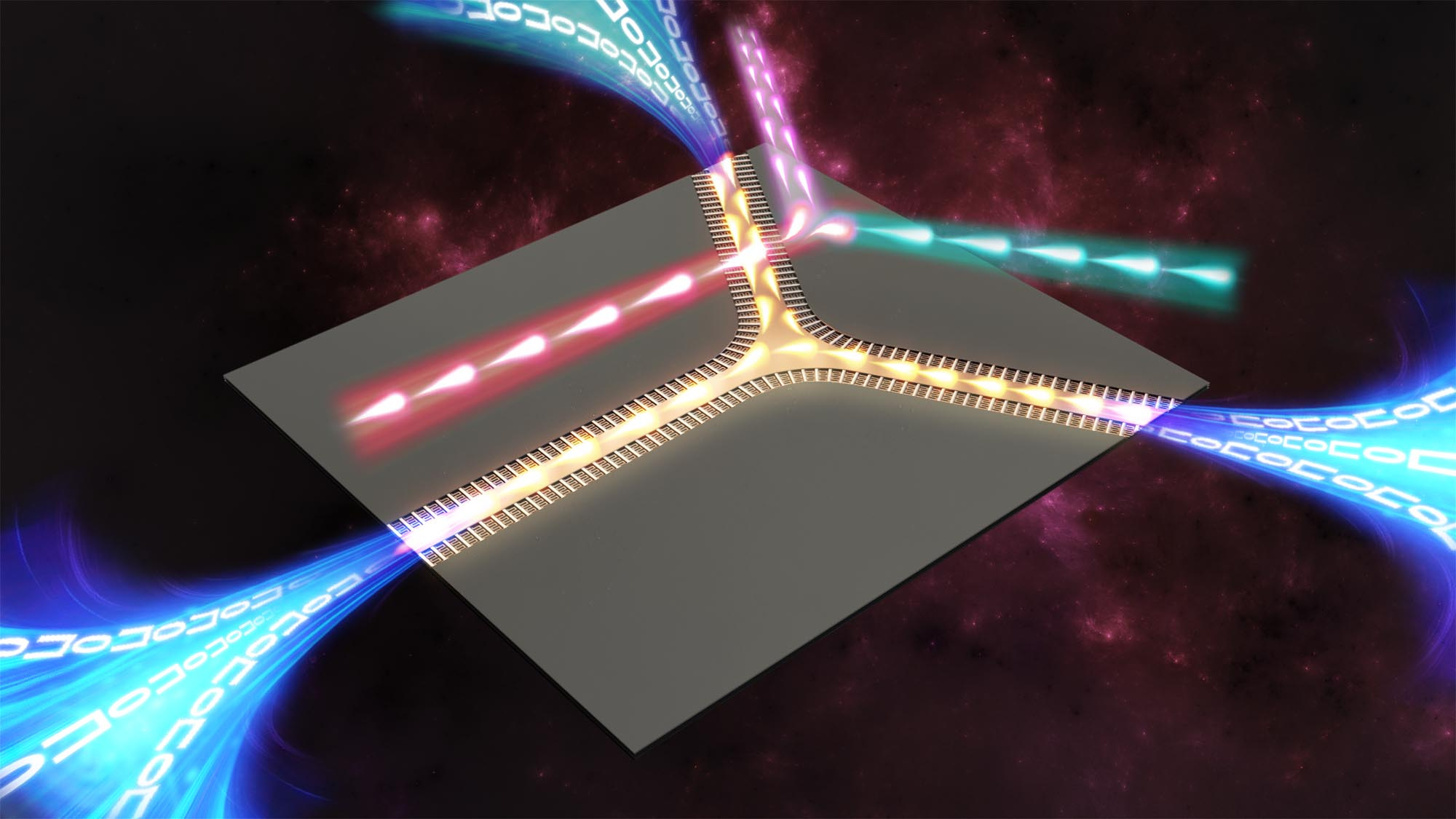
Figure 1: Illustration of metagrating-based waveguide for routing elastic waves
In our recent published paper in Communications Physics, infusing the stopping-band feature with metasurface concept, we have proposed an omnidirectional-total-reflection metagrating using only two unit cells. As shown in Fig. 1, acting as two parallel boundaries, metagratings have provided a new strategy for guiding mechanical waves. Compared with defected or topological metamaterial, the metagrating-based waveguide has shown great advantages in in ultrathin footprint, broadband performance, and full-angle availability.
Deploying the alternate arrangement of two unit cells, metagrating enable reflect impinging waves from all directions in a specular style. We have experimentally demonstrated that a closed region enveloped by metagratings enables accomplish mechanical wave cages with no leakage (Fig. 2). Furthermore, the metagratings acting as waveguide boundaries can trap and guide mechanical waves propagating along a pre-defined path (Fig. 3).
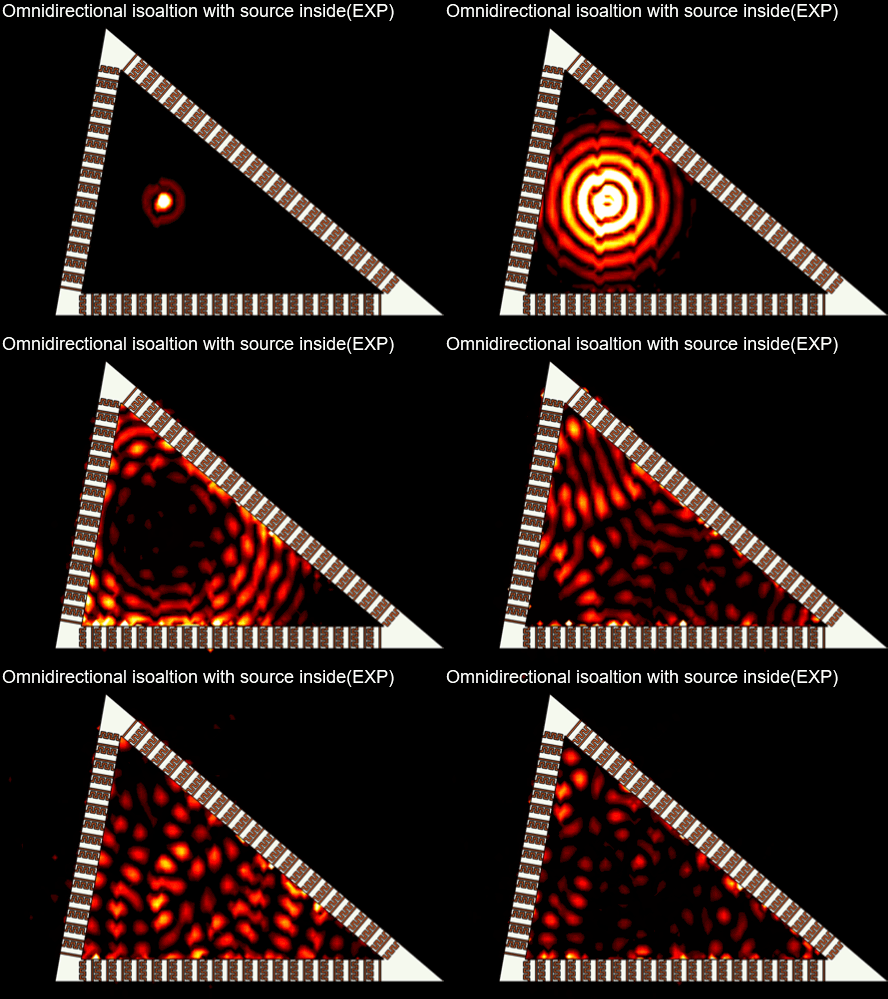
omnidirectional isolation
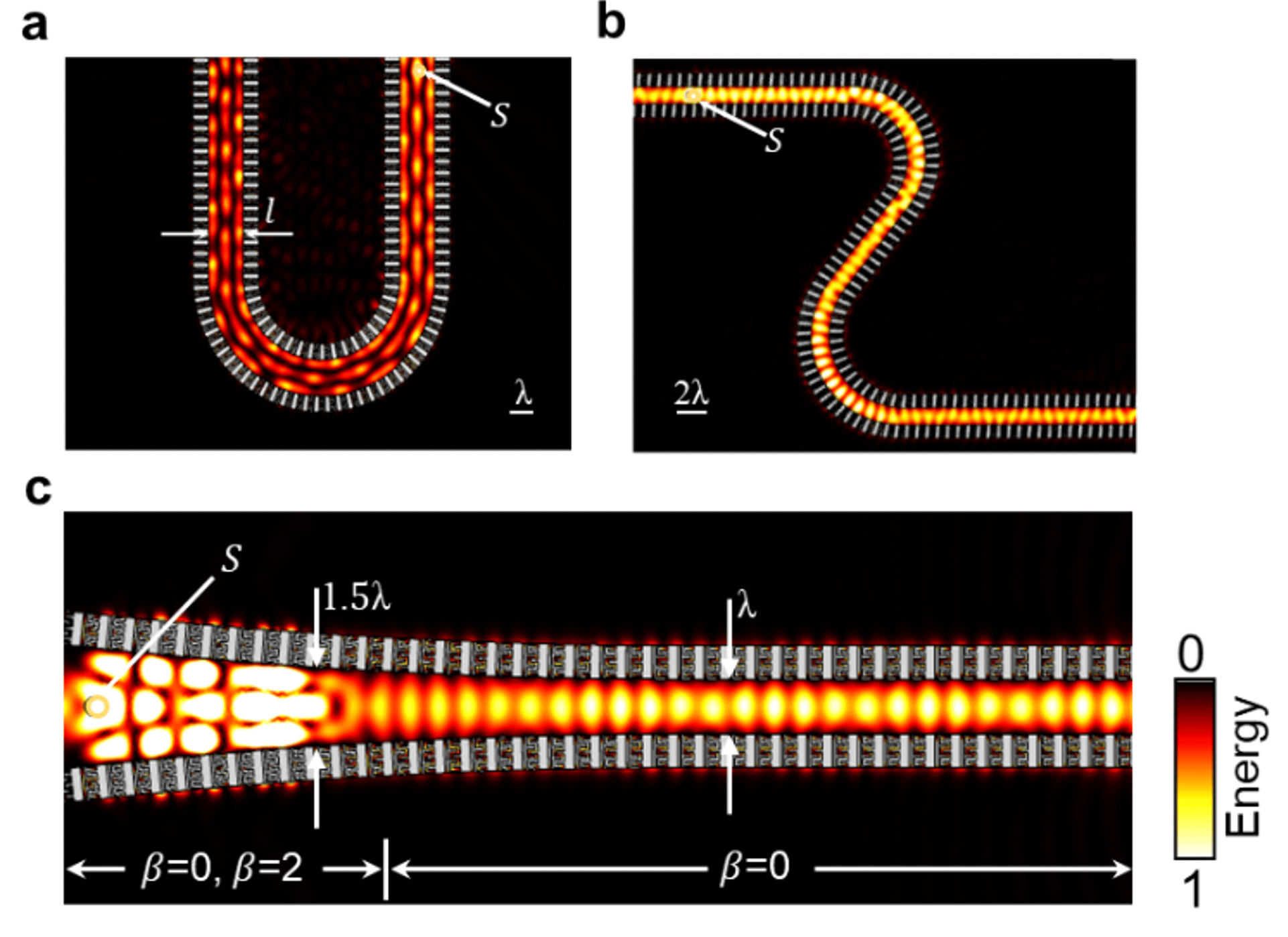
More novel functionalities of metagrating-based waveguide are demonstrated via a series of design strategies. The state-of-art device is capable of making a smooth U-turn to redirect inversely with almost no leakage (Fig. 4a). Also, it can guide mechanical waves with high efficiency even after continuous sharp corners, like a “N”-shaped path (Fig. 4b). We can notice that multiple rows of standing waves are coupled in the wide waveguide, while the single mode is permitted in narrow one. Allying geometric optics approach with Fabry-Perot resonance condition, we have developed the elastic guided-mode theory for predicting guided-mode order in the waveguide pattern. When the point source is placed at the center of waveguide, the guided-mode order is determined by the ratio between waveguide width and wavelength . Furthermore, by changing the width in Fig. 4c, a gradient waveguide enable convert the guided-mode pattern from multiple modes to single mode smoothly, which means the metagrating-based waveguide possesses rectifying capacity, accurately predictable manipulation and potential tunability for a low-loss, long-distance energy transport.
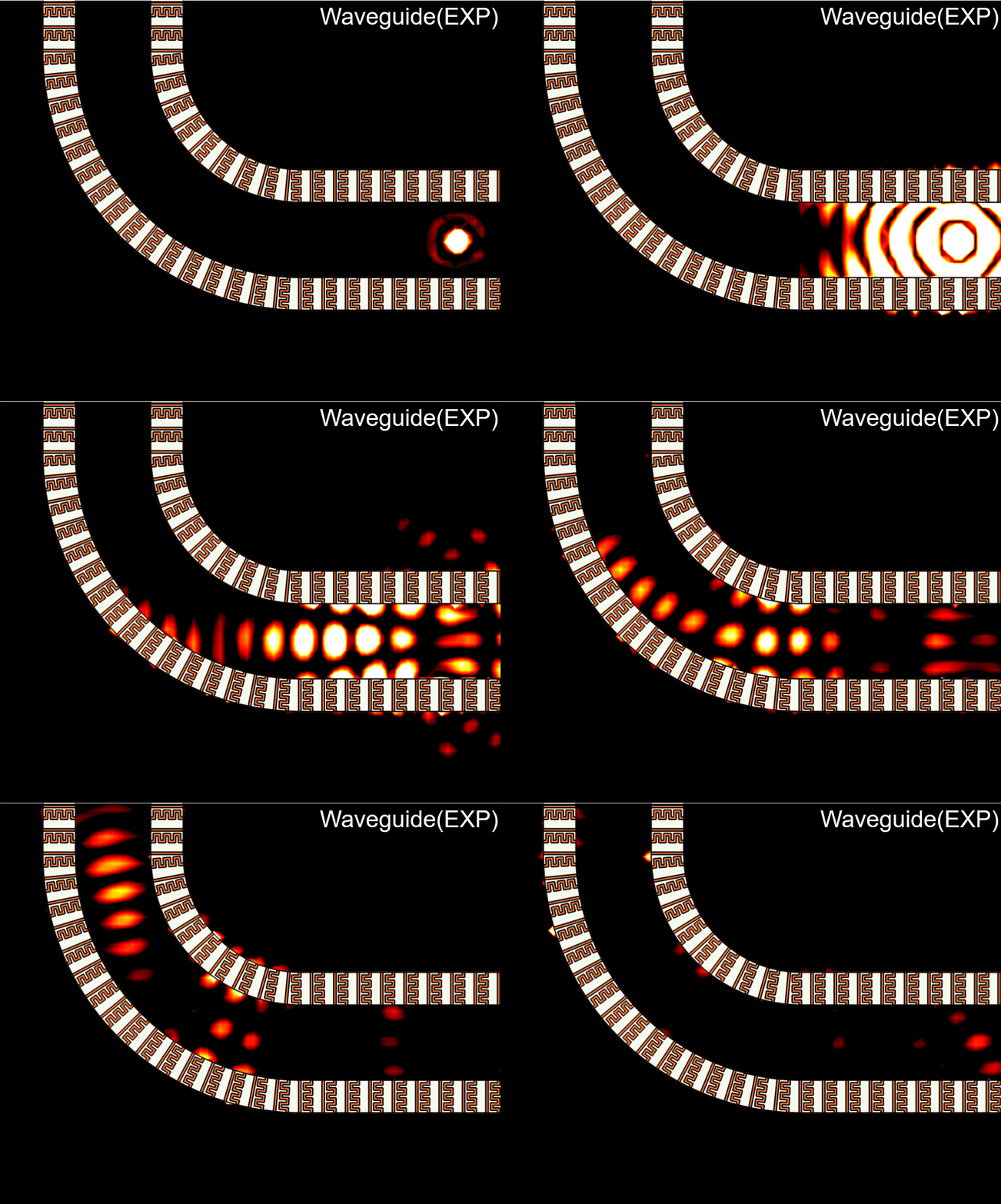
Figure 3: Experimentally measured (EXP) transient response of waveguide
This work presents a new avenue to realize efficient waveguide for mechanical waves. The metagrating-based waveguide shows great advantages in ultrathin footprint, broadband performance and full-angle availability. We envision that the proposed waveguide prototype capable of highly confined omnidirectional-wave-trapping and efficient routing may catalyze fruitful applications on vibration and noise control, energy harvesting, microfluidics, wave steering in acoustics and other waves.
For more information, please refer to our paper published in Communications Physics, “Realization of ultrathin waveguides by elastic metagratings https://doi.org/10.1038/s42005-022-00843-0”.
Follow the Topic
-
Communications Physics
An open access journal from Nature Portfolio publishing high-quality research, reviews and commentary in all areas of the physical sciences.

Related Collections
With Collections, you can get published faster and increase your visibility.
Nonlinear dynamics of living systems
Publishing Model: Open Access
Deadline: Nov 09, 2026
Active, Entangled or Confined: Polymer Physics Across Synthetic and Living Matter
Publishing Model: Open Access
Deadline: Dec 31, 2026