PARK2 and PARK7 Gene Polymorphisms as Risk Factors Associated with Serum Element Concentrations and Clinical Symptoms of Parkinson’s Disease

Parkinson’s disease (PD) is a complex neurodegenerative disorder, characterized by the loss of dopaminergic neurons at substantia nigra region of the brain. Diagnosis of PD is based on clinical manifestation of symptoms, medical history and neurological examination.
PARK2 and PARK7 Gene Polymorphisms as Risk Factors Associated with Serum Element Concentrations and Clinical Symptoms of Parkinson’s Disease
Like

Share this post

Choose a social network to share with, or copy the URL to share elsewhere

This is a representation of how your post may appear on social media. The actual post will vary between social networks

Explore the Research

SpringerLink
SpringerLink SpringerLink

Association Between NOS1 Gene Polymorphisms and Schizophrenia in Asian and Caucasian Populations: A Meta-Analysis - NeuroMolecular Medicine

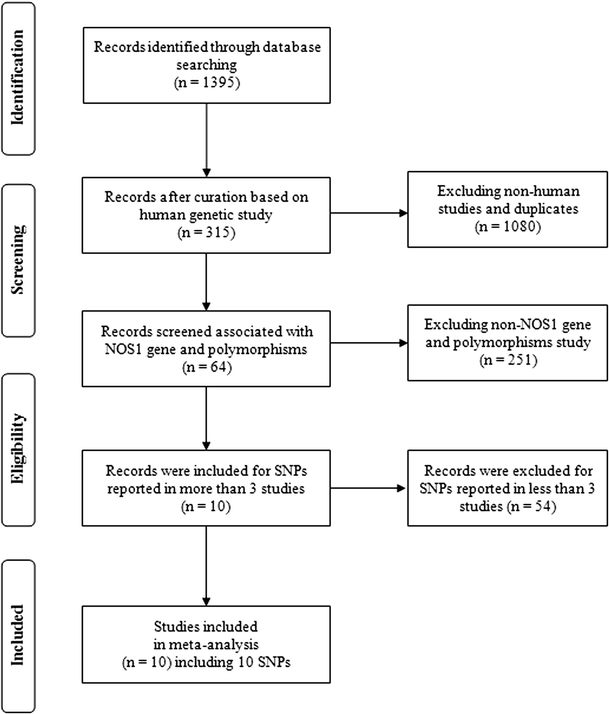
Schizophrenia is a complex psychiatric disorder characterized by memory impairments with delusions and hallucinations. Several investigations have focused on determining the association between NOS1 (nitric oxide synthase-1) polymorphisms and risk of schizophrenia (SZ). However, the association of rs2682826, rs3782206, rs499776, rs3782219, rs41279104, rs3782221, rs1879417, rs4767540, rs561712, and rs6490121 polymorphisms with schizophrenia remains inconclusive. We performed a systematic meta-analysis for each polymorphism to determine its association with SZ by calculating their pooled odds ratio and 95% confidence intervals. The heterogeneity between studies was evaluated using Cochran’s Q test to adopt random effects or fixed effects model. Based on our analysis, the rs3782206 polymorphism showed a strongest association with schizophrenia in allelic OR 1.15 (95% CI [1.05–1.25]), homozygote OR 1.35 (95% CI [1.09–1.66]), dominant OR 1.16 (95% CI [1.04–1.29]), and recessive OR 1.29 (95% CI [1.05–1.58]) models in Asian population. Similarly, in Caucasian population, the rs499776 polymorphism attributes risk association in homozygote OR 0.70 (95% CI [0.50–0.98]), dominant OR 3.57 (95% CI [2.34–5.27]), and recessive models OR 0.68 (95% CI [0.50–0.93]) with schizophrenia. Further, the sensitivity analysis was carried out based on leave-one-out method to confirm the reliability of the analysis. Overall, our meta-analysis demonstrates the significance of NOS1 genetic variants that are functionally associated with cognitive and neuropsychiatric symptoms of schizophrenia.

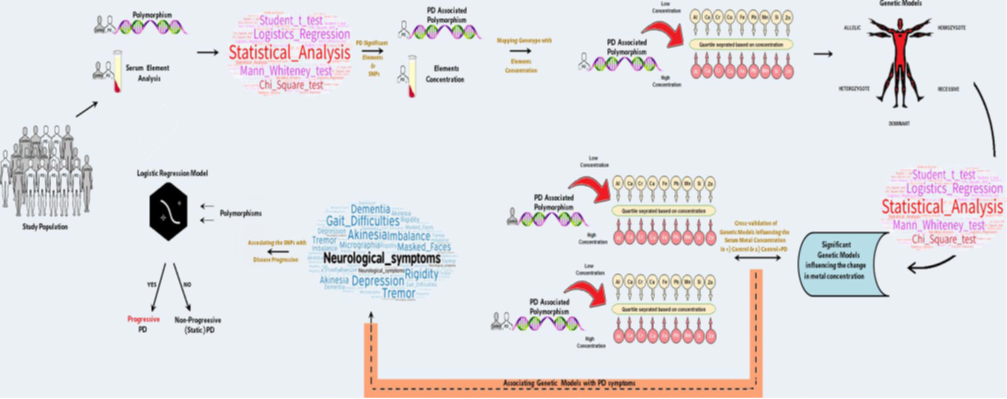
In summary, the effects of genetic polymorphisms of the PARK2 and PARK7 genes on serum trace elements are investigated in a large cohort of the Indian population. We have noticed a significant influence of the PARK2 and PARK7 polymorphisms on serum elements’ homeostasis of Cu, Fe and Zn in PD. Further analyses of genotypes and element concentrations with clinical variables showed a significant relationship with the neuropsychiatric symptoms of PD. Taken together, our results demonstrate the genotype-dependent effect on the serum concentrations and clinical symptoms. This is a rare study in the area of neurology to investigate the influence of genetic polymorphisms on serum trace elements; therefore, it is difficult to compare our results with other data in the literature. Hence, our results needed to be interpreted with caution. However, the combined association of gene polymorphisms and serum trace elements in PD risk remains unexplored. Researches in this perspective are currently required to understand the biological mechanisms relating to genetic variants and trace elements.