Planning for the Future, One Conversation at a Time
Published in Neuroscience and General & Internal Medicine

When dementia erases the vocabulary of preference, when motor neuron disease silences the voice, when Parkinson's disease advances beyond the reach of any intervention, who decides how and where that person dies? And why has no one in Indian medicine systematically asked physicians what they think about this?
This is the story of a study that tried to answer those questions, and in doing so, uncovered something far more complicated than its investigators expected.
The research began under the leadership of a neurologist, Dr Arunmozhimaran Elavarasi and her team at the All India Institute of Medical Sciences, New Delhi with Prof Manjari Tripathi, the Head of the Department of Neurology who had long observed a troubling gap between what modern medicine promised its most vulnerable patients and what it actually delivered at the end of life.
Neurodegenerative diseases, by their nature, follow a trajectory that is known in broad outline even when its precise pace remains uncertain. Parkinson's disease, dementia, motor neuron disease, progressive supranuclear palsy, and their many related conditions share a common feature: they move relentlessly forward, and they eventually arrive at a place where the patient can no longer participate in decisions about their own care. Advance care planning, the structured process by which patients articulate their values and preferences for future medical treatment while they still retain the capacity to do so, exists precisely to bridge that gap and to ensure that dignity at the end of life is honoured, not assumed. Evidence from across the world consistently shows that it reduces unwanted hospitalizations, improves quality of life, and allows patients to die with dignity and comfort. However, across much of India, it remained a concept discussed in academic journals but rarely in clinics.
The study that emerged from this concern was ambitious in scope. With no dedicated funding, a team of researchers drawn from institutions across the country set out to conduct the first mixed-methods investigation of its kind, targeting the physicians most likely to care for patients with neurodegenerative disorders: neurologists, geriatricians, and movement disorder specialists spread across a nation of 1.4 billion people.
The first phase was a structured online survey, carefully designed and vetted by neurologists and a palliative care specialist, disseminated through professional groups and academic mailing lists from October 2024 to March 2025. 140 physicians responded, a sample large enough to yield meaningful data.
What the survey revealed was, in some respects, encouraging. An overwhelming 93.6 percent of respondents acknowledged that advance care planning was necessary. However, the data beneath that figure told a far more sobering story. Only a quarter of physicians felt they had sufficient time to hold such conversations. Nearly two-thirds reported inadequate institutional resources. More than half expressed a need for greater clarity on the legal dimensions of advance care planning in India. Furthermore, approximately 16 percent had never encountered the concept in any formal or informal setting whatsoever.
But numbers, however striking, cannot capture the texture of reluctance. To understand why a practice almost universally deemed necessary remained so persistently absent from clinical life, the research team turned to qualitative inquiry. Two final-year medical students conducted semi-structured in-depth interviews with fifteen physicians purposively selected from the survey pool. Two final-year medical students, Pavit Singh and K.N. Parvathy, who were also the study's principal architects alongside Dr. Elavarasi, conducted semi-structured in-depth interviews with fifteen physicians purposively selected from the survey pool. The choice to use medical students as interviewers was deliberate and methodologically astute. Senior colleagues asking about deficiencies in practice invite performance. Students, by contrast, invite candor. We also had a strong team with experts in Movement Disorders with experience in Advance care planning from the USA and Canada.
What emerged from those conversations was a portrait of a profession caught between knowing and doing. Physicians described crowded clinics where there was barely time to address the presenting complaint, let alone a conversation about the long arc of a neurodegenerative illness. They described the absence of counselors, dedicated rooms, and trained support staff - the basic institutional infrastructure that transforms a good intention into a meaningful encounter. They described families steeped in denial, unwilling to contemplate a future of progressive dependency and loss. They described the fear that raising the subject of end-of-life care would extinguish hope, erode trust, or drive patients to seek more optimistic counsel elsewhere. And they described a confusion so fundamental that it threatened the entire enterprise. Many physicians, when asked about advance care planning, spoke instead about deep brain stimulation, infusion therapies, and symptom management in advanced disease. The word "advance" had, for many, hijacked the concept entirely. This was not a failure of intelligence but of exposure: without structured training, without institutional conversation, a term borrowed from a different healthcare context had been reinterpreted through the lens of what physicians already knew. For a neurologist managing a patient with progressive neurodegeneration, "advance" inevitably connoted treatment escalation rather than future preference documentation.
It bears noting that this picture is not uniform across the country. In certain centres, particularly in southern India, advance care planning conversations are already being held with patients and families living with neurodegenerative conditions. These pockets of practice, where physicians have built the language, the relationships, and the clinical habit of discussing future care, represent precisely the kind of model that could be replicated more widely. They demonstrate that the barriers are real but not insurmountable.
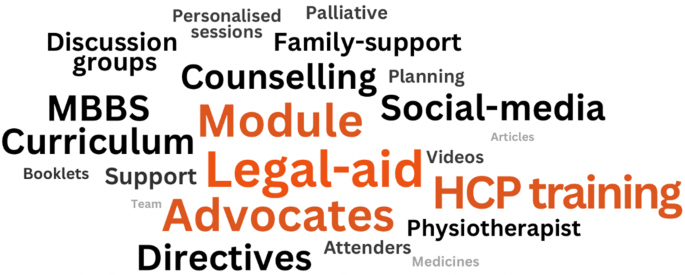
The physicians who participated in this study were not indifferent to the idea. They were, in fact, willing and in many cases eager. What they asked for, consistently and across different practice settings, was institutional support: a legal framework that clearly delineated their obligations and protections, dedicated time and space within the clinical encounter, trained counselors and social workers to share the weight of these conversations, and education woven into medical training from its earliest stages. They did not need to be persuaded of the value of advance care planning for their patients with neurodegenerative disease. They needed the conditions under which it could actually happen.
The study concluded with a proposal that was as much linguistic as it was clinical: that the term "future care planning" might travel more clearly across the conceptual landscape of Indian medicine, sidestepping the confusion with advanced disease stages or surgical intervention that the word "advance" inadvertently invited.
What this research ultimately documented was not simply a gap in physician practice. It documented the early contours of a conversation that Indian medicine is ready to have, about progressive illness, dignity, and the right of every patient to shape the final chapters of their own story. The message from the participating physicians was clear: we want to have these conversations. Give us the framework, the space, the people, and the clarity to do so.

Follow the Topic
-
BMC Health Services Research
An open access, peer-reviewed journal that considers articles on all aspects of health services research, focusing on digital health, governance, policy, system quality and safety, delivery and access, financing and economics, implementing reform, and the workforce.

Related Collections
With Collections, you can get published faster and increase your visibility.
Strengthening health system resilience: from emergency preparedness to response and recovery
Health systems worldwide are increasingly facing the dual challenges of rising health demands and the unpredictability of emergencies. Recent and ongoing polycrises—whether the COVID-19 pandemic, sporadic outbreaks of emerging or reemerging diseases, or increasingly frequent emergencies resulting from natural hazards—have highlighted the urgent and compelling need for enhanced health system preparedness and resilience. Effective emergency preparedness involves not only robust planning and response strategies but also the capability to adapt and recover quickly from disruptions. This Collection aims to explore the multifaceted aspects of strengthening health systems to ensure they can effectively prepare for, respond to, and recover from emergencies and maintain continuity of care.
Addressing the resilience of health systems is crucial for safeguarding public health and ensuring that healthcare providers can deliver effective services during crises. Recent advancements have included the integration of technology in health management, improved supply chain logistics, and enhanced workforce training. Furthermore, frameworks for assessing health system resilience have been developed, offering valuable insights into best practices. However, ongoing research is needed to evaluate the effectiveness of these strategies and to implement innovative solutions that can be adapted to various contexts and crises.
Topics for submission but are not limited to:
- Governance, leadership, and policy approaches for resilient health systems
- Frameworks and metrics for assessing and strengthening health system preparedness and resilience
- Financing mechanisms and economic resilience of health systems in emergencies
- Community engagement and locally led strategies in crisis preparedness, response and recovery
- Workforce training, surge capacity, and capability building for emergency response
- Supply chain management and essential resource security during emergencies
- Digital technologies and data-driven innovations for emergency preparedness, response and recovery
- Health system resilience in underserved, vulnerable, or fragile settings
This Collection supports and amplifies research related to SDG 3: Good Health and Well-being.
All manuscripts submitted to this journal, including those submitted to collections and special issues, are assessed in line with our editorial policies and the journal’s peer review process. Reviewers and editors are required to declare competing interests and can be excluded from the peer review process if a competing interest exists.
Publishing Model: Open Access
Deadline: Mar 19, 2027
Strengthening private and public health insurance models for affordability of health services and financial protection
The rising costs of healthcare and the increasing burden of out-of-pocket expenses have underscored the need for effective health insurance models that promote financial protection and affordability. This Collection aims to explore innovative approaches to strengthen both private and public health insurance systems, focusing on risk pooling, equitable access, and coverage expansion. By examining various insurance frameworks, we aim to understand how they can better serve populations, particularly in low- and middle-income countries where catastrophic health expenditures are prevalent.
Advancements in health insurance models have demonstrated the potential to significantly reduce financial barriers to healthcare access, contributing to improved health outcomes. Research has shown that effective risk pooling mechanisms and the implementation of universal health coverage (UHC) can mitigate catastrophic health expenditures and enhance the quality of healthcare services. As health systems worldwide face increasing pressures, it is crucial to identify and share best practices that ensure equitable access to essential health services while maintaining financial sustainability.
Topics for submission:
- Strategies for cost reduction in health insurance
- Addressing catastrophic health expenditure through insurance
- Reducing out-of-pocket costs for vulnerable populations
- Enhancing risk pooling for equitable access
- Advancing universal health coverage (UHC) initiatives
This Collection supports and amplifies research related to SDG 3 (Good Health and Well Being).
All manuscripts submitted to this journal, including those submitted to collections and special issues, are assessed in line with our editorial policies and the journal’s peer review process. Reviewers and editors are required to declare competing interests and can be excluded from the peer review process if a competing interest exists.
Publishing Model: Open Access
Deadline: Dec 11, 2026