Porous Microreactor Chip for Photocatalytic Seawater Splitting over 300 Hours at Atmospheric Pressure


As green hydrogen production gains urgency, photocatalytic seawater splitting offers a sustainable path—but catalyst stability in saline conditions remains a bottleneck. Now, researchers from Xiamen University, USTC, and SINANO-CAS, led by Prof. Fengzai Lv and Prof. Zhenchao Dong, present a porous Ag3PO4/CdS microreactor chip that maintains 0.81 % solar-to-hydrogen efficiency for >300 h in natural seawater under ambient pressure and visible light, marking a 30× leap in durability over prior systems.
Why This Chip Matters
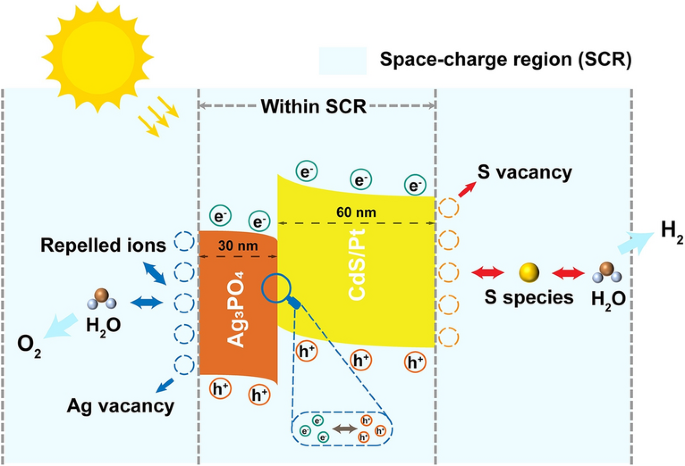
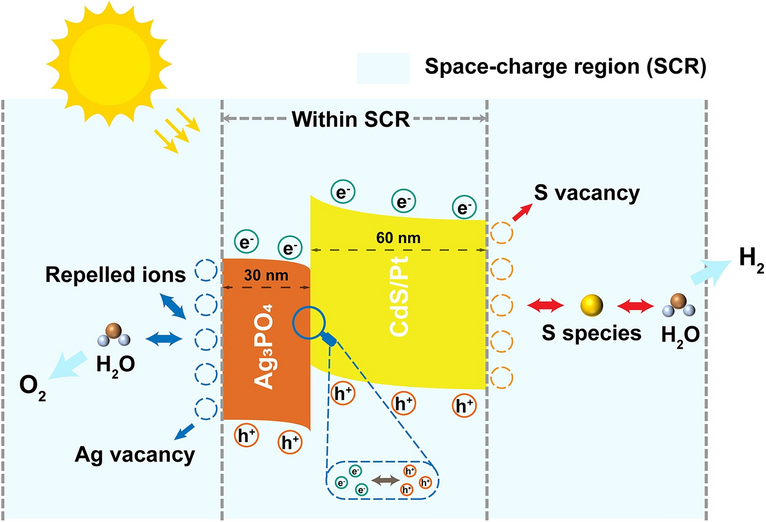
- Catalytic Selectivity: Ag vacancies repel Cl- ions; S vacancies anchor S-species and H2O, suppressing side reactions.
- Space-Charge Engineering: 30 nm Ag3PO4/60 nm CdS heterojunction stays within the 354 nm space-charge region, enabling band-bending-tuned carrier transport without loss of redox strength.
- Gas Separation: Layered geometry physically separates H2 and O2 evolution sites, cutting recombination.
- Scalability: A 256 cm2 outdoor prototype delivers 68 mmol H2 h-1 m-2 under natural sunlight—no vacuum, no cooling, no forced convection.
Innovative Design & Features
- Materials: Film-type Ag3PO4(O2 site) and CdS (H2 site) co-deposited on porous Al2O3; 0.3 nm Pt atomic clusters decorate CdS.
- Vacancy Control: O2 partial pressure during e-beam evaporation tunes Ag and S vacancy densities (EPR g = 2.003).
- Structure: 1–10 µm surface pores enhance mass transfer; cross-sectional EDS confirms sharp, continuous heterointerface.
- Characterization: KPFM visualizes 1.4 V contact-potential drop across the junction; thickness-dependent band bending verified by UPS, XPS, and EIS.
Performance & Outlook
- Stability: 25-day cyclic test (300 h total) shows <16 % activity loss; no delamination after “double-85” test (85 °C/85 %RH).
- Efficiency: 0.92 % peak STH (0.81 % average) in seawater; AQY 12.3 % at 420 nm; 18O-labeling confirms O2 from water oxidation.
- Scalability: Modular 1 m2 panel projected to yield 0.54 mol H2 day-1; circular reactor designed for varied terrain.
Challenges & Next Steps
Vacancy oxidation remains the dominant decay pathway; the team is now exploring in-situ vacancy regeneration and anti-fouling coatings to push lifetime beyond 1000 h.
This work provides a materials-by-design roadmap for saline-water splitting and demonstrates a ready-to-scale prototype that turns sunlight and seawater into fuel—no precious freshwater required.

Editor of Nano-Micro Letters, which is an Open-Access, peer-reviewed journal reported papers that have at least one dimension ranging from a few sub-nanometers to a few hundreds of micrometers. The journal is published by Springer Nature and indexed by SCI, EI, SCOPUS, Pubmed, etc. The 2025 JCR Impact Factor is 38.5. The 2025 CiteScore is 58.9.
Follow the Topic
-
Nano-Micro Letters
Nano-Micro Letters is a peer-reviewed, international, interdisciplinary and open-access journal that focus on science, experiments, engineering, technologies and applications of nano- or microscale structure and system in physics, chemistry, biology, material science, and pharmacy.