Unfortunately you are not authorized to view that page.
Pradeep Kumar, Era Upadhyay*, Anoop Yadav (2026). Spatiotemporal assessment and machine learning-based prediction of PM2.5 Emissions from biomass combustion in Rural India
Published in Earth & Environment, Sustainability, and Biomedical Research
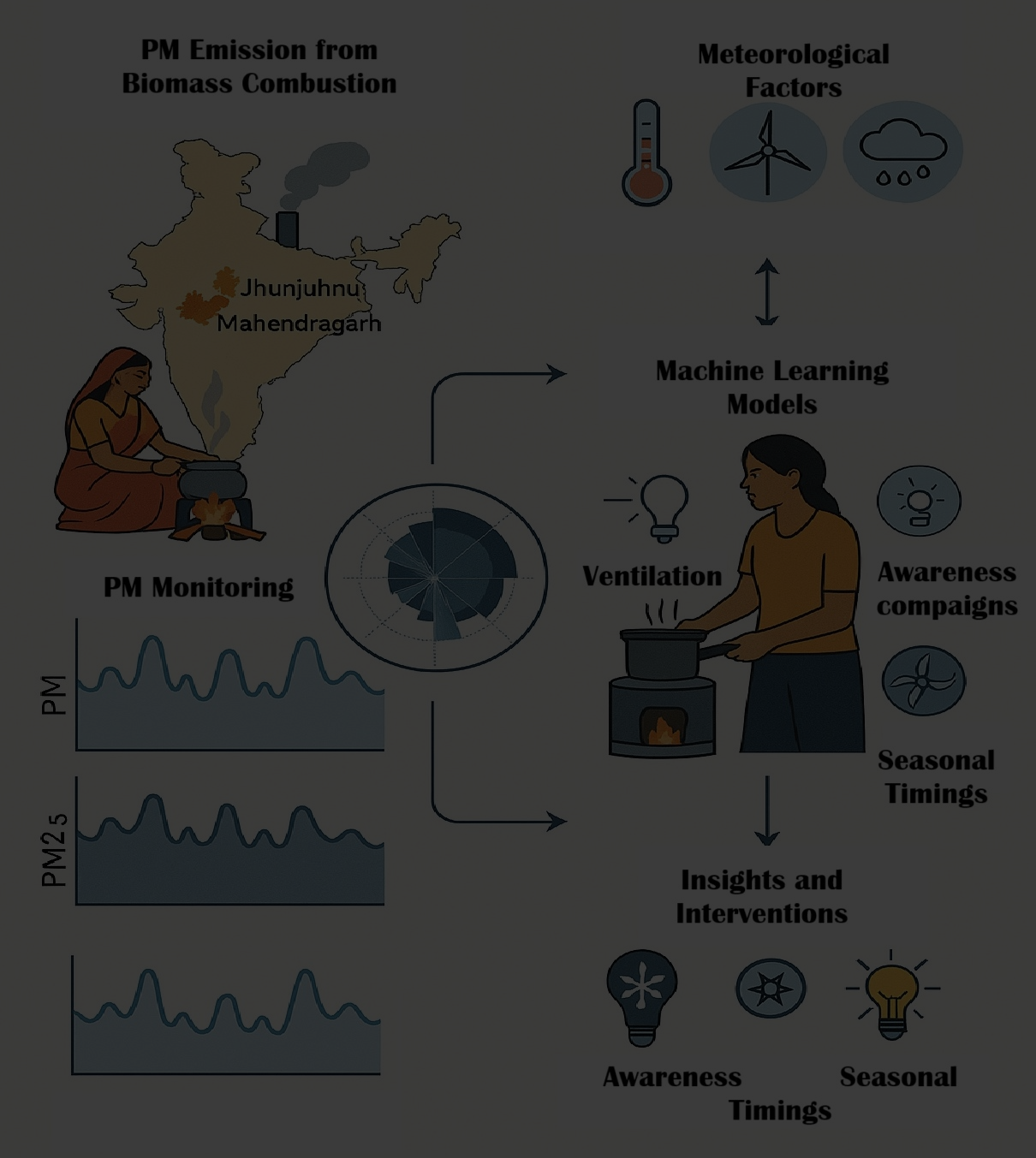




This research combines environmental monitoring with data-driven analytics to provide a comprehensive understanding of biomass-related air pollution in rural settings.
Using the GRIMM D-11 Aerosol Spectrometer, we monitored PM₁, PM2.5, PM₄, and PM₁₀ concentrations over a full annual cycle during key cooking periods in rural households. The findings revealed severe seasonal and diurnal variability, with winter evenings and mornings consistently showing the highest PM2.5 concentrations—often exceeding WHO 2021 air quality guidelines by several orders of magnitude.
Our study identified several critical observations:
- Winter stagnation and low wind speeds significantly intensified pollutant accumulation.
• Fine and ultrafine particles dominated pollution episodes, highlighting serious health concerns for indoor exposure.
• Mahendragarh consistently exhibited higher PM concentrations, while Jhunjhunu showed stronger signatures of localized combustion and dust resuspension.
• Wind direction and seasonal meteorology strongly influenced pollutant dispersion and transport pathways.
To move beyond conventional statistical analysis, we implemented machine learning frameworks including Random Forest, XGBoost, clustering, anomaly detection, and SHAP interpretability analysis. Among the tested models, Random Forest demonstrated the strongest predictive capability (R² up to 0.87), while classification models achieved approximately 98% accuracy in identifying pollution severity categories.
Importantly, SHAP analysis revealed that lagged PM2.5 concentrations, humidity, wind speed, and temperature-related variables were among the strongest predictors of pollution episodes. Unsupervised clustering further identified distinct pollution regimes associated with combustion intensity and meteorological stagnation.
One of the most significant findings was the consistently high PM₁/PM2.5 ratio (>0.7), emphasizing the dominant role of ultrafine particles in rural household pollution. These particles are especially concerning due to their ability to penetrate deeply into the respiratory system and contribute to long-term health risks.
Our work highlights the urgent need for:
• Clean cooking interventions and improved ventilation strategies
• Winter-focused public health awareness campaigns
• Real-time predictive air quality systems for rural communities
• Regulatory attention toward PM₁ and PM₄ alongside PM2.5 and PM₁₀
By integrating spatiotemporal analysis with interpretable machine learning, this study demonstrates how data-driven tools can support rural air quality management and health-focused environmental policy in biomass-dependent regions.
We hope this work contributes toward advancing sustainable rural energy transitions and protecting vulnerable communities from the hidden burden of household air pollution.
#AirPollution #PM25 #MachineLearning #BiomassBurning #RuralIndia #EnvironmentalHealth #AirQuality #Sustainability #PublicHealth #DataScience

Follow the Topic
-
Bulletin of Atmospheric Science and Technology
This journal covers research related to the broad areas of atmospheric sciences and meteorology.

What are SDG Topics?
An introduction to Sustainable Development Goals (SDGs) Topics and their role in highlighting sustainable development research.
Continue reading announcementRelated Collections
With Collections, you can get published faster and increase your visibility.
AISAM Conferences and Workshops
Publishing Model: Hybrid
Deadline: Ongoing
Artificial Intelligence and Meteorology
Progress in Numerical Weather Prediction, and more generally in meteorology, has traditional stemmed from increased availability of Earth observations, improved knowledge of the bio-geo-physical processes represented in numerical models, and an ever growing computational capacity to realistically simulate weather and environmental phenomena.
As typical of scientific and technological developments, periods of continuous and gradual developments alternate pivotal moments in which cognitive and technological advancements permit more rapid and disruptive innovations. These phases call for different approaches and methodologies to take advantage of the new opportunities and aim at real breakthroughs.
This is the case for Meteorology and Climate sectors, thanks to a generational leap in the HPC infrastructure, combined with unprecedented data availability for Earth Observations, which truly belong to Big Data. This confluence of data and computational resources has been calling for new approaches to optimally extract the potentially available information.
Artificial Intelligence, and Machine Learning methods in particular, have been identified as a key innovative methodology to leverage these opportunities and it is now necessary to proceed with development plans that can progressive integrate traditional model development, based on physical parameterisation, with AI-based approaches, that are extremely powerful and can be complementary. This is well explained in the comprehensive Technical Memo “Machine learning at ECMWF: A roadmap for the next 10 years”, by Peter Dueben et al. published in January 2021 (n. 878) as complement to the new ECMWF 10-year strategy.
The attention on Big Data, AI and Machine Learning methodologies is currently in a growing phase, as demonstrated by the numbers of scientific publications and applications. This special topic issue of BAST is therefore dedicated to "Artificial Intelligence and Meteorology" to foster an exchange of the ongoing scientific efforts and experiences.
Publishing Model: Hybrid
Deadline: Ongoing