Quantum collisions of neutral atoms
Published in Physics




The idea behind this work is much older than our experiment. Controlled collisions in optical lattices were already explored in the early days of neutral-atom physics, including in pioneering work in the 2000s. Atoms trapped in an optical lattice can be entangled by briefly bringing them onto the same site, where their interaction imprints a state-dependent phase shift. Those experiments beautifully revealed the underlying physics, however they were not pursued as a scalable route to quantum computing and lacked access to individual atoms and their quantum states. What made us return to this idea now was a technical change in our own setup: after a major upgrade, our optical superlattice became stable enough that we could revisit these collisional processes with much finer control and, with a quantum gas microscope, observe exactly how well the gates were working. Getting there, however, also meant overcoming very mundane problems, including weather-driven humidity changes that could misalign the lattice and spoil a good measurement. All this opened the door to asking a different question: could an old many-body physics idea become a high-performance quantum gate?
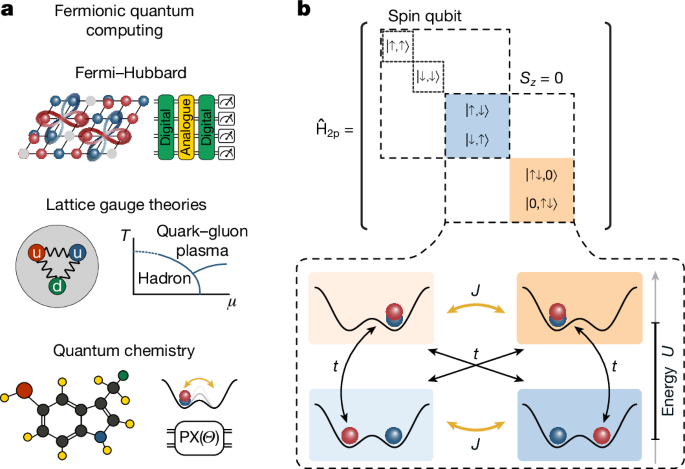
Our work explores what happens when these ingredients are combined. We trap ultracold fermionic lithium atoms in a two-dimensional optical lattice and then transform the lattice into a superlattice that splits each site into a pair of closely spaced wells. Each of these double-wells contains two atoms with opposite spins — essentially the smallest possible system where fermionic interactions can be studied in isolation. When we lower the barrier, the atoms can briefly tunnel and interact, and this makes them exchange in a coherent way (See Fig. 1). In the language of quantum computing, that exchange is a √SWAP gate: an entangling gate and therefore a fundamental building block for universal quantum computation.
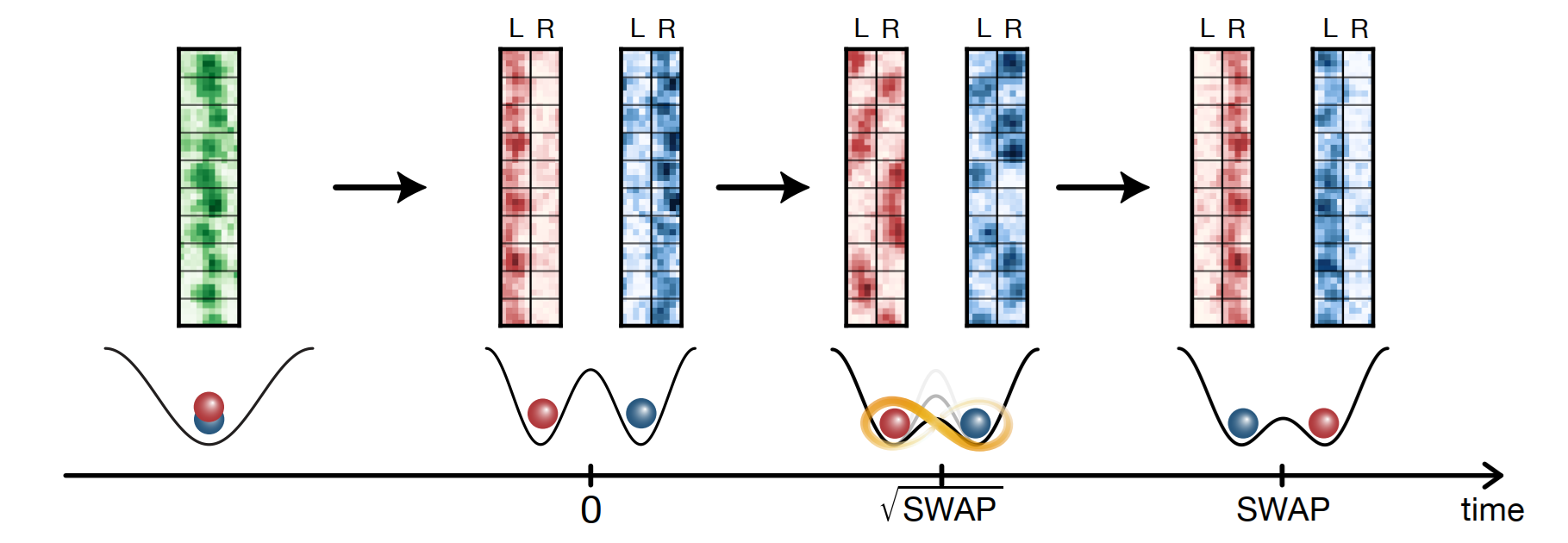
Using the quantum gas microscope, we can directly watch the gate dynamics. Starting with one spin-up atom and one spin-down atom in a double well, we observe the system evolve as the atoms exchange their spins and pass through an entangled state halfway through the motion. For a long time, it wasn’t clear whether our approach could reach fidelities competitive with the leading platforms. The physics was clear, and the hardware and sequences were in place, but achieving the required level of stability took sustained effort. After a lot of effort the system had finally become robust enough to run reliably over extended periods. During one such stretch in October, we left the lab for a hike in the German Alps and monitored the experiment remotely. While eating schnitzel by the Eibsee, we watched some of the best data in the paper come in, clearly revealing coherent dynamics over more than a hundred gate cycles. From repeated gates measurements, we extracted fidelities up to 99.75%, putting collisional gates in optical lattices on par with the best neutral-atom entangling gates. The coherence was also striking. After creating a Bell state, we tracked its phase evolution and observed high-contrast oscillations throughout the full measurement window. This lets us place a lower bound of more than ten seconds on the coherence time, four orders of magnitude longer than the gate duration.
But for fermions, spin is only part of the story. One of the reasons they are so interesting is that they can also move in correlated ways that have no simple analogue in ordinary qubit platforms.
We therefore built a composite gate sequence to isolate a pair-exchange process, where two atoms tunnel together between neighboring sites. This kind of correlated motion also appears in the fermionic systems we ultimately want to understand. In molecules, for example, electrons often move in pairs during bond formation or rearrangement, as single-particle processes would involve energetically costly intermediate states. More broadly, such pair processes play a central role in systems ranging from model materials to problems in quantum chemistry. So beyond showing that collisional gates can reach high fidelity, our experiment also demonstrates a first route toward controlling the specifically fermionic processes that make these systems so interesting in the first place.
Looking ahead, these results suggest a different perspective on quantum computing with atoms in optical lattices. For many years, optical lattices have been regarded primarily as platforms for analog quantum simulation of Hubbard models and other many-body systems. Our work shows that the same physics can also be harnessed for digital quantum logic, with competitive gate fidelities and coherence times. Perhaps more importantly, fermionic atoms offer something unique: a hardware platform where the basic building blocks already obey the same statistics and conservation laws as the particles we ultimately want to simulate. Instead of translating fermionic physics into generic qubits, the quantum processor itself can work directly with fermionic states instead of translating everything into generic qubits. Controlled collisions in optical lattices were once seen mainly as a beautiful demonstration of many-body physics.
Today, with microscopic control and readout, they begin to look like a practical route toward programmable fermionic quantum processors.

Follow the Topic
-
Nature
A weekly international journal publishing the finest peer-reviewed research in all fields of science and technology on the basis of its originality, importance, interdisciplinary interest, timeliness, accessibility, elegance and surprising conclusions.

Related Collections
With Collections, you can get published faster and increase your visibility.
Carbon Dioxide Removal
Publishing Model: Hybrid
Deadline: Jan 16, 2027
Cancer Neuroscience: from mechanisms to therapy
Publishing Model: Hybrid
Deadline: Jan 30, 2027