Quasi‑Solid Gel Electrolytes for Alkali Metal Battery Applications
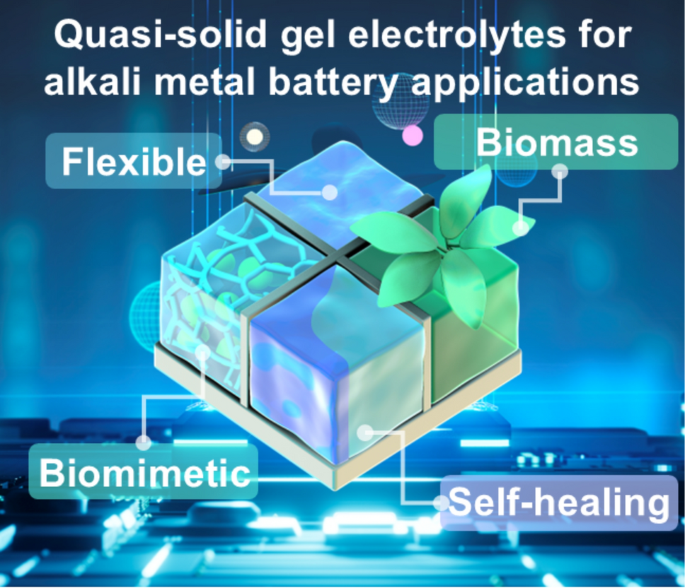
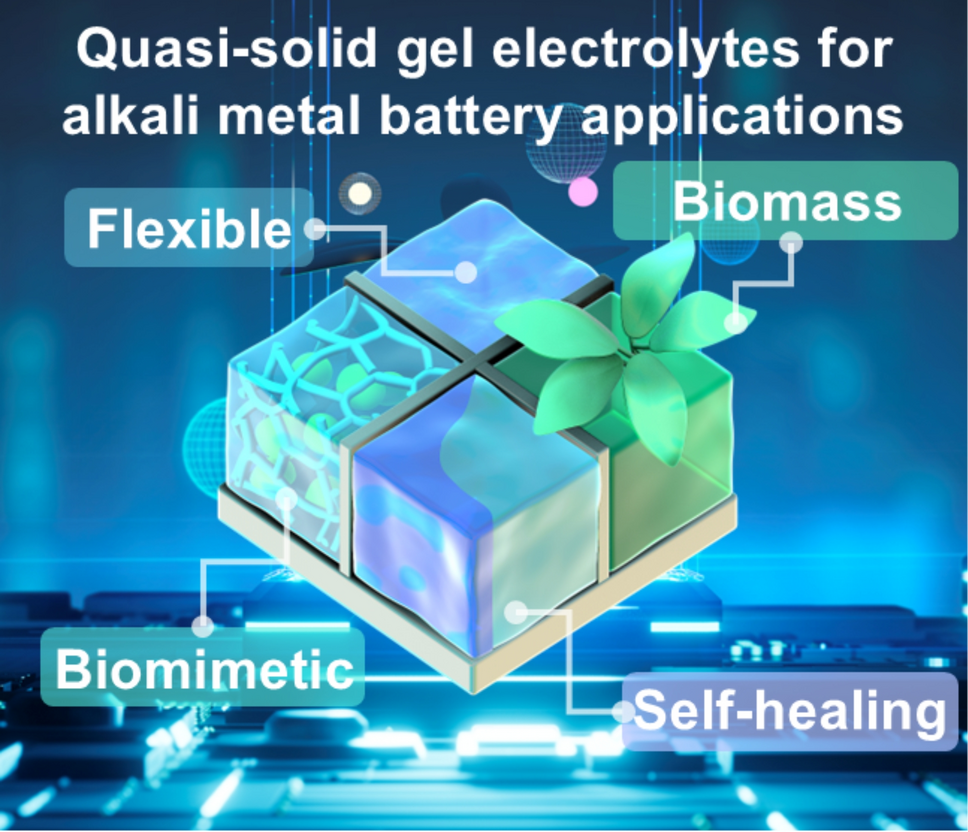

As global energy storage races toward higher safety, sustainability and energy density, traditional liquid electrolytes are hitting a “flammability-leakage” wall. Now, a team led by Prof. Guoxiu Wang (University of Technology Sydney) and Dr. Hao Tian has delivered a 66-page roadmap in Nano-Micro Letters that systematically reviews quasi-solid gel electrolytes (QSGEs) for Li/Na/K metal batteries. The work offers plug-and-play design rules that unite self-healing, flexible, biomimetic and biomass functions in one gel platform.
Why Quasi-Solid Gels Matter
• Safety First: QSGEs cut fire risk by locking solvents in a 3-D polymer net, passing nail-penetration and 150 °C thermal abuse tests without leakage.
• Dendrite Shield: In-situ formed Li–Al–O or Na–COO– layers homogenize ion flux, enabling > 3000 h Li stripping/plating at 0.5 mA cm-2.
• Green Chemistry: Cellulose, chitosan and lignin replace petro-based monomers, giving 94 % biodegradability and 30 % cost reduction.
Innovative Design Toolbox
• Four Functional Families: (i) Self-healing (boronic-ester, disulfide, H-bond), (ii) Flexible (COF, PVDF-HFP, cellulose composite), (iii) Biomimetic (ant-nest SiO2, leaf-like Al2O3, brain-like MOF-in-MOF), (iv) Biomass (bacterial cellulose-IL, lignocellulose, acetylated chitosan).
• Cross-linking Recipes: UV-triggered PEGDA-UPy delivers 1.0 × 10⁻³ S cm-1 at 25 °C; patterned electro-spinning raises toughness to 613 % elongation.
• Hybrid Ion Channels: Hollow UiO-66 with –COO– lined pores lifts Li+ transference number to 0.90 while blocking TFSI-.
Applications & Benchmarks
• High-Voltage LMB: Li|QSGE|NCM811 pouch reaches 3.1 mAh cm-2, 300 cycles at 1C with 80 % capacity and 99.7 % CE.
• Ultra-Long SMB: Na|TPDBD-CNa-QSSE|Na3V2(PO4)3 maintains 91 % after 1000 cycles at 60 mA g-1.
• Extreme-Temp KIB: 48 M KAc gel operates from −20 °C (3.4 mS cm-1) to 90 °C (23.5 mS cm-1), delivering 250 mAh g-1 at 0.5 A g-1.
Challenges & Roadmap
Key gaps remain: (i) scaling roll-to-roll UV curing to ≤ 20 µm thickness, (ii) pushing ionic conductivity to ≥ 5 mS cm⁻¹ below −20 °C, (iii) closing the loop with fully recyclable QSGEs. Future work will integrate machine-learning-guided polymer discovery and in-line impedance monitoring for gigawatt-hour production.
This comprehensive review provides a one-stop blueprint for next-gen safe, sustainable and high-energy alkali-metal batteries. Stay tuned for more game-changing advances from Prof. Wang’s team at UTS!

Editor of Nano-Micro Letters, which is an Open-Access, peer-reviewed journal reported papers that have at least one dimension ranging from a few sub-nanometers to a few hundreds of micrometers. The journal is published by Springer Nature and indexed by SCI, EI, SCOPUS, Pubmed, etc. The 2025 JCR Impact Factor is 38.5. The 2025 CiteScore is 58.9.
Follow the Topic
-
Nano-Micro Letters
Nano-Micro Letters is a peer-reviewed, international, interdisciplinary and open-access journal that focus on science, experiments, engineering, technologies and applications of nano- or microscale structure and system in physics, chemistry, biology, material science, and pharmacy.