Reading the rock while drilling
Published in Earth & Environment, Civil Engineering, and Mechanical Engineering
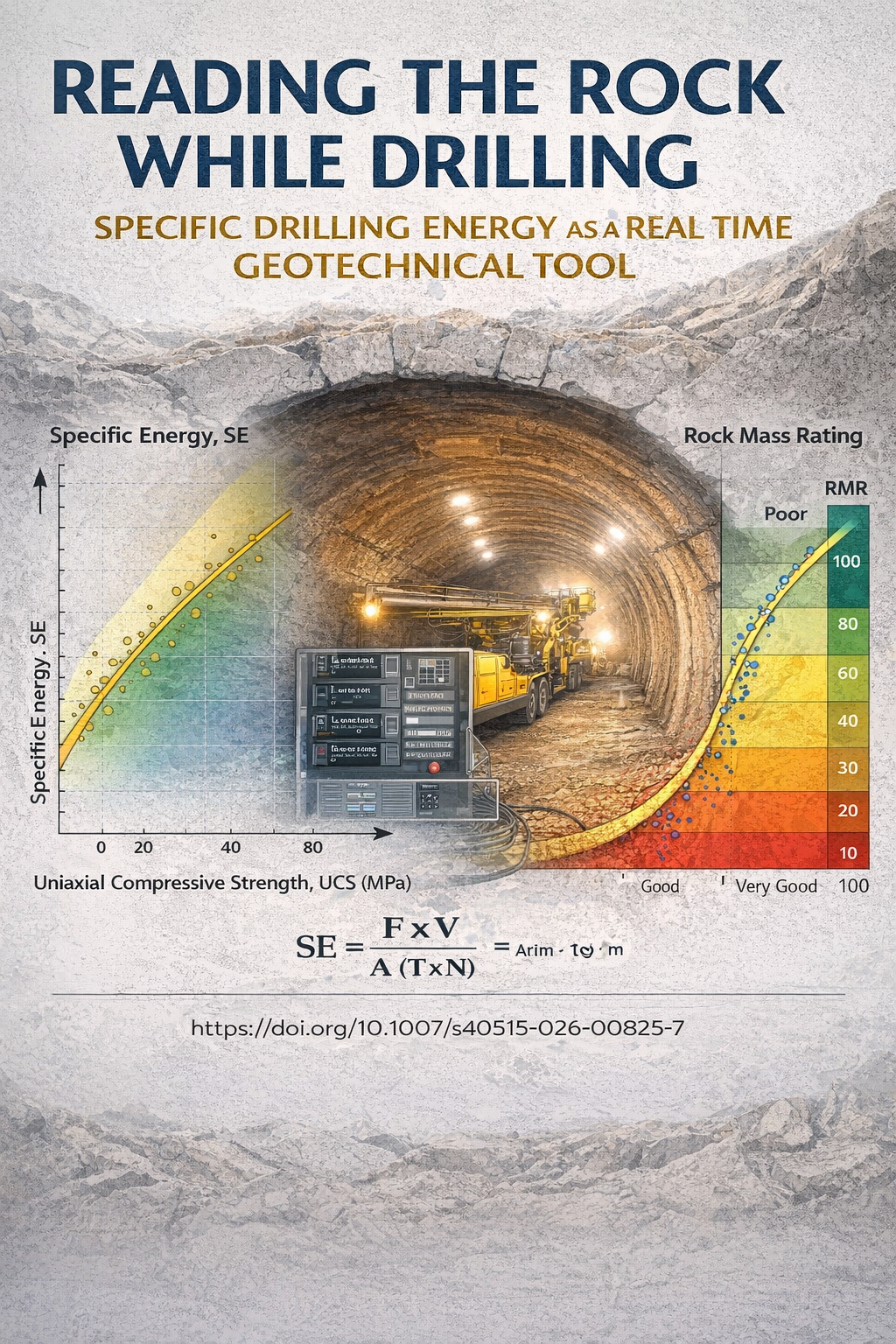

Tunnel construction generates enormous volumes of data. Yet much of it is traditionally underused.
Every drill hole executed during a drill and blast round contains mechanical information about the ground. Thrust, torque, rotation speed and penetration rate are continuously recorded by modern monitoring systems. These parameters are usually treated as operational controls, adjusted to optimise productivity. However, they also reflect something deeper: the mechanical resistance of the rock mass itself.
Our recent study explores how specific drilling energy, calculated directly from these parameters, can be transformed from a performance metric into a geotechnical decision support tool during tunnel construction. The full article is published in Transportation Infrastructure Geotechnology and can be accessed here:
https://doi.org/10.1007/s40515-026-00825-7
Specific energy was originally introduced by Teale in 1965 as a measure of the mechanical work required to remove a unit volume of rock. Its physical meaning is straightforward. It represents the energy input per cubic metre excavated, and therefore has the dimensions of stress. In simplified terms, the higher the specific energy, the greater the resistance offered by the rock to drilling.
Over decades, researchers have demonstrated correlations between specific energy and intact rock strength, including uniaxial compressive strength. What has changed in recent years is not the theory, but the instrumentation. Measure While Drilling systems now allow continuous digital recording of drilling parameters at centimetric resolution. Instead of isolated laboratory samples, we can now obtain quasi continuous mechanical information along the tunnel alignment.
The study examines two contrasting case studies. The Cabrejas Tunnel in Spain crosses soft sedimentary formations composed of shales, gypsum bearing layers and sandstones. During design, laboratory tests performed on core samples suggested relatively low strength values. However, once excavation began, in situ behaviour indicated stronger material than initially assumed. Core disturbance and fluid interaction during drilling had reduced laboratory strength estimates.
To resolve this discrepancy, specific energy was calculated from drilling parameters recorded by the jumbo during excavation. By applying empirical correlations between specific energy and uniaxial compressive strength, it became possible to estimate rock strength directly at the excavation face. The results showed strength values closer to in situ behaviour than to the conservative laboratory data obtained during design.
This had immediate practical consequences. Support systems defined under the assumption of soil like behaviour could be optimized toward lighter configurations appropriate for soft rock conditions. Excavation rounds were extended. Blasting efficiency improved. Most importantly, the adaptation was supported by quantitative mechanical evidence rather than intuition.
The second case study, the La Quiebra tunnels in Colombia, offered a contrasting geological environment. There, excavation proceeded through granodiorite belonging to the Antioquia Batholith. The challenge was not underestimated strength, but spatial variability associated with weathering and faulting.
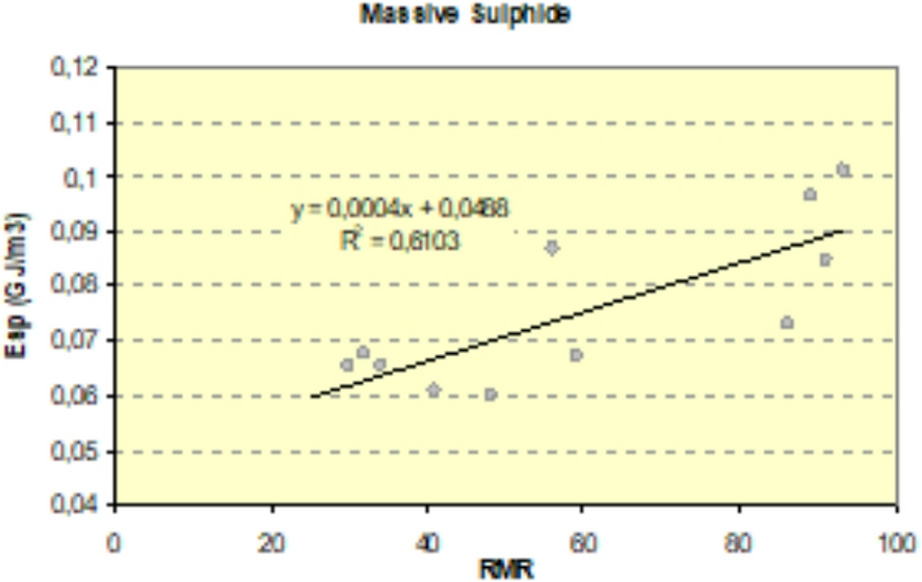
In this project, specific energy derived from Measure While Drilling data was correlated with the Rock Mass Rating classification system. As shown in the normalization curves presented in the article, specific energy values could be translated into geomechanical ratings along the tunnel alignment. This enabled continuous estimation of rock mass quality, even in faces where direct geological mapping was temporarily unavailable.
What emerges from both cases is not simply a correlation, but a methodological shift.
Traditionally, geotechnical characterization precedes construction. Site investigation defines parameters that guide design. During construction, monitoring verifies assumptions. The approach presented here partially inverts that logic. Construction itself becomes an additional investigation tool. Drilling, which is unavoidable in drill and blast tunnelling, simultaneously provides mechanical characterization data.
This integration reduces uncertainty in heterogeneous ground. It also improves responsiveness. When specific energy increases unexpectedly, it may indicate harder lithology, reduced fracturing or changes in confinement. When it decreases, it may signal increased weathering or structural weakness. Because the information is continuous, transitions between geological units can be detected with high spatial resolution.
Importantly, this does not eliminate the need for conventional geotechnical methods. Face mapping, laboratory testing and instrumentation remain essential. What specific energy provides is an additional layer of data that is cost effective and immediately available. It complements, rather than replaces, traditional approaches.
From a broader perspective, this work reflects a wider trend in underground construction. Digitalization is transforming excavation from a purely mechanical process into a data generating environment. When interpreted correctly, operational parameters become proxies for geomechanical properties. This reduces reliance on sparse sampling and enhances adaptive design.
The implications extend beyond drill and blast tunnels. Similar principles apply to Tunnel Boring Machines, where torque and penetration rates have long been linked to rock mass properties. In both conventional and mechanized tunnelling, specific energy offers a physically meaningful, dimensionally consistent indicator that bridges operational performance and rock mechanics.
Ultimately, the key insight is conceptual. Drilling is not only a means to advance the face. It is also a continuous experiment in rock breakage. Every centimetre drilled represents an interaction between machine and ground. By quantifying the energy required for that interaction, we obtain a direct measure of the resistance offered by the rock mass.
In doing so, we convert routine excavation into a real time geotechnical observatory.
Further technical details and correlations are described in the published article in Transportation Infrastructure Geotechnology:
https://doi.org/10.1007/s40515-026-00825-7
More of my research on rock mechanics, tunnelling and real time geotechnical characterization can be found on my Springer Nature author profile:
Antonio Alonso-Jiménez | Research Communities by Springer Nature
Follow the Topic
-
Transportation Infrastructure Geotechnology
This is a dedicated platform for showcasing new developments in transportation-related geotechnology.