Regional aerosol hygroscopicity influences radiative forcing globally
Published in Earth & Environment, Education, and Mathematical & Computational Engineering Applications
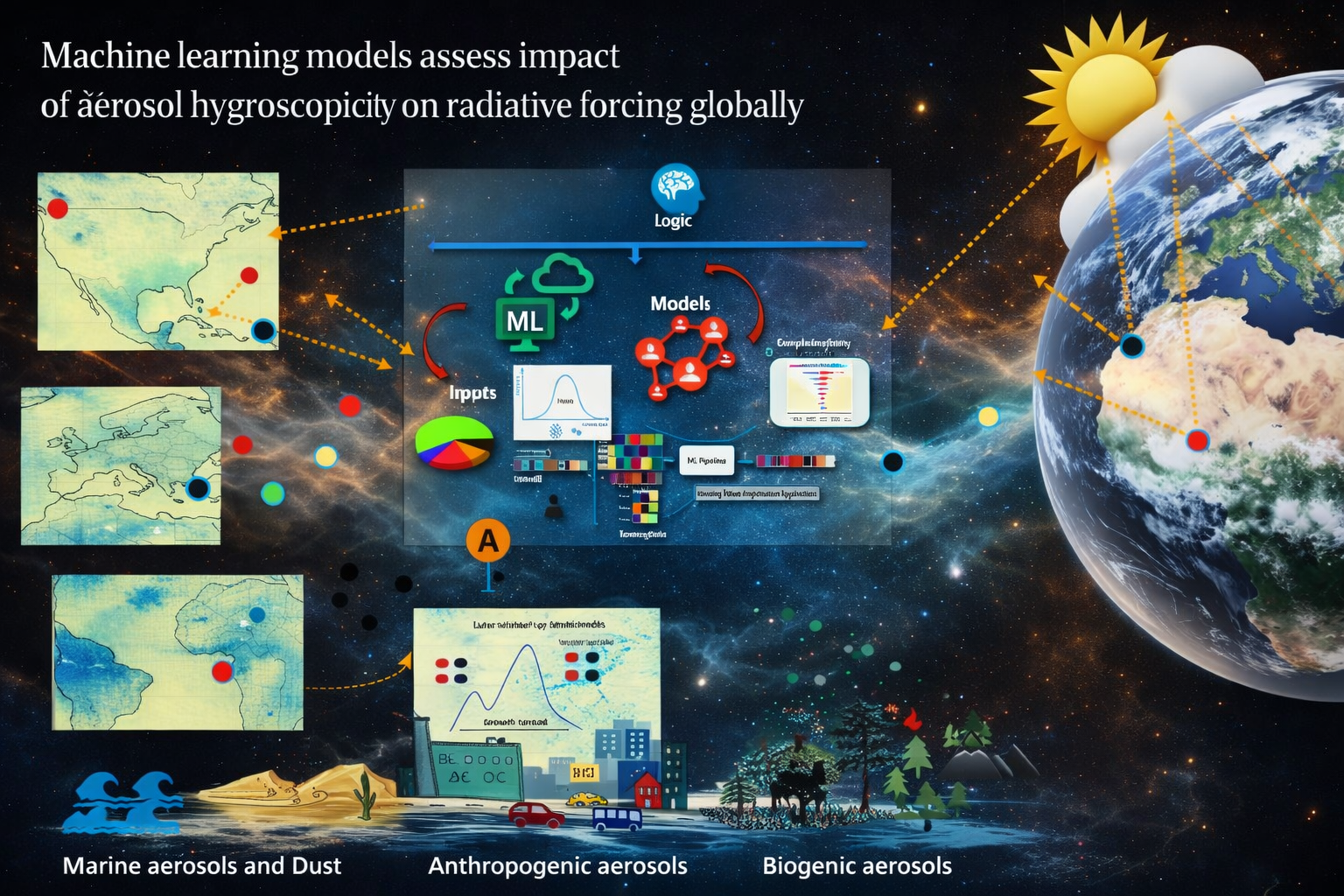




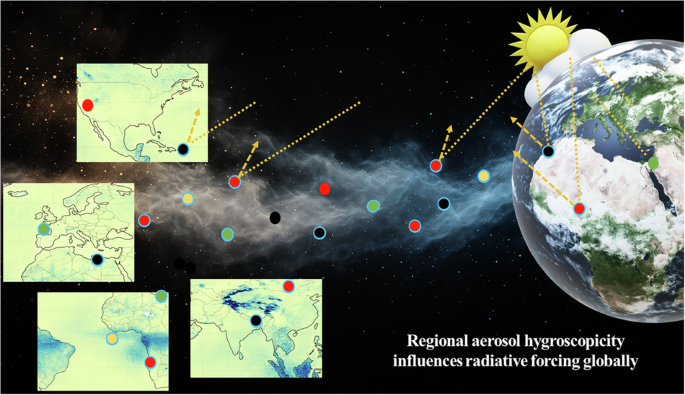

As this work started 2 years ago and finally reached its end, or I can say the beginning of implementation globally. It took time, many simulations, hours of brainstorming, many revisions, and rejections, but it reached its destination.
Aerosols are very tiny suspended particles on this big planet Earth. Although it's tiny, it alters the whole global atmosphere, especially through its most important physiochemical property, ‘hygroscopicity’. It is very simple to define aerosol particles that absorb water and grow, but in practice, it is complicated and can lead to misjudgments, misinterpretations, or incorrect predictions.
We see clouds everywhere! From their beautiful artistic appearance to the cumulus clouds (raining), they influence every scenario globally. But many of us missed the beginning or the formation of clouds, which is aerosols and their growth. At its primary stage, the so-called sub-saturation directly influences the Earth's energy balance. In short, the inflow and outflow of solar radiation determine life on Earth. Many studies examine its modeling & parametrization, but on a global scale, ignoring its local and regional influences, which biases and further introduces uncertainty into predictions. It's well known that combining regional models yields global models, but continually relying on classical methods to estimate aerosol hygroscopicity is not sufficient for parameterizing and modeling the global atmosphere and for weather prediction.
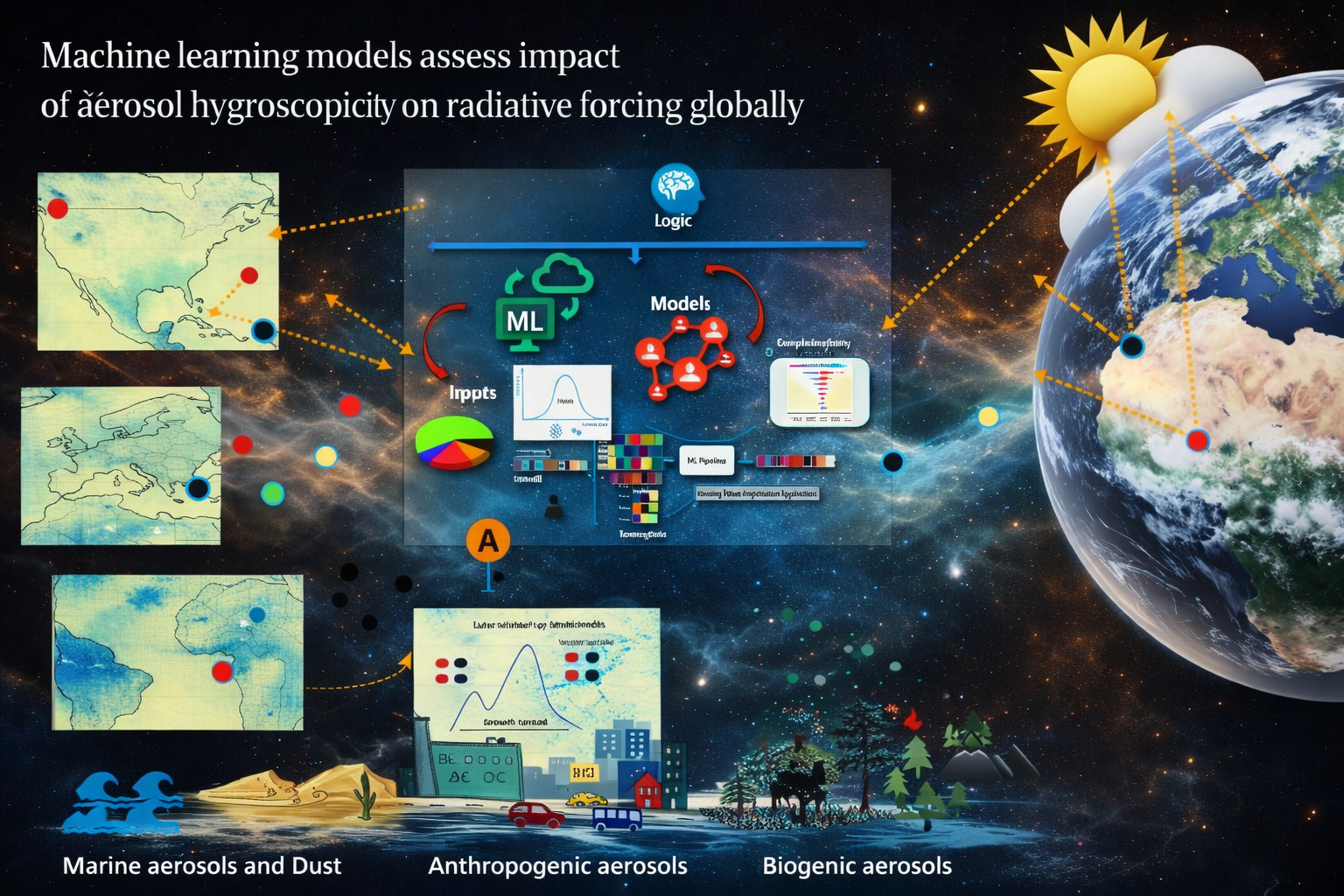
On the other hand, technology in humankind is taking pace. AI and machine learning are becoming essential and beneficial in many research fields. Not so new, but also not so prominent in atmospheric research, but relevant. Here, our work lies in developing a machine learning framework to predict the misinterpreted direct effect of aerosol hygroscopicity. Ranging from regional site-specific to its influence on global radiative forcing. Training and testing several models and methods across multiple sites globally reveal a stronger negative effect on radiative forcing than previous studies.
Does that mean ignoring additional bias from regional inputs in the global model and also assuming a common or constant hygroscopicity for all aerosols, regional and aerosol mixing is the reason of 10% of the uncertainty in the direct effect on global radiation, and further complicates climate forecast. Testing on more than 20000 data sample points at different particle diameter in this framework which make it robust and evaluates by factor 2-3 stronger negative cooling. Maybe such findings support a shift toward region-specific aerosol parameterizations as a critical step for reducing uncertainty in direct radiative forcing estimates in next-generation models. This will represent a transformative leap forward in our understanding of climate science over the next decade.
Shravan Deshmukh

Follow the Topic
-
Nature Communications
An open access, multidisciplinary journal dedicated to publishing high-quality research in all areas of the biological, health, physical, chemical and Earth sciences.
-
Communications Earth & Environment
An open access journal from Nature Portfolio that publishes high-quality research, reviews and commentary in the Earth, environmental and planetary sciences.


Related Collections
With Collections, you can get published faster and increase your visibility.
Climate adaptation and resilience in urban and rural communities
Publishing Model: Open Access
Deadline: Jun 30, 2026
Women's Health
Publishing Model: Hybrid
Deadline: Ongoing



Please sign in or register for FREE
If you are a registered user on Research Communities by Springer Nature, please sign in