Regularly Arranged Micropore Architecture Enables Efficient Lithium-Ion Transport in SiOx/Artificial Graphite Composite Electrode
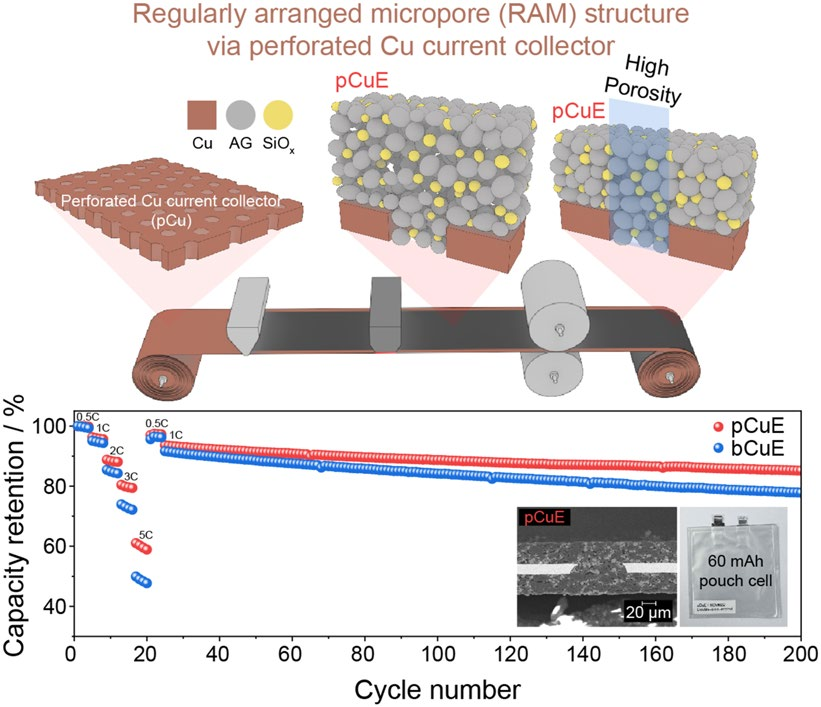

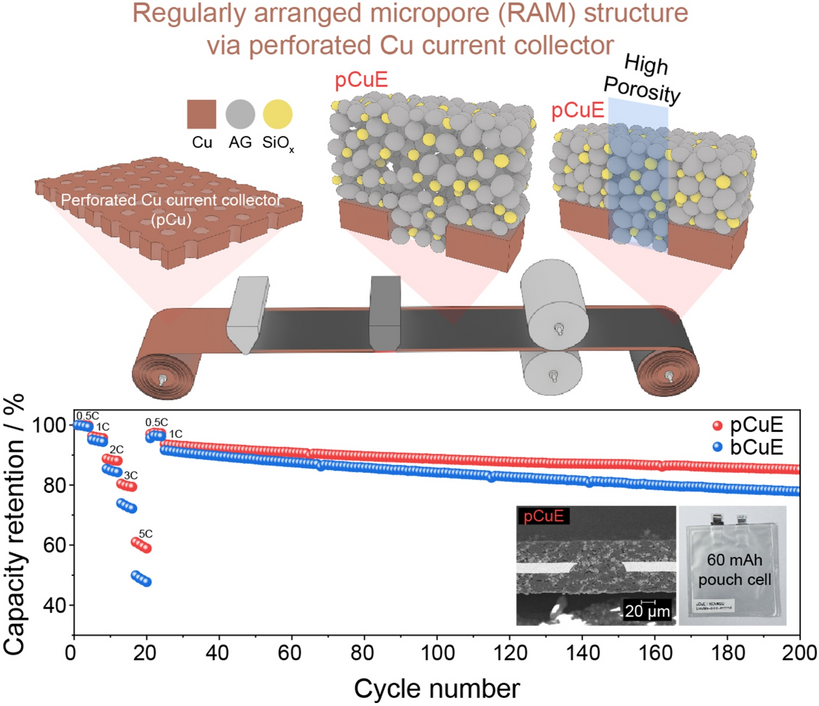

As demand rises for fast-charging and high-energy lithium-ion batteries, thick SiOx-based anodes still face slow ion transport and mechanical degradation. Researchers led by Prof. Hongkyung Lee and Prof. Yong Min Lee now report a scalable solution based on a perforated Cu (pCu) current collector, which induces a regularly arranged micropore (RAM) structure. This simple yet powerful design enhances ion diffusion, mechanical stability, and overall electrochemical performance in SiOx/artificial graphite (AG) electrodes.
Why Micropore Regulation Matters
- Transport bottleneck: Thick SiOx/AG electrodes suffer from tortuous Li-ion pathways and concentration polarization, which limit rate capability.
- Mechanical degradation: SiOx experiences large volume change, causing cracking, delamination, and rapid capacity loss.
- Scalability gap: Existing pore-engineering approaches (laser patterning, additives) add complexity; a simple, compatible method is needed for industrial use.
Design Concept: Perforated Cu Induces RAM
- Perforation mechanism: Chemical etching produces microscale holes in Cu foil. When slurry is cast and calendered, holes fill with active material, producing alternating high-porosity domains (HPds) above perforations and low-porosity domains (LPds) elsewhere.
- Interface chemistry and mechanics: Etching creates hydroxyl-rich Cu surfaces that enhance wetting and hydrogen-bonding with PAA binder, while the filled holes form an interlocking interface that resists delamination.
Transport Dynamics & Electrochemical Advantages
- Faster, more uniform ion flux: Microstructure-resolved segmentation and pore-network analysis show larger equivalent pore radii, higher coordination numbers, and lower tortuosity in HPds—facilitating rapid Li-ion access and more homogeneous ion distribution.
- Reduced polarization at high rates: Pseudo-4D electrochemical simulations show lower overpotential and deeper utilization during fast discharge (e.g., 3C), consistent with experiments.
- HPd–LPd synergy: HPds act as local ion reservoirs, improving ion supply to adjacent LPds and mitigating localized depletion.
Performance Highlights
- Rate capability: RAM electrodes deliver higher capacities across 0.2C–5C and recover well when returned to low C-rates.
- Durability: Slower growth of interfacial resistance, smaller irreversible thickness changes, and minimal delamination yield markedly improved cycle life.
- Scalability: Double-sided pCu electrodes and 60-mAh pouch cells confirm manufacturing viability.
Practical Benefits & Outlook
- Energy-density gain: Perforation reduces Cu mass (~32%), raising gravimetric energy density to ~258 Wh kg-1 and volumetric to ~694 Wh L-1.
- Manufacturing-ready: pCu retains sufficient tensile strength for roll-to-roll processing. Future work should optimize perforation geometry and extend the RAM concept to higher-Si formulations.
This simple, low-cost modification of the current collector provides a practical route to fast-charging, long-life SiOx anodes and advances scalable battery electrode engineering.

Editor of Nano-Micro Letters, which is an Open-Access, peer-reviewed journal reported papers that have at least one dimension ranging from a few sub-nanometers to a few hundreds of micrometers. The journal is published by Springer Nature and indexed by SCI, EI, SCOPUS, Pubmed, etc. The 2024 JCR Impact Factor is 36.3. The 2024 CiteScore is 53.1.
Follow the Topic
-
Nano-Micro Letters

Nano-Micro Letters is a peer-reviewed, international, interdisciplinary and open-access journal that focus on science, experiments, engineering, technologies and applications of nano- or microscale structure and system in physics, chemistry, biology, material science, and pharmacy.


Please sign in or register for FREE
If you are a registered user on Research Communities by Springer Nature, please sign in