Researchers demonstrate a powerful structure–cation engineering strategy to tune optical and dielectric behavior in ferrite nanomaterials.

Our study shows how Sr-doping in SrxZn₁₋ₓFe₂O₄ nanomaterials enables precise tuning of optical & dielectric properties through cation engineering. • High-frequency electronics • Optoelectronic devices • Energy-storage materials • Ferrite-based tunable components
Researchers demonstrate a powerful structure–cation engineering strategy to tune optical and dielectric behavior in ferrite nanomaterials.
Like

Share this post

Choose a social network to share with, or copy the URL to share elsewhere

This is a representation of how your post may appear on social media. The actual post will vary between social networks

Explore the Research

Nature
Nature Nature

Tuning optical and dielectric properties of strontium-zinc ferrite nanomaterials through structure-cation engineering - Scientific Reports

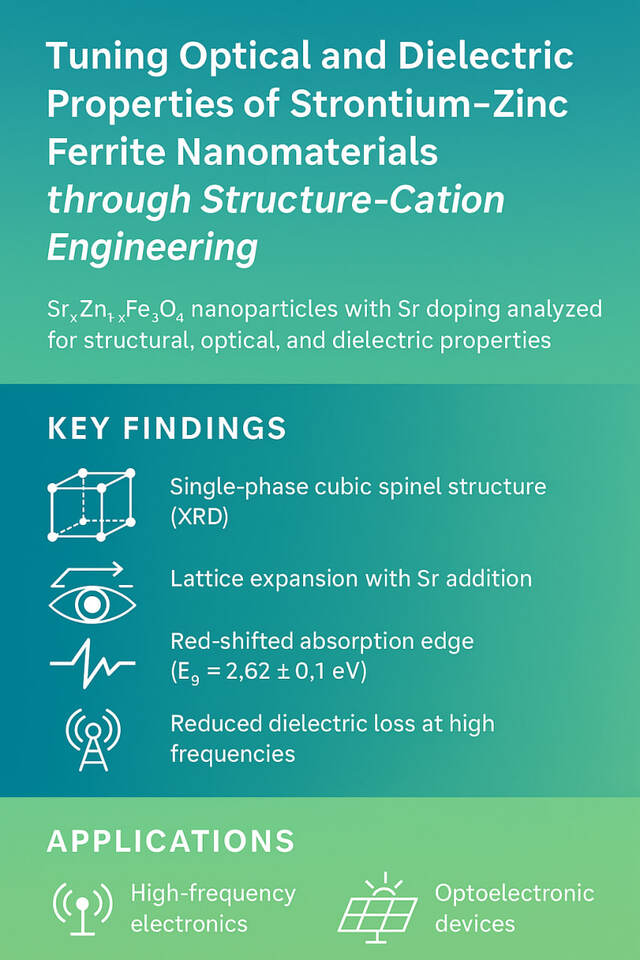
Herein, SrxZn1−xFe2O₄ nanoparticles produced by chemical co-precipitation are examined to determine how strontium (Sr) doping affects their structural, morphological, optical, and dielectric characteristics. The creation of a single-phase cubic spinel structure was verified by X-ray diffraction, and peak shifts indicated lattice expansion brought on by the addition of Sr. A homogeneous grain morphology with nanoscale dimensions was found by FESEM investigation. The metal-oxygen vibrational modes in the Raman and FTIR spectra showed changes that suggested local structural distortion. With a lowered optical bandgap of 2.62 ± 0.1 eV, UV-Vis spectroscopy revealed a red shift in the absorption edge, improving semiconducting properties. AC conductivity and complex modulus tests revealed improved charge transport and relaxation behavior, whereas impedance spectroscopy indicated decreased dielectric loss (tan δ) at high frequencies. Mössbauer spectroscopy revealed that doping resulted in a redistribution of Fe2+ between tetrahedral and octahedral sites. According to these results, Sr-doped ZnFeO₄ is a promising material for use in high-frequency and optoelectronic device applications. This work develops a structure-cation engineering approach, where Mössbauer spectroscopy validates cation redistribution, allowing for simultaneous tuning of optical and dielectric properties, providing a new avenue for the development of ferrite-based optoelectronic and energy storage materials.

This work investigates SrxZn₁₋ₓFe₂O₄ nanoparticles synthesized via chemical co-precipitation to understand how strontium (Sr) doping modifies their structural, optical, dielectric, and charge-transport properties.

🔬 Major Scientific Contributions:
XRD confirms single-phase cubic spinel, with peak shifts revealing Sr-induced lattice expansion
FESEM shows uniform nanoscale grains
Raman & FTIR analysis detects metal–oxygen vibrational changes → local structural distortion
UV–Vis spectroscopy shows red-shifted absorption and reduced bandgap (2.62 ± 0.1 eV)
AC conductivity & modulus studies demonstrate improved charge transport and relaxation
Impedance spectroscopy reveals decreased dielectric loss (tan δ) at high frequencies
Mössbauer spectroscopy identifies Fe²⁺ redistribution between tetrahedral and octahedral sites

🎯 Applications:
• High-frequency electronics
• Optoelectronic devices
• Energy-storage materials
• Ferrite-based tunable components

This study establishes a structure–cation engineering approach for designing next-generation ferrite nanomaterials.


Please sign in or register for FREE

If you are a registered user on Research Communities by Springer Nature, please sign in

Follow the Topic

Materials for Devices
Physical Sciences > Materials Science > Materials for Devices
Materials for Energy and Catalysis
Physical Sciences > Materials Science > Materials for Energy and Catalysis
Energy Harvesting
Technology and Engineering > Biological and Physical Engineering > Microsystems and MEMS > Energy Harvesting
Supercapacitors
Physical Sciences > Materials Science > Materials for Energy and Catalysis > Supercapacitors
Optical Data Storage
Physical Sciences > Materials Science > Optical Materials > Optical Data Storage

Related Collections

With Collections, you can get published faster and increase your visibility.

Fundamental Problems of High Temperature Superconductivity - FPS2025

This collection aims at reporting new advances in the field in association with the conferece of Fundamental Problems in Superconductivity - FPS2025 The collection will consider full research articles, perspectives and review papers. All contributions will undergo the same rigorous peer-review process of any other paper published in the journal.

Publishing Model: Hybrid

Deadline: Jan 01, 2026

Development of new superconducting materials with exotic properties and mechanisms

Since the discovery of cuprate high-Tc superconductors in 1986, various kinds of layered superconductors including Fe-based, MgB2, BiS2-based, Ni-based, and van-der-Waals systems have been developed. Furthermore, exotic superconducting properties and unconventional pairing mechanisms have been revealed. Recently, superhydrides exhibited high Tc close to room temperature under high pressures. On the basis of these developments of new superconductors, collecting established review articles and reports on new discoveries will be highly desired in the field of pure and applied science of superconductivity.

Publishing Model: Hybrid

Deadline: Ongoing