Rethinking Psychological Capital: A Bourdieusian Critique of Neoliberal Subjectivity
Published in Social Sciences and Behavioural Sciences & Psychology




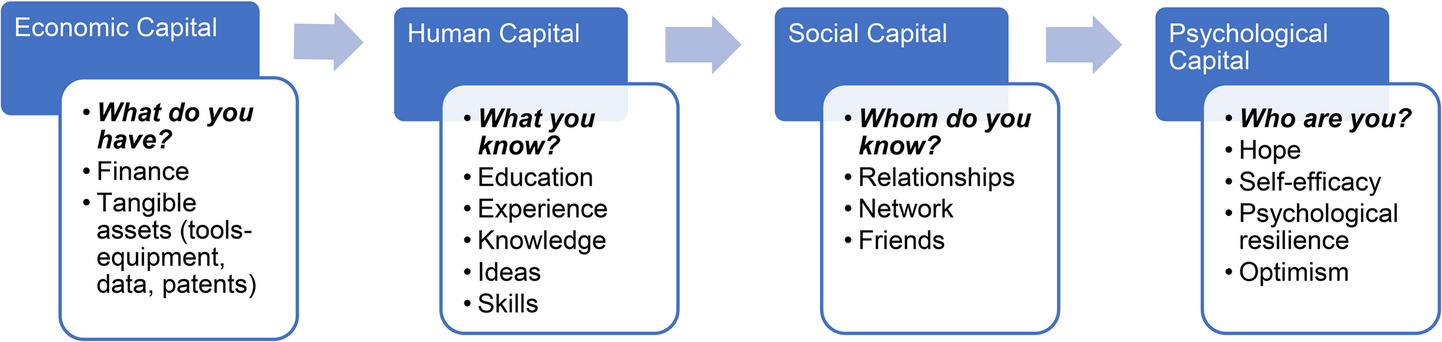

From Psychological Resource to Normative Subject
In much of the existing literature, PsyCap is treated as a neutral, universally applicable construct. It is often positioned within human capital theory and strategic management discourse as a strategic asset capable of generating competitive advantage.
This raises a fundamental question:
What kind of subject does PsyCap implicitly construct?
When hope, resilience, optimism, and self-efficacy are repeatedly linked to productivity, performance, and organizational commitment, they begin to function not merely as descriptive traits but as normative expectations. The resilient individual becomes someone who remains adaptive under structural strain. The optimistic individual is oriented toward forward-looking performance. The self-efficacious individual internalizes responsibility for outcomes.
In this sense, PsyCap does more than measure psychological strengths. It participates in shaping an idealized form of subjectivity aligned with contemporary economic rationalities.
Our article, recently published in Human Arenas, can be accessed here: https://doi.org/10.1007/s42087-026-00557-7
Why Bourdieu?
To analyze these dynamics, we drew on Pierre Bourdieu’s theory of capital, habitus, and field. His framework allows us to move beyond an individualistic reading of psychological traits and instead examine how they acquire value within structured social spaces.
From a Bourdieusian perspective, psychological characteristics are not equally distributed inner resources. Their development, recognition, and legitimacy depend on class position, cultural capital, social networks, and institutional habitus. Hope, resilience, or self-efficacy become meaningful and advantageous only when they are recognized within specific fields.
This shift enables us to reconceptualize PsyCap as a socially mediated form of symbolic capital rather than an isolated psychological asset.
The Epistemological Question
Our inquiry also engages with broader debates about psychology’s epistemological foundations. The discipline often privileges measurability, standardization, and intervention readiness. Constructs gain legitimacy through quantification and empirical validation.
However, quantification does not eliminate normative assumptions. PsyCap exemplifies this tension. While methodologically sophisticated, it carries embedded assumptions about the ideal self: self-regulating, adaptive, optimistic, and continuously improvable.
By situating PsyCap within discussions of neoliberal subjectivity, governmentality, and symbolic power, we aim to illuminate the ideological conditions under which such psychological models emerge and gain authority.
Cultural and Structural Embeddedness
Another important dimension concerns cultural transferability. Much PsyCap research is conducted within Western, individualistic contexts. Yet psychological constructs are not culturally neutral. The meanings attached to resilience or hope differ across collectivist and relational settings.
When models developed in one socio-cultural context are universalized, they risk obscuring alternative understandings of well-being rooted in community, relationality, and shared responsibility. A culturally grounded analysis therefore becomes essential.
What This Study Contributes
This study does not reject the value of psychological resources. Nor does it deny the importance of hope, optimism, resilience, or self-efficacy.
Rather, it asks under what conditions these traits become valued, how they convert into symbolic capital, and how they may function within broader systems of power and recognition.
By reconceptualizing PsyCap through Bourdieu’s sociology, we reposition it within structures of class, institutional habitus, and cultural capital. This perspective shifts the focus from individual enhancement to structural embeddedness.
Toward a Reflexive Psychology
If PsyCap is understood solely as an internal asset, it risks reinforcing a model of self-optimizing individuals responsible for navigating structural constraints alone. If, however, it is situated within social, cultural, and institutional contexts, it opens space for a more reflexive and socially grounded psychological science.
Our aim is to contribute to interdisciplinary dialogue between psychology and sociology and to encourage critical reflection on how psychological constructs are shaped by historical, cultural, and ideological forces. In doing so, we invite a reconsideration of how psychological knowledge is produced, legitimized, and mobilized within contemporary social and economic structures.

I’m Ayşe Yavuz from Türkiye. I have completed my master and PhD in Curriculum and Instruction, Educational Sciences at Aydın Adnan Menderes University (2025), with a background in Psychological Counseling and Guidance.
Follow the Topic
-
Human Arenas
The aim of this journal concerns the interdisciplinary study of higher psychological functions (as topic of a general theory of psyche from the perspective of cultural psychology) in human goal-oriented liminal phenomena in ordinary and extraordinary life conditions.

Related Collections
With Collections, you can get published faster and increase your visibility.
Arena of Technologies
Publishing Model: Hybrid
Deadline: Ongoing
Arena of Health
Publishing Model: Hybrid
Deadline: Ongoing