Secondary data use of tocilizumab clinical studies to address regulatory needs for rare and pediatric trials
Published in Biomedical Research, Paediatrics, Reproductive Medicine & Geriatrics, and Statistics







Addressing the Data Gap in Rare Diseases
Up to 36 million people in the EU live with a rare disease, yet 95% of these conditions still have no authorized treatment options. Traditional clinical trials often struggle in this space due to small patient numbers and disease heterogeneity. To bridge this gap, the INVENTS project is developing a groundbreaking framework using innovative modeling and simulation to accelerate drug development.
The core challenge in rare disease research is generating enough evidence for regulatory approval when the patient population is inherently limited. The INVENTS project (https://invents-he.eu/) aims to overcome these hurdles by maximizing the value of existing clinical and real-world data.
At the heart of this initiative is a data sharing initiative using data from 20 clinical trials and real-world studies, using tocilizumab, a drug developed by Roche for both common and rare inflammatory conditions. By analyzing data from over 10,000 patients, the project aims to improve how we estimate treatment effects and extrapolate findings across different populations.
A Collaborative and Ethical Approach
This project is a massive collaborative effort, funded by the European Union’s Horizon Europe Research and Innovation program under grant agreement 101136365, as well as the Swiss State Secretariat for Education, Research and Innovation (SERI) and the UKRI Innovative UK under their Horizon Europe Guarantee scheme.
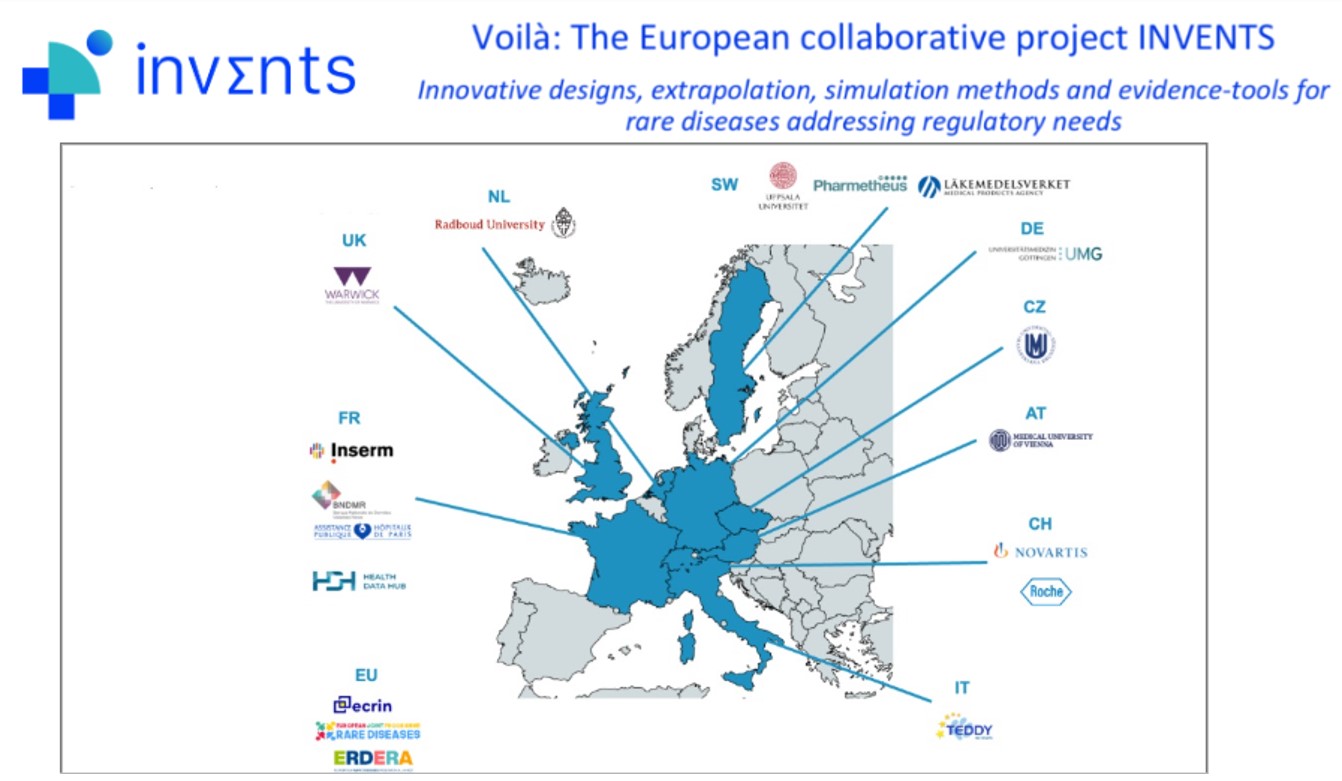
Research is carried out by a group (consortium) of experts from universities and institutions across Europe, including France, the Netherlands, Austria, Sweden, Germany, Czech, Italy and the UK.
The research is conducted with a strong commitment to ethics and data privacy. Because it uses secondary data from past trials, no new patients are recruited. All data is strictly pseudonymized and hosted in a secure environment by the Health Data Hub (HDH) in France, ensuring that patient privacy is protected while still allowing researchers to unlock vital medical insights. The research protocol has been registered in the ISRCTN registry (https://doi.org/10.1186/ISRCTN13592648).
The Path Forward:
Ultimately, INVENTS is about more than just data—it’s about people. By providing regulators and drug developers with a reliable framework for small-population evidence, the project aims to speed up the delivery of safe and effective treatments to those who need them most. As the project progresses, the team plans to share their results through open-access publications and software, ensuring that these innovative methods can benefit the global scientific community.
Follow the Topic
-
ISRCTN: The UK’s Clinical Study Registry
A primary clinical trial registry recognised by WHO and ICMJE that accepts studies involving human subjects or populations with outcome measures assessing effects on human health and well-being, including studies in healthcare, social care, education, workplace safety and economic development.