Sex Differences in Fitted Face Mask Performance
Published in Earth & Environment, General & Internal Medicine, and Public Health


But the journey to that question took substantial time and planning. During the COVID-19 pandemic, masking was at the forefront of nonpharmaceutical public health interventions for the general public. Prior to the pandemic, EPA researchers were preparing for studies of woodsmoke exposure and the benefit of wearing respirators to protect against its harmful effects. Inhalation risks took on broader relevance with the SARS-CoV-2 virus and the global COVID-19 pandemic. Recognizing the variety of inhalation exposure threats, our research pivoted to address needs around masking and respirator use. Study data addressed emerging issues and questions surrounding mask availability and protection efficiency in various scenarios (1-6). Using two research grade particle counters to simultaneously sample our particle supplemented (aerosolized salt water) chamber environment and the space behind a ported mask worn by a human participant, we characterized variation in the fitted effectiveness of the most commonly worn masks even when accounting for things like beard hair, instruction level, and multiple reuses. These studies provided a better understanding of sources of mask performance variability but left open questions about individual variation in fitted filtration efficiency (FFE). This led us to investigate how sex impacts overall mask fit and performance.
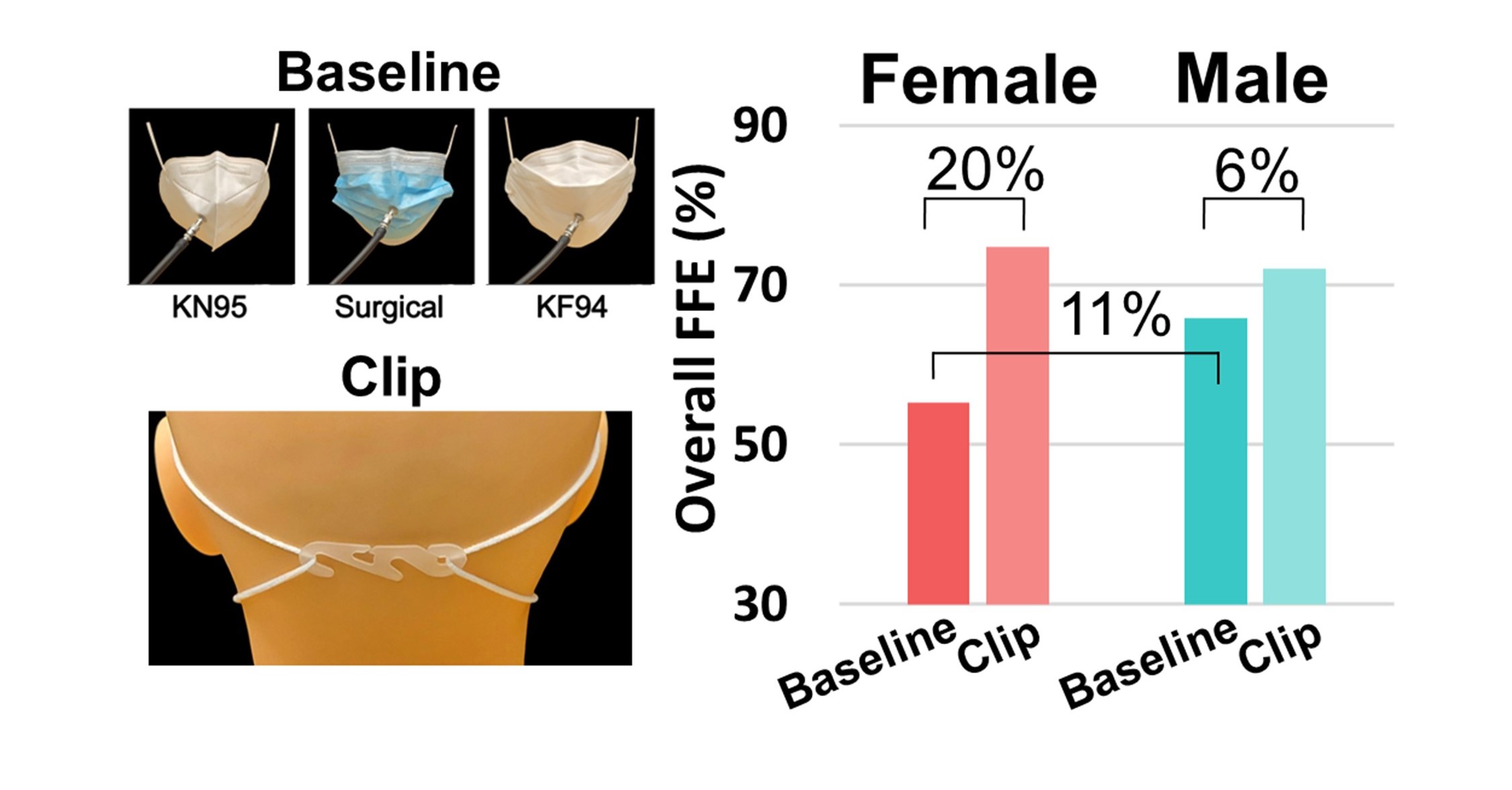
Averaged Ear Loop Masks Fitted Filtration Efficiency (FFE): 50 Female and 50 Male Participants.
We measured the variation in mask performance of four commonly worn disposable face masks, in a cohort of healthy adult participants (N=100, 50% female, 50% male, age range 18-55, average age = 32.3 ± 9.2 years, Body Mass Index (BMI) range 19-33.4, average BMI = 25.5 ± 3.4). Given the wide array of human face shapes and sizes, we also measured and imaged the heads and faces of our participants to better understand underlying factors influencing ear loop mask performance (manuscript under review). In our manuscript published in the Journal of Exposure Sciences and Environmental Epidemiology, we report a few findings that are relevant for public health interventions. Our first finding was that the N95 respirator we tested, a tri-fold model designed to accommodate many face types, performed the best of all tested face coverings, with fitted filtration performance not affected by the sex of the wearer (97.4% for females, 98.2% for males, see Figure 2). Although the fit testing protocol we used is based on workplace requirements, we provided instructions for how to wear the respirator with the general public in mind. These instruction conditions were the same we had previously shown to produce the best fitted efficiency in a demonstration study7.
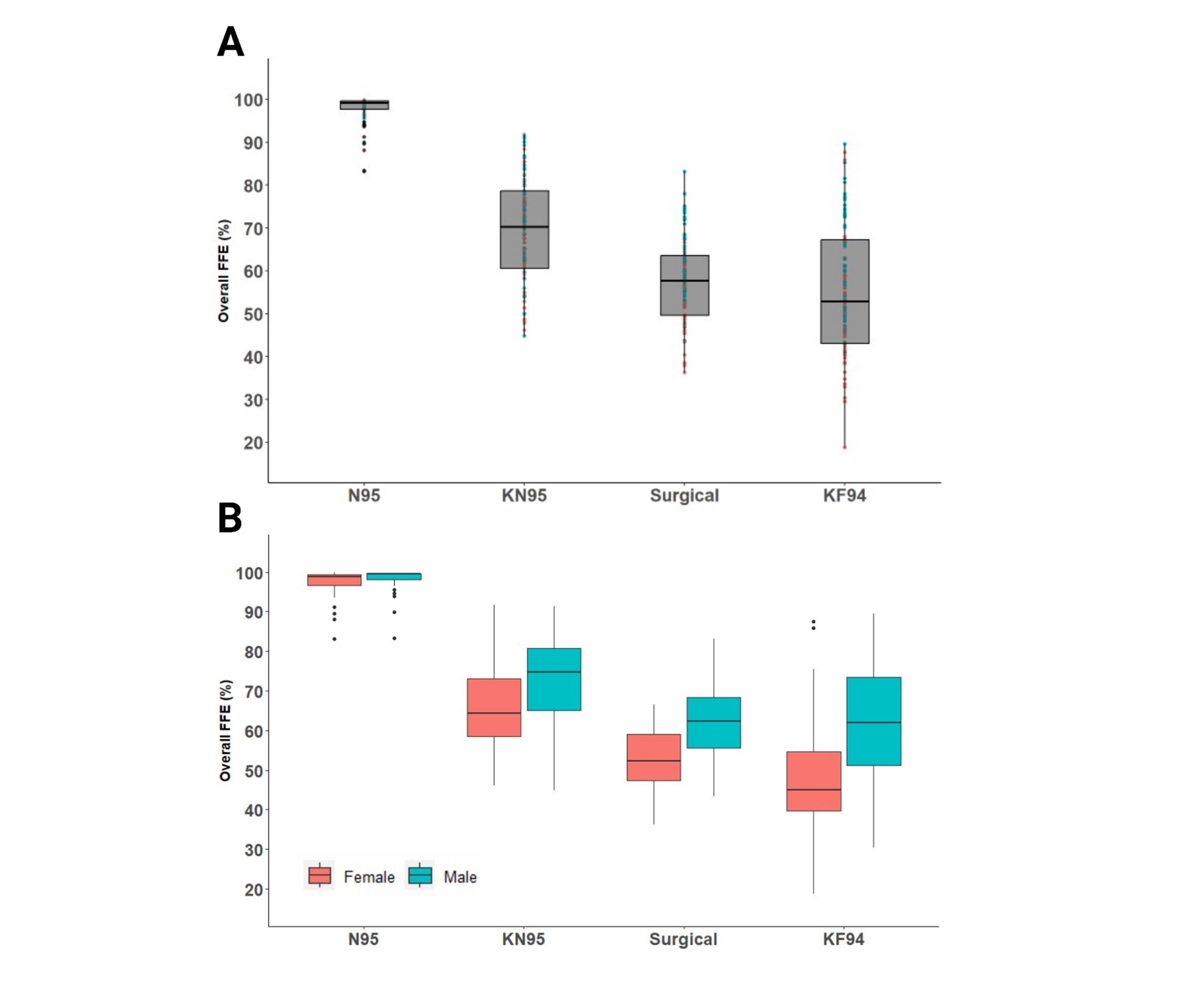
Fig. 2. Fitted Filtration Efficiency (FFE) of N95 respirator and Ear Loop Type Masks.
A. All 100 Participants, B. Split by Sex (50 Female, 50 Male).
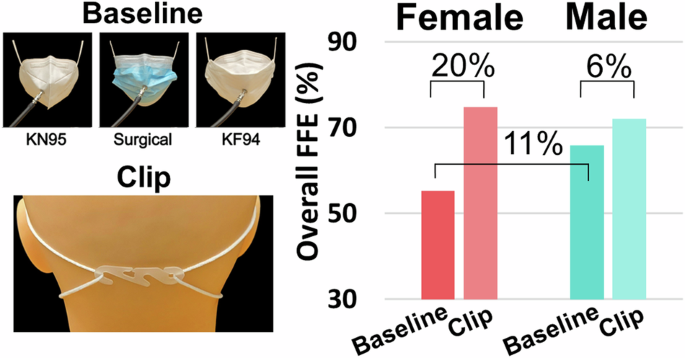
Our second finding focused on ear loop masks (KN95, surgical, and KF94) that were reported to be more commonly used during the COVID-19 pandemic. These masks performed significantly better “out of the box” for males compared to females. We attribute this performance advantage to the well-known average size difference between the human sexes, with males having larger bodies and in proportion, larger heads, and faces, compared to females. Although males are about 7% larger than females, their mask performance was on average about 11% better (KN95 = 7.4%, Surgical = 10.1%, KF94 = 15.2%, see Figure 2). This pattern suggests that lower fitted performance could translate to higher inhalation risks for the average female relative to the average male when each wears an ear loop model mask.
Finally, results showed that a simple ear loop clip worn behind the head (see mannequin demonstration in graphical abstract at top) dramatically improved fitted performance for females (20%) compared to males (6%). Each mask showed significantly greater improvement for females than males (KN95 = 18.8% vs. 4%, Surgical = 13.7% vs. 4.1%, KF94 = 26.1% vs. 9.7%, see Figure 3). In fact, KN95 performance was noticeably better with a clip for females than for males (84.5% vs. 77%). The findings suggest that clips worn with ear loop masks will tend to benefit females, potentially providing equivalent or better filtration performance relative to males.
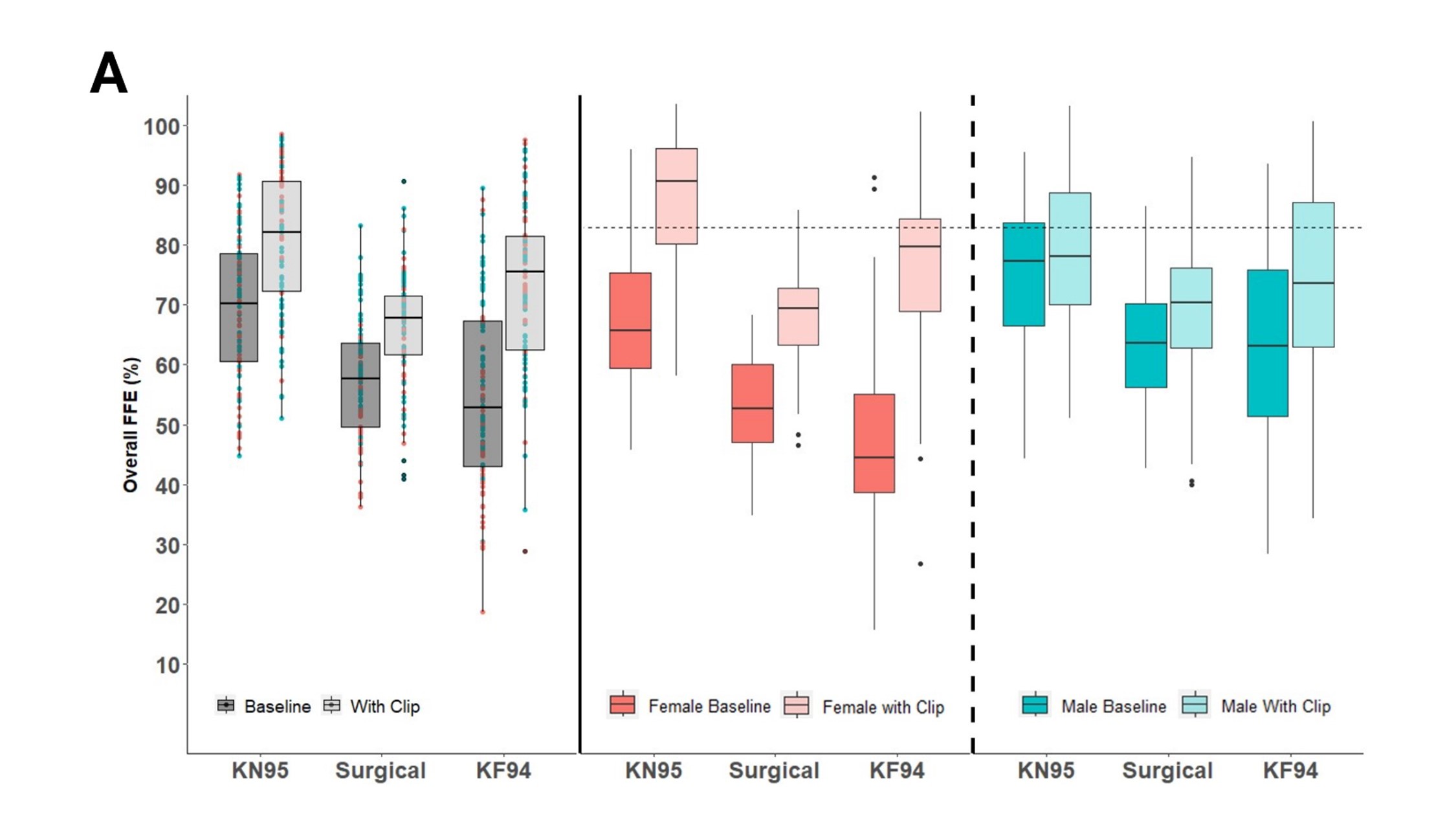
Fig. 3. Fitted Filtration Efficiency (FFE) of Ear Loop Type Masks at Baseline and with Clip, for all 100 Participants and split by Sex.
Follow-up analyses and future studies will help to pinpoint the specific head and facial features that should be accounted for when determining whether performance can improve with a clip intervention. Variability in the level of filtration efficiency masks achieve, as worn by the public, has real-world public health consequences. Our study and follow-up data from samples with broader age, BMI, and health status, can provide actionable data to help individuals identify the respiratory protection that works best for them. Ideally, rather than simply assuming a one-size-fits all mask protects all people equally, members of the public can incorporate an understanding of the level of filtration performance they are likely to achieve and the modifications and alternatives that may improve personal protection.
The full manuscript titled "Variation in the fitted filtration efficiency of disposable face masks by sex" is available here: https://www.nature.com/articles/s41370-024-00697-4
References
- Chen H, Samet JM, Tong H, Abzhanova A, Rappold AG, Prince SE Can disposable masks be worn more than once? Ecotoxicol Environ Saf 2022; 242: 113908.
- Clapp PW, Sickbert-Bennett EE, Samet JM, Berntsen J, Zeman KL, Anderson DJ et al Evaluation of Cloth Masks and Modified Procedure Masks as Personal Protective Equipment for the Public During the COVID-19 Pandemic. JAMA Intern Med 2020; e-pub ahead of print 2020/12/11; doi 10.1001/jamainternmed.2020.8168.
- Prince SE, Chen H, Tong H, Berntsen J, Masood S, Zeman KL et al Assessing the effect of beard hair lengths on face masks used as personal protective equipment during the COVID-19 pandemic. J Expo Sci Environ Epidemiol 2021; 31: 953-960.
- Sickbert-Bennett EE, Samet JM, Clapp PW, Chen H, Berntsen J, Zeman KL et al Filtration Efficiency of Hospital Face Mask Alternatives Available for Use During the COVID-19 Pandemic. JAMA Intern Med 2020; e-pub ahead of print 2020/08/12; doi 10.1001/jamainternmed.2020.4221.
- Sickbert-Bennett EE, Samet JM, Prince SE, Chen H, Zeman KL, Tong H et al Fitted Filtration Efficiency of Double Masking During the COVID-19 Pandemic. JAMA Intern Med 2021; 181: 1126-1128.
- Bennett WD, Prince SE, Zeman KL, Chen H, Samet JM A novel method for the quantitative assessment of the fitted containment efficiency of face coverings. Infect Control Hosp Epidemiol 2023; 44: 1481-1484.
- Chen H, Pennington ER, Case MW, Tong H, Rappold AG, Samet JM et al Improvement in Fitted Filtration Efficiency of N95 Respirators With Escalating Instruction of the Wearer. AJPM Focus 2022; 1: 100014.

Follow the Topic
-
Journal of Exposure Science & Environmental Epidemiology
This journal aims to be the premier and authoritative source of information on advances in exposure science for professionals in a wide range of environmental and public health disciplines.