'SIMONA' software package released!
Published in Social Sciences and Physics
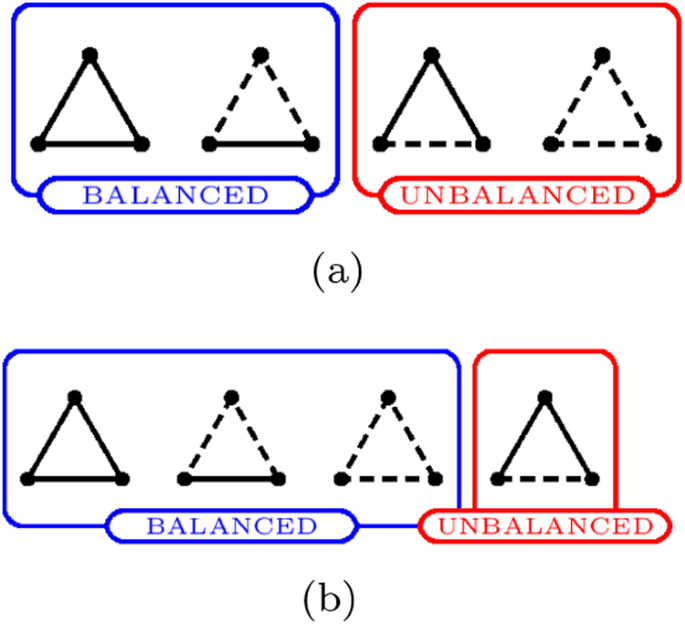

More specifically, we consider graphs whose edges are associated with a +1, a -1 or a 0 and propose an iterative method to correctly sample a set of four ensembles of signed networks, i.e. those associated with both the free-topology and the fixed-topology versions of the Random Graph Model and the Configuration Model: in the former case, signs are shuffled along with the edges while, in the latter, signs are permuted on a set of connections that, instead, are kept fixed. In words, the benchmarks belonging to the first basket are designed to model situations where agents can choose both with whom and how to interact while the benchmarks belonging to the second basket are designed to model situations where agents can solely choose how to interact. Since our approach relies upon exact maximum-entropy distributions, it is inherently unbiased, even for highly heterogeneous networks.
The binary, undirected, signed models implemented by the present package are introduced and solved in the paper by Gallo, Garlaschelli, Lambiotte, Saracco, Squartini "Testing structural balance theories in heterogeneous signed networks" Comm. Phys. 7, 154 (2024) a summary of which can be found here. For what concerns the theoretical methodology lying at the basis of the entropy-based canonical models, see the paper by Park and Newman "Statistical mechanics of networks" Phys. Rev. E 70, 66117 (2004) and the paper by Squartini and Garlaschelli "Analytical maximum-likelihood method to detect patterns in real networks" New J. Phys. 13, 083001 (2011).

Tiziano Squartini is Associate Professor at the IMT School of Advanced Studies in Lucca, within the NETWORKS Research Unit. He holds a Master Degree in Physics (2008) and a PhD Degree in Physics (2011) from the University of Siena (thesis title: "Information-theoretic approach to the analysis of complex networks"). During the biennium 2012-2013 he was post-doctoral Researcher at the Lorentz-Institute for Theoretical Physics (LION - University of Leiden, NL) under the supervision of Diego Garlaschelli. From January 2014 to October 2015 he was post-doctoral Researcher at the Institute for Complex Systems UOS Sapienza in Rome, under the supervision of Luciano Pietronero. From November 2015 to November 2018 he was Assistant Professor (RTD-A) at the IMT School for Advanced Studies in Lucca; from December 2018 to December 2021 he was a Tenure Track researcher (RTD-B) within the same institute. He is the "Complex Systems and Networks" Track Director at IMT, where he teaches the courses "Introduction to Network Science", "Network Reconstruction" and the second module of "Maximum-Entropy Models of Complex Systems". He is PhD Board Member of the National Doctorate in Artificial Intelligence and visiting fellow at the Institute for Advanced Study (IAS - University of Amsterdam, NL). He currently collaborates with the Supervisory Policy Division of the Dutch National Bank, Bank of England and Bank of Mexico. He is author of around 60 publications in peer-reviewed international journals (including major ones like Nature Reviews Physics, Physics Reports, Physical Review Letters), peer-reviewed book chapters and of two co-authored monographs. His research interests lie at the intersection between statistical physics and graph theory, both on the theoretical and the applied side: some of the research topics pursued by him concern network reconstruction, systemic risk estimation in financial networks, (mis)information spreading on social networks and functional brain networks analysis.
Follow the Topic
-
Communications Physics
An open access journal from Nature Portfolio publishing high-quality research, reviews and commentary in all areas of the physical sciences.

Related Collections
With Collections, you can get published faster and increase your visibility.
Nonlinear dynamics of living systems
Publishing Model: Open Access
Deadline: Nov 09, 2026
Active, Entangled or Confined: Polymer Physics Across Synthetic and Living Matter
Publishing Model: Open Access
Deadline: Dec 31, 2026