Single atom in a superoscillatory optical trap
Published in Physics

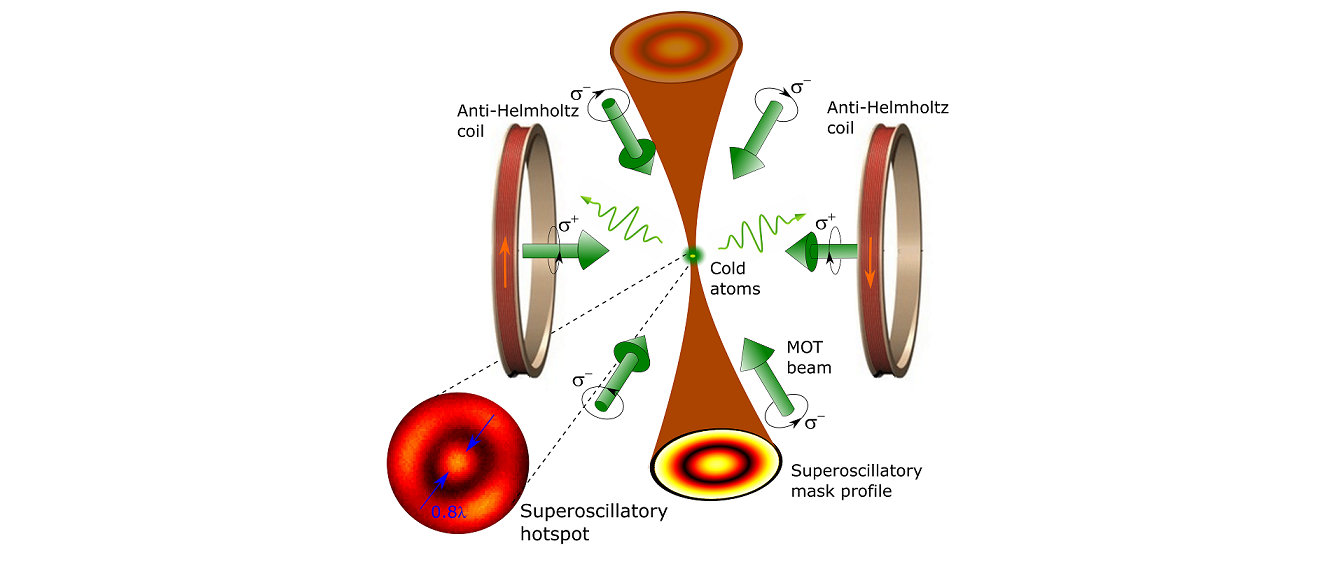


The performances of an optical trap depend on the ability to reduce its transverse size, such that one can optimally control the relative position of the atom and eventually get an inter-traps distance as small and precise as possible. The size of a conventional diffraction-limited trap can be defined by the Abbe radius of its optical hotspot.
However, it is possible to reduce the size of the hotspot beyond Abbe’s limit using the phenomenon of superoscillations that allows band-limited function to locally oscillate faster than its highest Fourier component. Optical superoscillations are rapid subwavelength spatial variations of the intensity and phase of light, occurring in complex electromagnetic fields formed by the interference of several coherent waves. In recent years, the understanding of the superoscillatory phenomenon in optics has led to the development of superoscillatory lensing, imaging, metrology technologies and trapping of nanometres-size dielectric objects.
In our paper, published in Communications Physics, we report the trapping of a single atom in a superoscillatory optical trap where the transverse size is subwavelength and below the Abbe’s limit by a factor 0.69(3).
Superoscillatory traps can find applications when compact and tunable ensembles of trapped atoms are needed for quantum simulation of many-body effects, cooperative quantum metasurfaces, and for single-molecule quantum chemistry.
David Wilkowski is an associate professor at the University of Cote d'Azur in France and at the Nanyang technological university in Singapore. He is a principal investigator at the Centre for Quantum Technologies, at the Centre for Disruptive Photonic Technologies, and at Majulab (CNRS IRL 3654). His research interests are ranging from quantum simulation, quantum sensing, coherent transport to nanophotonics and plasmonics. He is mainly working with ultracold gas systems.
Follow the Topic
-
Communications Physics
An open access journal from Nature Portfolio publishing high-quality research, reviews and commentary in all areas of the physical sciences.

Related Collections
With Collections, you can get published faster and increase your visibility.
Nonlinear dynamics of living systems
Publishing Model: Open Access
Deadline: Nov 09, 2026
Active, Entangled or Confined: Polymer Physics Across Synthetic and Living Matter
Publishing Model: Open Access
Deadline: Dec 31, 2026