Solid–State Hydrogen Storage Materials with Excellent Selective Hydrogen Adsorption in the Presence of Alkanes, Oxygen, and Carbon Dioxide by Atomic Layer Amorphous Al2O3 Encapsulation
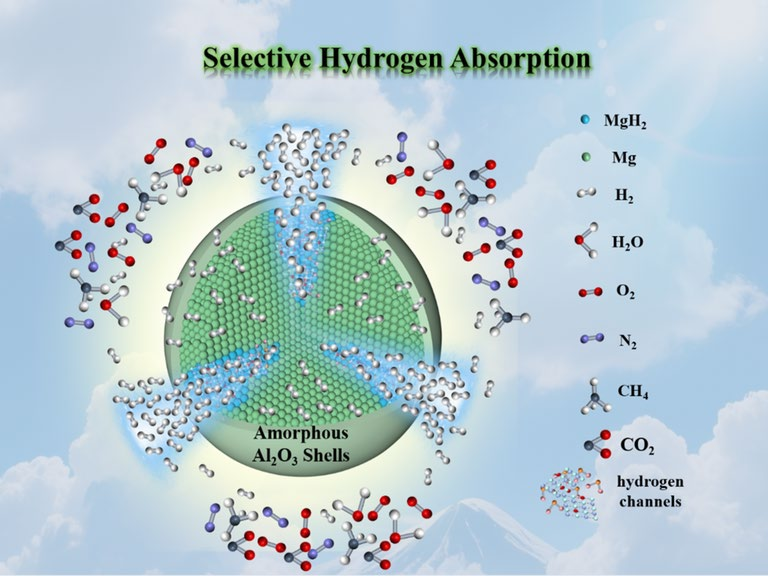

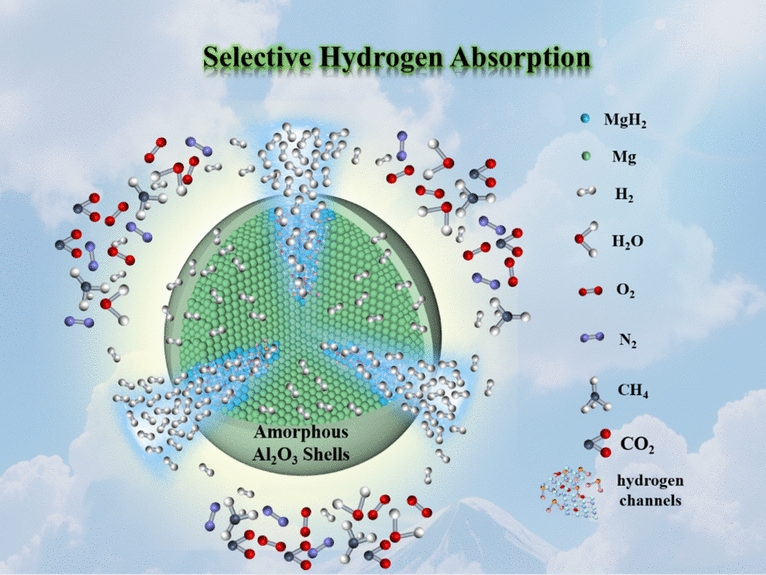

As hydrogen becomes a cornerstone of future clean-energy systems, practical solid-state storage must tolerate real, impure gas streams while retaining high capacity and fast kinetics. A research team led by Zhenyu Wang and Jinying Zhang (Xi’an Jiaotong University) reports a simple, effective solution: conformal, atomic-layer deposited amorphous Al2O3 shells (≈10 nm) on catalytically tuned MgH2–ZrTi particles (MgH2–ZrTi@Al2O3), which selectively admit H2 but block common contaminants (CH4, O2, N2, CO2) and deliver robust cycling and air stability.
Why Al2O3 Encapsulation Matters
- Selective adsorption: The amorphous Al2O3 shell permits rapid H2 permeation while preventing penetration or reaction of larger/more reactive species (CH4, O2, CO2), enabling hydrogenation from impure gas mixtures.
- Air stability: Coated particles show no detectable MgO or Mg(OH)2 after extended air exposure (months), a dramatic improvement over uncoated MgH2.
- Kinetics & capacity balance: The 10 nm shell preserves fast kinetics and high usable capacity by working in concert with internal Zr/Ti catalysts and hydrogen channels.
- Mechanical/chemical robustness: Amorphous shells remain intact after multiple de/re-hydrogenation cycles, supporting long-term operation.
Innovative Design and Features
- Atomic-layer engineering: Ultrathin, conformal Al2O3 layers were grown by ALD directly on MgH2–ZrTi particles, producing amorphous shells that are invisible in XRD but clear in TEM/elemental mapping.
- Synergistic core composition: MgH2 is modified with dispersed ZrO2 and few-layer Ti3C2 to create internal hydrogen channels and lower dehydrogenation temperatures (~185 °C onset for optimized composites).
- Mechanistic confirmation: MD simulations and experimental gas-uptake studies show H2 uniquely permeates the Al2O3 layer while other gases are adsorbed or shallowly intercalated, explaining observed selectivity.
- Operating window: Selective hydrogen uptake is achieved at moderate temperatures (75–125 °C), making solar-thermal or low-grade-heat charging feasible.
Key Performance Highlights
- ~4.79 wt% H2absorbed at 75 °C within 3 h under 10% CH4 + 90% H2; ~4.0 wt% absorbed at 100 °C in O2/CO2-containing mixes.
- Excellent cycling: ≈96.9% capacity retention after 30 cycles under impure H2; ~95.0% retention after 50 full de/re-hydrogenation cycles.
- No detectable oxidation products after months of air exposure for 10 nm coatings, while uncoated materials rapidly degrade.
Applications and Future Outlook
This ALD-encapsulation strategy opens a pathway to practical storage that accepts industrial/by-product hydrogen streams (e.g., coke-oven gas) without costly purification. Future work should explore scalable ALD workflows, alternative amorphous shell chemistries, and integration with system-level heat management for solar-assisted charging. This study presents a materials-level breakthrough toward deployable, selective, and air-tolerant hydrogen storage.

Editor of Nano-Micro Letters, which is an Open-Access, peer-reviewed journal reported papers that have at least one dimension ranging from a few sub-nanometers to a few hundreds of micrometers. The journal is published by Springer Nature and indexed by SCI, EI, SCOPUS, Pubmed, etc. The 2025 JCR Impact Factor is 38.5. The 2025 CiteScore is 58.9.
Follow the Topic
-
Nano-Micro Letters
Nano-Micro Letters is a peer-reviewed, international, interdisciplinary and open-access journal that focus on science, experiments, engineering, technologies and applications of nano- or microscale structure and system in physics, chemistry, biology, material science, and pharmacy.