Sustaining Precipitation Over India!
Published in Earth & Environment and Agricultural & Food Science


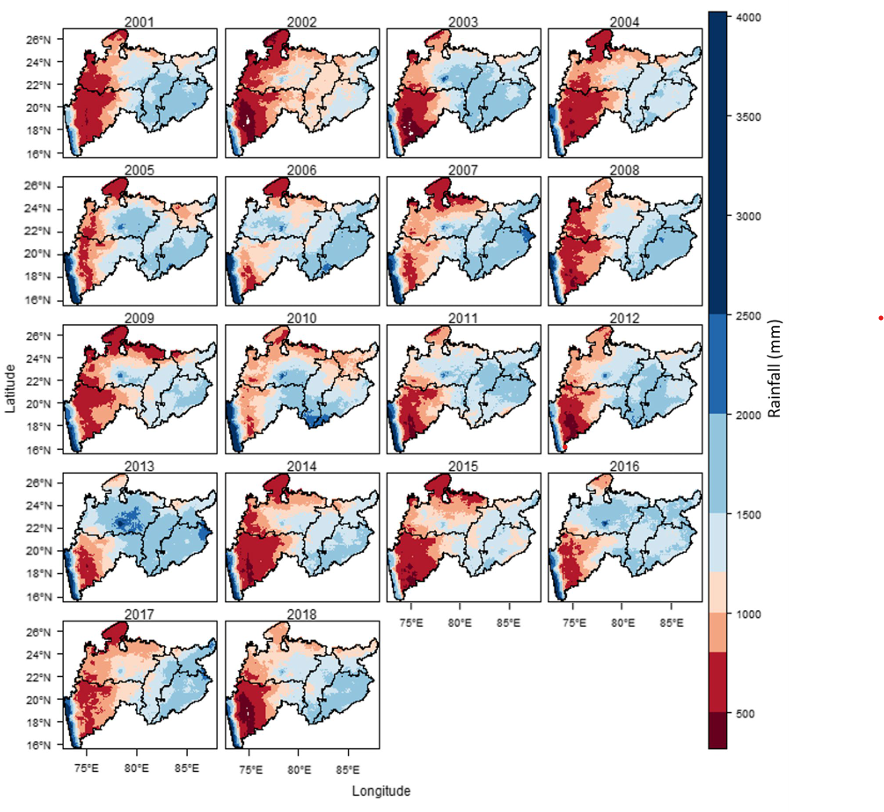
Huge population and High Water Demand need the sustainable presence of water. But major water sources in India are Rivers and monsoon rainfall. Ground water level is depleting fast, and hence monsoon rainfall is the only hope to renew the surface and underground water sources. But rainfall is becoming erratic. To sustain the rainfall over the Indian region, we need to understand the rainfall pattern first. Though various factors control rainfall occurrences one of the main factors as hypothesized in our research work is Forest Cover. For example, we have noticed that majority of the area in Maharashtra in the eastern aspect of Western Ghats are frequently facing droughts. Our Long term analysis of Rainfall revealed that lack of large area of Natural Forest cover could be the Major reason for this. We have proved that Forest attracts rainfall in our study. Also, one can see increasing trend of rainfall in the Rajasthan and Punjab area which has some link to the increasing Green Cover due to various Water Conservation Measures and Canals.
To verify the link between the presence of Forest and Rainfall we have taken the whole of Central India. Central India is a complex tropical forested landscape spread over five Indian states [Maharashtra (MH), Madhya Pradesh (MP), Chhattisgarh (CH), Odisha (OD), and Jharkhand (JH)], covering a total area of 986,580 sq. km, extending between 15–26° N and 72–88° E.
we investigated the dependence of the spatiotemporal distribution of rainfall on the spatial distribution of forests in the central Indian forested landscape. Specifically, in a natural experiment, we explored and compared quantitatively the spatiotemporal variability in rainfall
within (i) forested, (ii) adjacent non-forested, and (iii) agricultural regions. Furthermore, the aim was to measure the rate of change in rainfall in the presence and absence of forests across different buffer zones and the variability in rainfall in different elevations and density classes inside and outside forests. We used CHIRPS monthly rainfall data, MODIS normalized difference vegetation index (NDVI), vegetation continuous field (VCF), and ASTER elevation data to examine the inter-annual and monthly variability in rainfall in the different strata.
The published article can be seen at:
https://link.springer.com/article/10.1007/s00704-023-04582-2
Dr. Jeganathan Chockalingam has been working in the field of Geo-Spatial Science and Technology since 1993, and possesses vast teaching and research experience. He started his scientific career at the Regional Remote Sensing Service Centre (RRSSC, ISRO -Dehradun: 1993-1996), then worked at the Indian Institute of Remote Sensing (IIRS, Department of Space, Dehradun: 1996-2008) and then at the University of Southampton, United Kingdom (2008-2011). He is the recipient of Indian National Geospatial Award (2015) and Klaas Jan Beek Award (2003). He has participated and contributed in the development of various RSGIS educational programmes at IIRS. He has also contributed significantly in many National Mission Projects (involving RS-GIS) of ISRO and developed many software packages (to say few SPLAM, STAMP, ADAMS for ISRO, ICIMOD and IWMI respectively). He is working as a professor in the Department of Remote Sensing, Birla Institute of Technology, Mesra, Ranchi, India since 2011. His main research interests include Geoinformatics, Geostatistics, Space-Time Dynamics of Vegetation, Natural Resources Monitoring & Modelling, Spatial Decision Modelling and Downscaling.
Follow the Topic
-
Theoretical and Applied Climatology
Theoretical and Applied Climatology, founded in 1949, showcases latest and significant developments from global studies in climate, atmosphere, and meteorology. A successor to Meteorologische Zeitschrift, it carries forward the traditions of one of the world’s oldest meteorological journals.

Related Collections
With Collections, you can get published faster and increase your visibility.
Climate Extremes and Urban Resilience: Integrating Physical Process, Adaptation Strategies, and Socio-Economic Impacts
The increasing frequency and intensity of climate extremes, coupled with rapid global urbanization, creates an urgent need for integrated research that bridges physical climate science with urban planning and socio-economic analysis. This collection addresses the critical knowledge gap between understanding extreme weather processes and implementing effective urban resilience strategies, providing a platform for interdisciplinary research that can inform evidence-based adaptation policies and practices. The collection will advance interdisciplinary collaboration between climate scientists, urban planners, engineers, and social scientists, fostering methodological innovations in coupled human-natural systems research. It will contribute to improved urban climate modelling capabilities, enhanced understanding of climate-society interactions, and development of transferable adaptation strategies. The research will also inform international climate assessment reports and support evidence-based policy development for urban climate resilience. This collection primarily addresses urban climatology and applied climatology, with significant contributions from mesoscale meteorology, climate extremes research, and climate impact assessment. It encompasses urban boundary layer dynamics, heat island effects, precipitation patterns in urban environments, and the modification of extreme weather events by urban morphology, while integrating these physical processes with adaptation science and climate services.
Publishing Model: Hybrid
Deadline: Dec 31, 2026
Satellite-Enabled IoT Networks for Remote Environmental Monitoring
This topical collection focuses on the emerging role of satellite-enabled Internet of Things (IoT) networks in advancing remote environmental monitoring. Traditional ground-based monitoring systems often suffer from limited coverage, high infrastructure costs, and unreliable connectivity in remote or inaccessible regions such as forests, oceans, and polar areas. The integration of satellite communication with IoT technologies enables global-scale, real-time environmental data collection, supporting applications such as climate change monitoring, disaster prediction, biodiversity conservation, and smart agriculture.
Recent advancements in Low Earth Orbit (LEO) satellite constellations, nanosatellites, edge computing, and AI-driven analytics are transforming the feasibility and scalability of such systems. These technologies enable continuous, energy-efficient, and intelligent monitoring solutions capable of addressing environmental challenges worldwide.
This collection invites contributions on innovative architectures, algorithms, and applications, including hybrid satellite-terrestrial IoT systems, geospatial analytics, AIoT-based environmental prediction, UAV integration, and secure communication frameworks. The goal is to provide a platform for interdisciplinary research that supports sustainable environmental management and global resilience.
Publishing Model: Hybrid
Deadline: Sep 30, 2026


Please sign in or register for FREE
If you are a registered user on Research Communities by Springer Nature, please sign in