Teachers’ and students’ perceptions of online education in Bangladesh: challenges and solutions
Published in Behavioural Sciences & Psychology, Education, and Arts & Humanities


Article overview
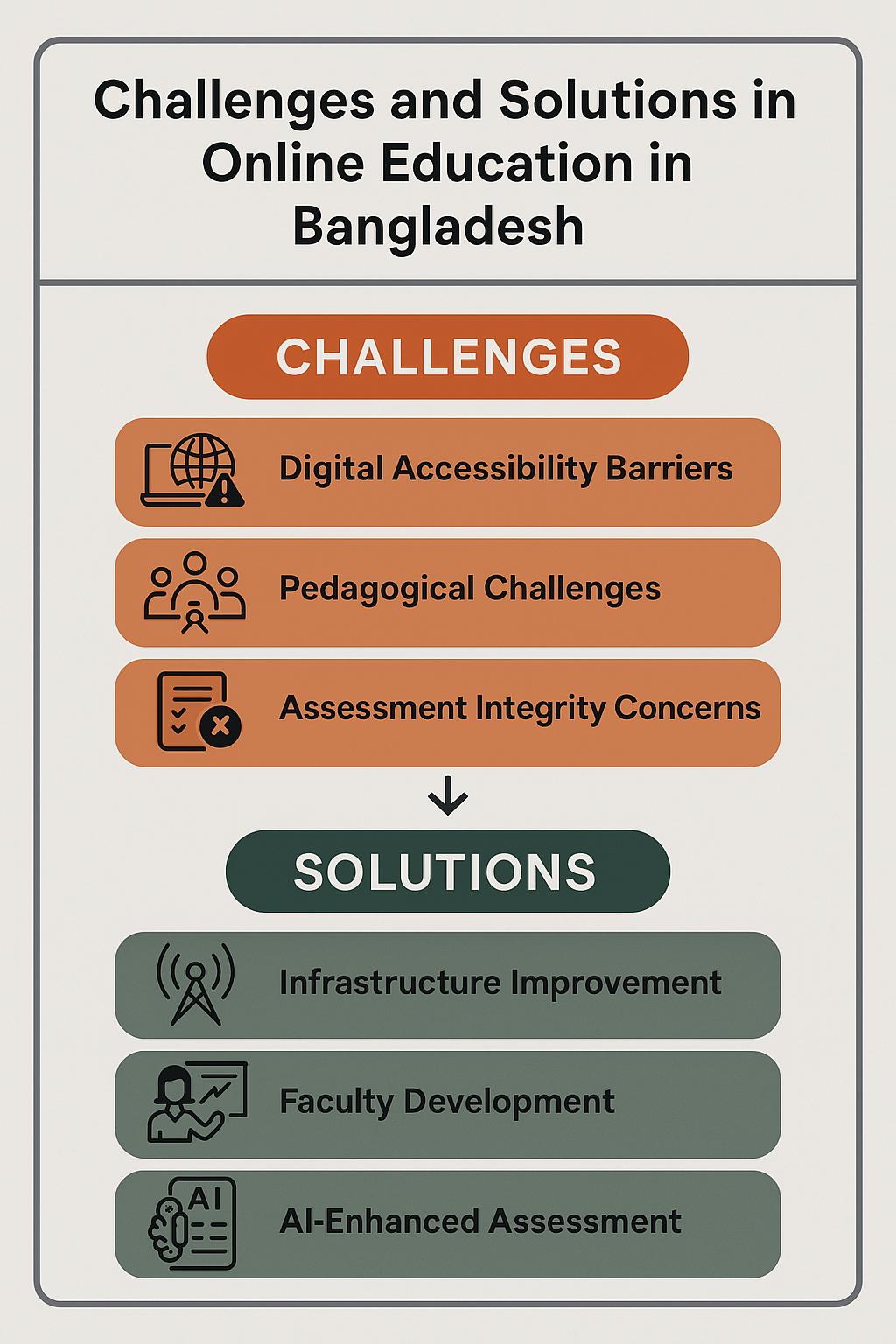
As online education becomes a key part of higher education worldwide, countries like Bangladesh still face major challenges—such as weak internet access, limited teacher training, and concerns about fair assessments. This carefully designed mixed-methods study, based on data from 130 participants in both urban and semi-urban universities, explores these issues in depth.
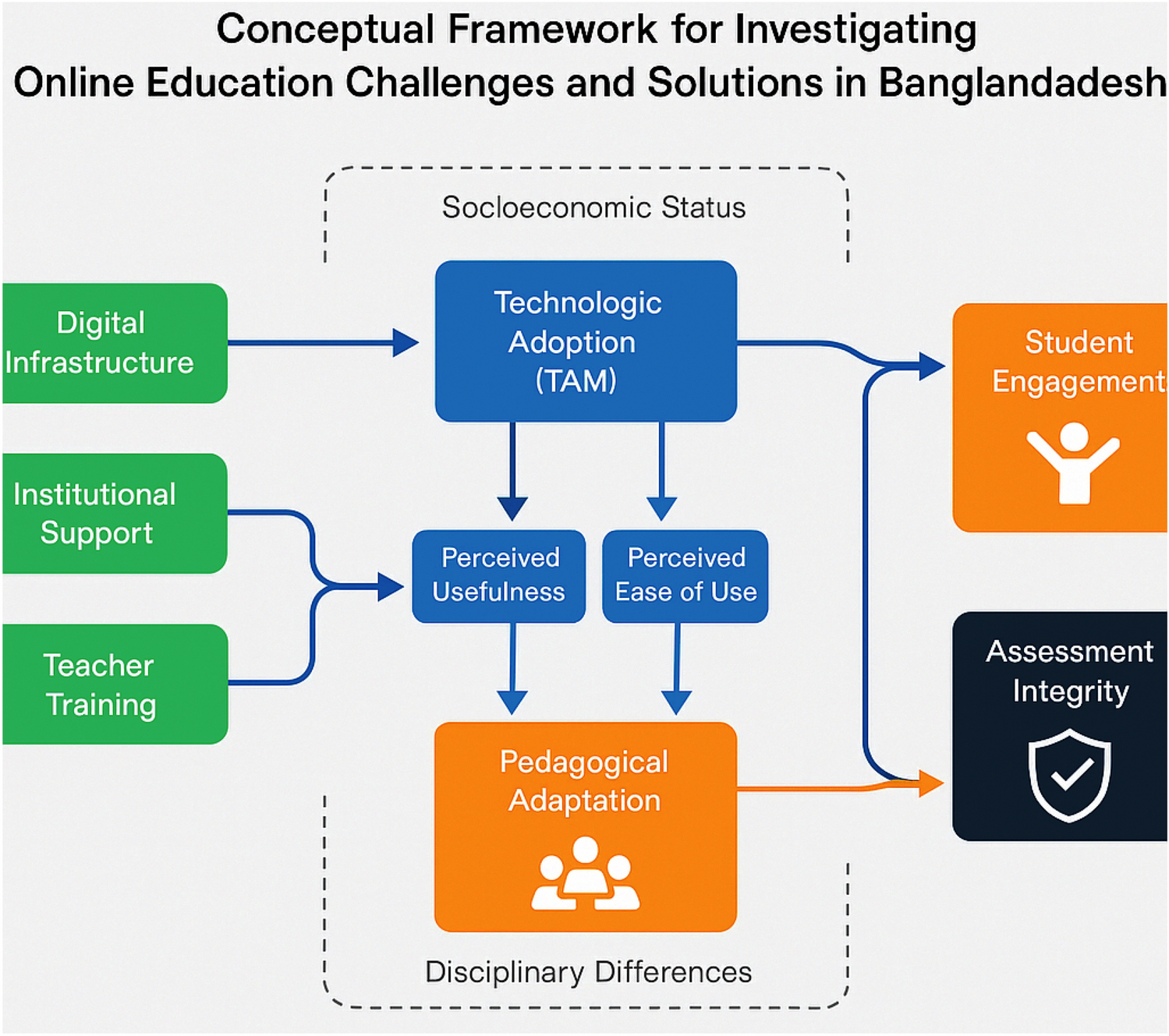
Using the Technology Acceptance Model (TAM), Digital Equity Framework, and Constructivist Learning Theory, the study identifies three main problems: poor digital access (especially in rural areas), low teacher confidence with online teaching, and unreliable online exams. Over 70% of rural students struggle with internet connectivity, and many teachers feel unprepared to teach online.
To solve these challenges, the study offers practical and well-researched solutions: set up hybrid learning centers in low-connectivity areas, provide proper digital training for teachers, and use blended assessments that include projects and oral tests. These ideas can help improve both university practices and national education policies.
All in all, this study supports a more inclusive and lasting model for online education in Bangladesh and offers valuable guidance for other developing countries facing similar issues.
The Journey Behind the Publication
The successful publication of this article marks the culmination of a long, emotional, and deeply personal journey—one shaped by unwavering dedication, relentless perseverance, and countless silent battles. Behind this academic achievement lies a story that only Allah and I truly understand—a story woven with sleepless nights, heartfelt prayers, and sacrifices that often went unseen.
This research did not emerge effortlessly. It endured more than 20 rejections—each one a test of my resolve, each one leaving a mark, but never breaking the spirit to continue. There were moments of deep discouragement, of self-doubt, and of questioning whether the effort would ever be recognized. But every setback became a lesson, every delay a step closer to refinement.
Throughout this process, I sacrificed time with loved ones, moments of rest, and personal comfort, all to ensure that this study would one day contribute meaningfully to the field. I held on to hope, to faith, and to the belief that sincere effort is never in vain.
Today, as this article finally finds its rightful place in the academic world, I am overwhelmed with gratitude. This success is not just a publication—it is a testimony to resilience, to faith, and to the quiet strength it takes to keep moving forward when the path seems uncertain.
This remarkable journey, filled with struggle and solitude, has finally met its beautiful end—with success.

SM Samuel Karim is an Assistant Professor and researcher in Applied Linguistics, with a specialization in English Language Teaching and educational technology. He has been serving at BGMEA University of Fashion and Technology (BUFT) since 2020. He obtained his BA in English (major in Language and Linguistics) from American International University-Bangladesh (AIUB), and his MA in English with a concentration in Applied Linguistics from Universiti Putra Malaysia (UPM), which is ranked 134th globally and 22nd in Asia according to the QS World University Rankings 2026.
He has been serving as a reviewer for the journal Educational Technology and Society (ET&S), affiliated with National Taiwan University, since November 2025. This high-impact, open-access journal is indexed in Scopus (Q1) and the Web of Science SSCI. In this role, he has reviewed a range of scholarly works, including research articles and book chapters. His research interests encompass artificial intelligence in education, discourse studies, syllabus design, and teacher education.
Research and Scholarly Contributions
He is an active researcher with multiple publications in reputable journals, newspapers and presented both national and international conferences. His scholarly work spans areas such as AI-driven learning, literary studies, applied linguistics, and research methodologies. His interdisciplinary perspective is further enriched by prior corporate experience, which enables him to integrate theoretical knowledge with practical applications. In his teaching, he effectively incorporates digital tools to foster dynamic and student-centered learning environments.
Ongoing Research Project
- Policing Manhood: Decolonizing Masculinity through Agbala Logic in Achebe and Contemporary South Asia (currently under review in a Scopus Q1-indexed journal).
Awards and Recognitions
- He was awarded First Place in the Islamic Competition Baitullar Chayay (2022), which included the opportunity to perform Umrah, funded by the As-Sunnah Foundation.
- He secured 4th place in Agent X, a national-level AI competition organized by NetCom Learning Bangladesh, for developing a high-quality chatbot, and received a mobile phone as an award, along with a Prompt Engineering certification from Microsoft (2025).
- He also received the Best Class Performance Award, achieving an A+ grade in the Advanced Computing course offered by Democracywatch.
He remains committed to continuous learning and academic collaboration, with a sustained focus on advancing research in language education and contributing to the intellectual development of students and the broader academic community.
Follow the Topic
-
Discover Education
An international, peer-reviewed open access journal that publishes original work in all areas of education, serving the community as a broad-scope journal for academic trends and future developments in the field.

Related Collections
With Collections, you can get published faster and increase your visibility.
Advancing Teaching & Learning: Integrating AI, Emerging Technologies, and Pedagogical Innovation
Collection "Advancing Teaching & Learning: AI, Emerging Technologies and Pedagogical Innovation" addresses a major challenge in education today. There is a lack of resources that bring advanced technologies and innovative teaching together. AI, digital tools and emerging technologies are transforming classrooms. Yet many teachers and education leaders struggle to use these tools effectively. This Collection fills that gap. It offers expert insights, practical strategies and real-world examples for modern teaching and learning.
The Collection is linked to the United Nations Sustainable Development Goal 4 on quality education. It shows how to make learning more accessible, inclusive and effective for all. AI, adaptive learning platforms and immersive technologies can personalise instruction. They can engage students and support diverse needs. At the same time, the human element of teaching remains central.
Readers will find practical guidance on curriculum design, digital literacy and evidence-based teaching methods. The approaches can be applied in classroom, blended and online learning. Beyond tools, the Collection inspires educators to rethink traditional methods. It encourages them to embrace innovation while keeping learning meaningful and student-focused.
By addressing the lack of comprehensive resources on advanced technologies, Advancing Teaching & Learning helps teachers, school leaders and instructional designers navigate the digital age. It equips them to create engaging, future-ready learning experiences. Students are prepared for a connected, digital world. Educators gain the confidence to unlock the full potential of every learner.
This Collection supports and amplifies research related to the United Nations Sustainable Development Goal 4 on quality education. It shows how to make learning more accessible, inclusive and effective for all. AI, adaptive learning platforms and immersive technologies can personalise instruction. They can engage students and support diverse needs. At the same time, the human element of teaching remains central.
Keywords: Teaching and Learning; AI in Education; Emerging Technologies; Digital Tools in Classrooms; Pedagogical Innovation; Adaptive Learning Platforms; Immersive Technologies; Quality Education (SDG 4); Classroom Innovation; Blended and Online Learning; Student Engagement; Teacher Professional Development; Future-Ready Learning; Instructional Design; Educational Technology Integration.
Publishing Model: Open Access
Deadline: Apr 15, 2027
Advancing Health Professions Education: Innovations, Strategies, and Global Perspectives
Health Professions Education (HPE) plays an important role in preparing competent, ethical, and compassionate healthcare professionals capable of responding to the complex demands of contemporary healthcare systems. In recent years, the field of HPE has witnessed a paradigm shift towards learner-centred, competency-based, and interprofessional education models that prioritize not only clinical expertise but also communication, professionalism, teamwork, and leadership skills.
This Collection invites original research, systematic or scoping reviews, case studies and brief reports and that critically examine the evolving landscape of HPE across medicine, dentistry, nursing, pharmacy, and other allied health disciplines. Key areas of interest include curriculum design and reform, innovative teaching and assessment methods, integration of digital and blended learning technologies, interprofessional education (IPE), faculty development, educational management, student support and well-being, and strategies to promote equity, diversity, and inclusivity in HPE.
We also welcome contributions that explore challenges and best practices in clinical training, rural and underserved community placements, global health education, policy development, accreditation, and institutional leadership in health education. Studies from low- and middle-income countries are strongly encouraged to enhance global representation and to promote scholarly exchange on scalable and contextually relevant innovations.
By consolidating scholarly work in this Collection, we aim to advance the discourse on high-quality, evidence-informed HPE that supports the achievement of Sustainable Development Goals (SDG 3 and SDG 4) and ultimately contributes to improved healthcare outcomes worldwide.
Publishing Model: Open Access
Deadline: Nov 30, 2026