The NASA Psyche Mission
Published in Astronomy
Explore the Research
 SpringerLink
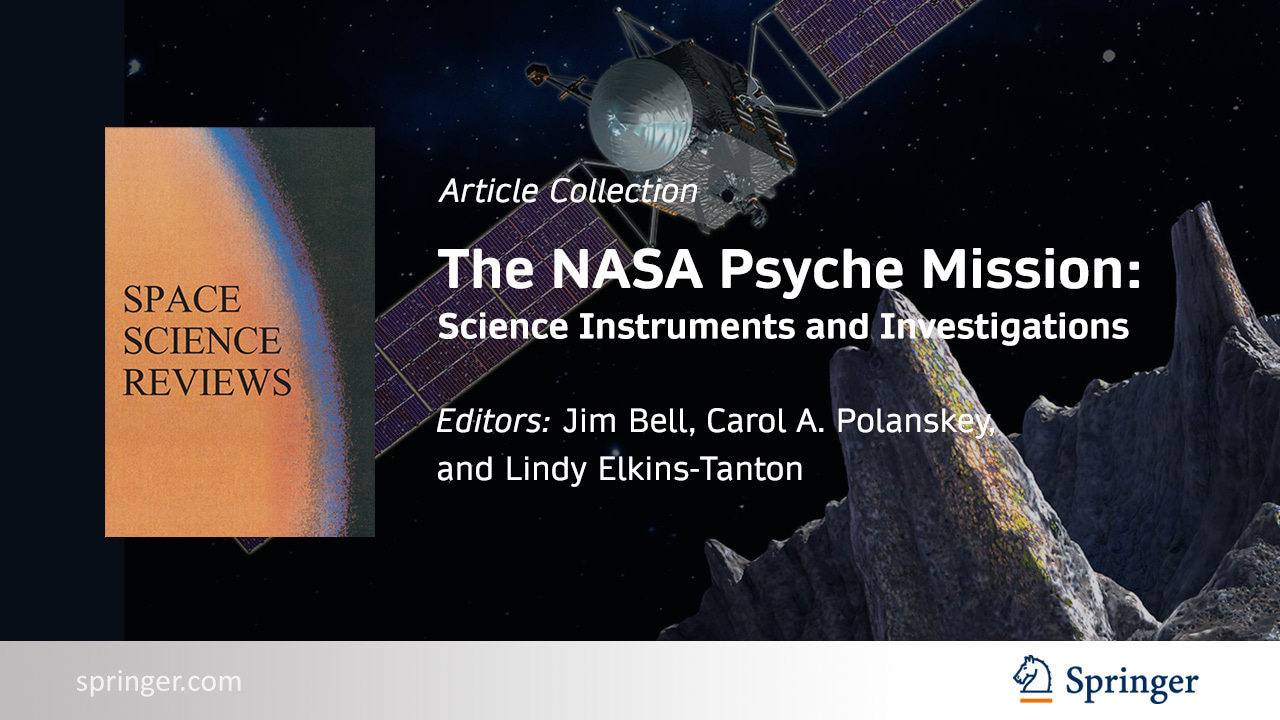
The NASA Psyche Mission: The First up-Close Exploration of a Metal-Rich World - Space Science Reviews
Space Science Reviews -
The main belt asteroid (16) Psyche was discovered in 1852. Over the more than 220 years since, astronomers have discovered that Psyche is the largest and most massive of the so-called “M Class” asteroids. Indeed, Psyche is now thought to singularly comprise roughly 1% of the mass of the main belt, and to have among the highest densities of any known asteroid.
After several years of design, reviews, fabrication, and testing, the Psyche spacecraft was finally launched into space from Kennedy Space Center on October 13, 2023, aboard a SpaceX Falcon Heavy rocket. At a high level, the Psyche mission is essentially a mission of exploration and discovery, designed to reveal for the first time the details of a class of solar system objects not yet seen up close – a metal-rich world.
This open-access topical collection of papers is intended to serve as the primary initial reference and starting point for readers to understand the background, motivation, and goals/objectives of the mission; the high-fidelity instrument investigations that are being used to achieve those goals/objectives; the details of the innovative spacecraft systems and operational processes that are taking those instruments to this interesting asteroid; and the detailed design of the mission that will be carried out there.
Please, start reading the editors' introduction: Bell, J.F., Elkins-Tanton, L. & Polanskey, C.A. The NASA Psyche Mission: The First up-Close Exploration of a Metal-Rich World. Space Sci Rev 222, 5 (2026). https://doi.org/10.1007/s11214-025-01255-6

Follow the Topic
-
Space Science Reviews

This is an international journal on scientific space research, with emphasis on scientific results and instruments in the fields of astrophysics, physics of planetary systems, solar physics, and physics of magnetospheres & interplanetary matter.



Please sign in or register for FREE
If you are a registered user on Research Communities by Springer Nature, please sign in