Toward the era of Quantitative Diagnostics
Published in Cancer

For millions of cancer patients worldwide until now, immunohistochemistry (IHC) remains the predominant method to assess protein biomarkers at tissue level in daily clinical practice. Admittedly, this method is great for cellular localization of the proteins. However, it is a mismatch for the quantitation of protein biomarker levels in clinical practice, and to a broad sense, in biomedical field at all. For one thing, this is at most a semi-quantitative method. To compensate, it requires a trained eyes to assess the results properly. No wonder it takes over 13 years for the standardization of Her2 levels for breast cancer patients alone 1. Yet until now, it is still troubled with many issues, requiring further help from Fluorescence in situ (FISH), which is so far the golden standard, yet not without its own issues as we discussed in the paper.
On the other hand, Enzyme Linked Absorbent Immunoassay (ELISA) has been widely used in daily clinical practice. It is simple, fast, objectively and reliable. More importantly, it requires minimum training to present most trustworthy results. Thus, this method can be used in all kinds of environments. It is especially useful for local hospitals and hospitals in developing countries, where the results of IHC analysis are questioned most often.
However, this method cannot be used to assess protein biomarkers at tissue level, as cancer tissues are persevered in Formalin Fixed Paraffin Embedded (FFPE) format in hospitals worldwide (You can find more information in the paper). Obviously, if we can develop an immunoassay like ELISA for protein biomarker assessment, it would greatly benefit the daily medical practice worldwide.
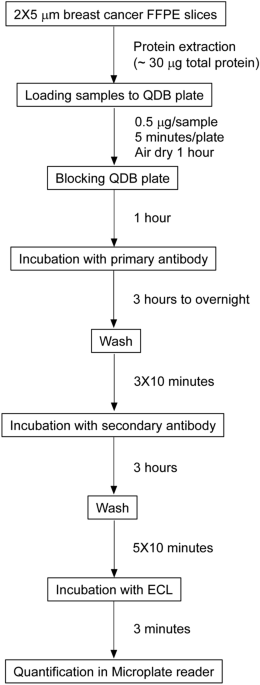
That is the rationale behind current study (https://rdcu.be/b5RNL), and indeed, the Quantitative Dot Blot (QDB)-based method allows objective quantitation of Her2 protein for breast cancer patients. The QDB method shares a lot of similarity with ELISA for daily clinical practice. It no long requires extensive training to present consistent and objective results to the clinicians worldwide. In fact, we have tested over 2000 clinical samples over the years, with over 95% concordance with IHC so far. It also eliminates the need of FISH analysis, as the results are either above (Her2+) or below (Her2-) our proposed cutoffs in QDB method.
Maybe the more significant part of this study is that we finally find the right platform (QDB) to develop the first immunoassay for absolute quantitation of protein biomarkers in FFPE specimens. In fact, using this platform, we have achieved absolute quantitation for over 10 protein biomarkers including Ki67, Cyclin D1, Estrogen Receptor (ER) and Progesterone receptor (PR) for breast cancer alone. With more suitable antibodies available in the future, we can easily extend this list much longer.
With the absolute quantitated protein biomarkers available, we finally have a practical tool to access one of the most valuable resources for cancer world: the enormous number of FFPE cancer specimens stored in the hospitals and medical institute all over the world. We may develop a first ever FFPE profile database using the expression levels of multiple protein biomarkers as a “fingerprint” to distinguish individual cancer specimens at population level2. We may also develop a brand new diagnostic method to achieve the ultimate goal of precision medicine-personalized medicine for cancer patients 3. We consider this study provides us the much needed key to a brand new field of Quantitative Diagnostics.

Follow the Topic
-
Scientific Reports
An open access journal publishing original research from across all areas of the natural sciences, psychology, medicine and engineering.

Related Collections
With Collections, you can get published faster and increase your visibility.
Phytochemicals and health
Publishing Model: Open Access
Deadline: Jul 28, 2026
Health Policy and Systems Research
Publishing Model: Hybrid
Deadline: Jul 14, 2026



Please sign in or register for FREE
If you are a registered user on Research Communities by Springer Nature, please sign in