Triboelectric Nanogenerators for Future Space Missions
Published in Bioengineering & Biotechnology and Materials
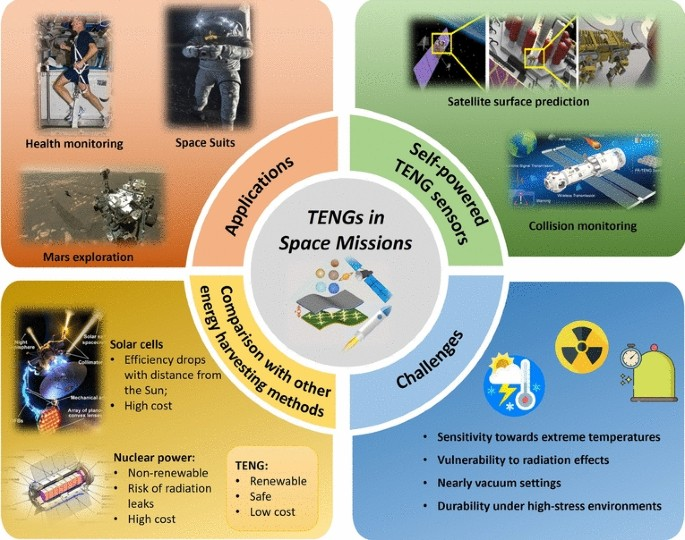

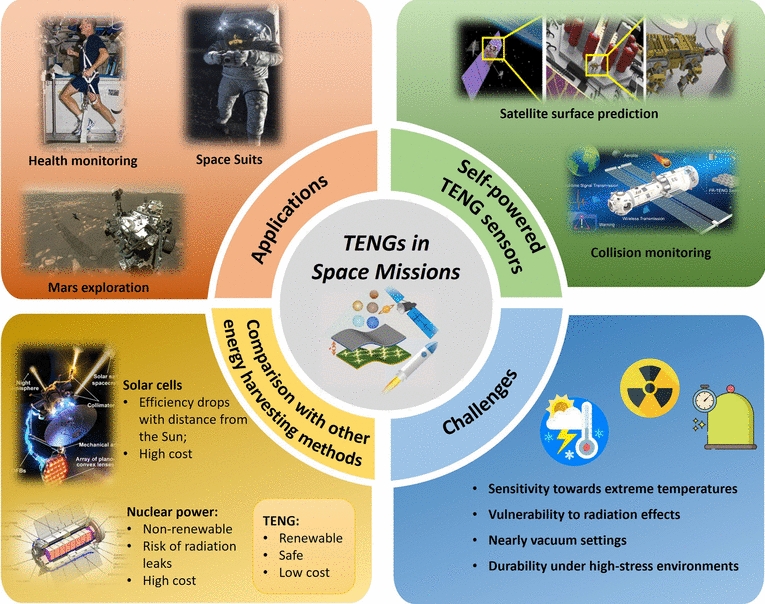

As spacecraft venture deeper into extreme environments (−270 °C to 1650 °C, 10-6 g, 5000 mSv), conventional solar, battery and nuclear sources reveal weight, radiation and eclipse limitations. Now researchers from Luleå University of Technology, Khalifa University and the University of Cambridge—led by Rayyan Ali Shaukat, Yarjan Abdul Samad and Yijun Shi—deliver the first panoramic review on triboelectric nanogenerators (TENGs) as lightweight, self-powered energy and sensing solutions for next-generation space systems.
Why TENGs Matter
• Energy everywhere – convert launch vibration, micrometeoroid impacts, astronaut motion and planetary wind into 10–100 mW m-2 without batteries.
• Extreme durability – PTFE/PDMS-based devices maintain 130 V, 8 µA output at −125 °C and 0.6 kPa Martian pressure; UV exposure boosts charge density by 157×.
• Dual function – same layer harvests power and acts as a self-powered sensor for real-time health, collision and dust monitoring, cutting harness mass by 30 %.
Innovative Design & Features
• Four working modes – contact-separation, freestanding, sliding and hybrid – matched to specific mission stimuli (crawl, flap, wheel, shaker).
• Space-grade stack – fluorinated polymers, MOFs, graphene and self-healing elastomers provide >260 °C tolerance, <5 % performance drift after 10 kGy radiation.
• mm-scale footprints – 9 cm2 patch delivers 98 V at 250 µm displacement; 3D-printable, foldable and whipple-shield-ready for Cube-Sat and EVA glove integration.
Applications & Future Outlook
• Planetary exploration – Mars-chamber validated TENGs power parachute dust-impact sensors, sustaining 12 mV signal after 100 dust collisions.
• Spacecraft health – bearing-embedded CL-TENG tracks flywheel micro-vibrations (1103 rpm) with 6 V output, enabling predictive maintenance without wiring.
• Manned systems – aerogel TENGs woven into suits generate 135 V, 6 µA from astronaut gait across −29 to 400 °C, feeding biometric sensors wirelessly.
• In-orbit robotics – cat-paw-inspired tribo-skins guide autonomous crawlers for truss assembly, while 3D-printed collision pods alert on 0.2 g debris strikes.
• Satellite links – Arctic-tested TENG buoys harvest wave energy (21.4 W m-3) to drive Iridium beacons at −40 °C, promising truly off-grid emergency comms.
Challenges & Opportunities
The review maps a roadmap spanning radiation-hardened MXene composites, AI-assisted digital twins, in-space 3D printing and hybrid TENG-TEG-solar architectures that together can close the power gap for smallsats, Artemis habitats and deep-space probes.

Editor of Nano-Micro Letters, which is an Open-Access, peer-reviewed journal reported papers that have at least one dimension ranging from a few sub-nanometers to a few hundreds of micrometers. The journal is published by Springer Nature and indexed by SCI, EI, SCOPUS, Pubmed, etc. The 2024 JCR Impact Factor is 36.3. The 2024 CiteScore is 53.1.
Follow the Topic
-
Nano-Micro Letters

Nano-Micro Letters is a peer-reviewed, international, interdisciplinary and open-access journal that focus on science, experiments, engineering, technologies and applications of nano- or microscale structure and system in physics, chemistry, biology, material science, and pharmacy.
Please sign in or register for FREE
If you are a registered user on Research Communities by Springer Nature, please sign in