




Nuclear fusion supplies the stars with the required energy to generate light. Marvelous benefits of fusion potential use are combined with the extremely challenging realization of fusion reactions in the laboratory. Conventional fusion approaches utilize mostly deuterium-tritium reactions occurring in a hot plasma (yielding one alpha particle and one neutron), as this scheme requires relatively low temperatures. However, complementary fusion schemes are potentially very attractive in various contexts. For example, the fusion reaction between a proton and the Boron-11 isotope gives off three alpha particles and involves only abundant and stable isotopes in the reactants. Moreover, this reaction is aneutronic, i.e. the reaction products contain almost no neutrons, strongly reducing unwanted effects such as radiation damage and activation of surrounding materials. Unfortunately, proton-Boron (pB) fusion is not currently achievable with conventional methods because of the ten-fold higher temperature required in comparison with the deuterium-tritium fuel. Luckily, the advancements in laser technology from the last decades offered a different approach to trigger pB fusion reaction which considers plasma conditions far from thermodynamic equilibrium. So, the interest of the scientific community in this matter was renewed: the high yield of alpha particles produced during the reaction is alluring not only for potential controlled fusion energy generation (advantageous electricity conversion) but also for multidisciplinary applications due to their useful energy range of several MeV.
In the last 15 years, a number of experiments focused on triggering the laser-driven pB fusion yield were carried out by different research teams, showing a steady increase in the emitted alpha yield. However, high-power, high-energy lasers have been used to accelerate protons from different H-rich targets to energies around 600 keV and above in order to reach the main resonance in the p-B reaction cross-section. Such energetic protons can interact with Boron either inside the laser-plasma (if the target contains both H and B elements, so-called “in-target” scheme), or using the beam-plasma approach (so-called “pitcher-catcher” scheme, where protons collide with Boron plasma). The produced alpha particle fluxes per shot are in principle sufficient for a number of applications, for example, highly-investigated proton-Boron capture therapy or the production of medical isotopes. Nevertheless, the limited repetition rate (single shot mode) of such large laser systems and their high level of complexity are not favorable for applications. Thus, new compact and cost-effective approaches have to be proposed.
On this ground, our team came up with an idea to try using the secondary resonance in the pB reaction cross-section: it is ten times less efficient and more narrow, therefore, it has not been much investigated in the laser-driven experiments so far. However, the proton energies corresponding to the secondary resonance are around 160 keV, which is four times less than required for the main one. This implies that less powerful laser systems can be exploited for the acceleration of protons, provided that the repetition rate of the laser system is increased, e.g. using kHz-class lasers.
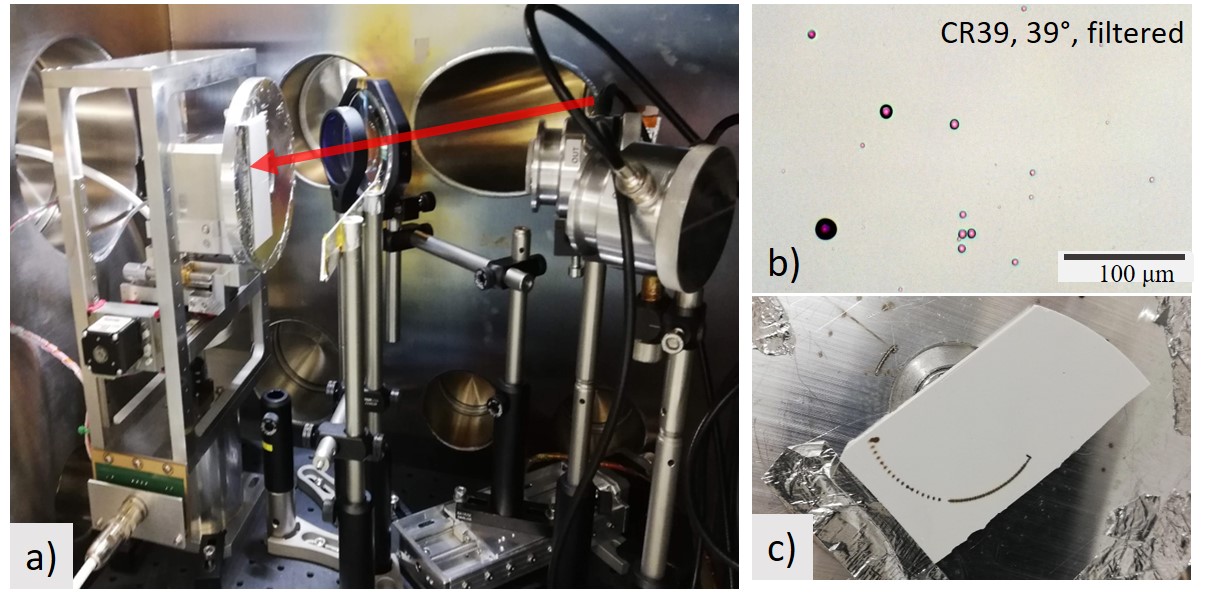
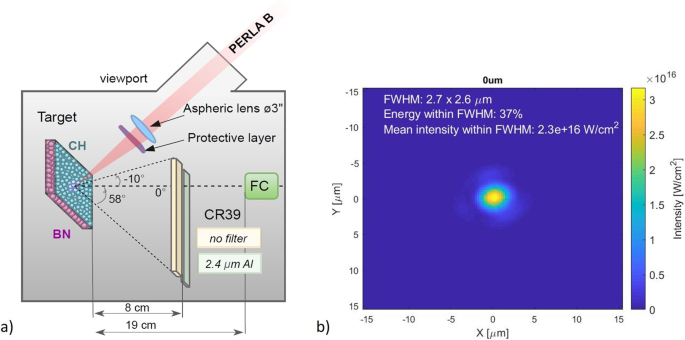
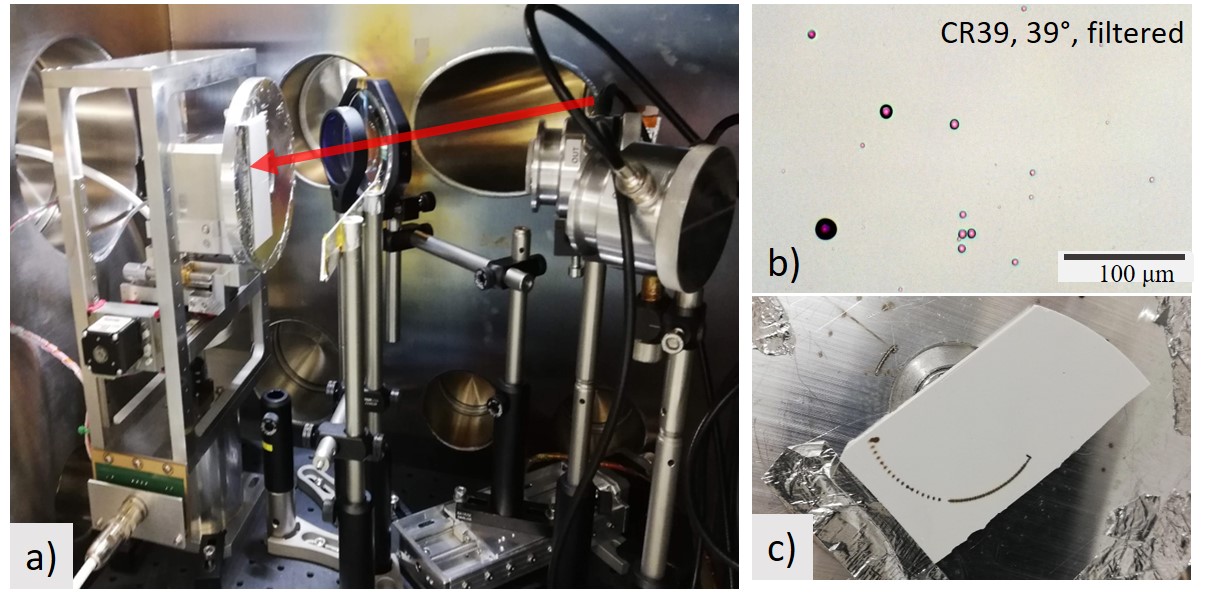
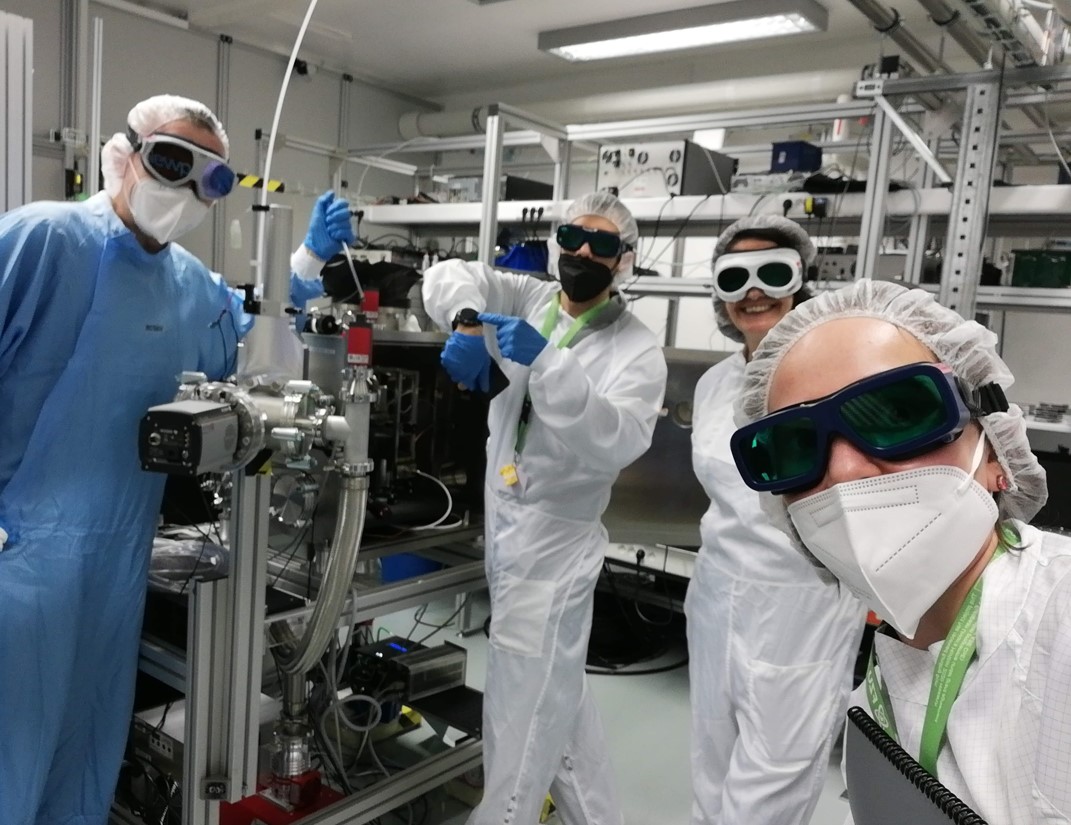
To test this idea, we organized an experiment at the HiLASE laser center, where a commercial tabletop PERLA laser is available, a high-repetition-rate (1 kHz, i.e. 1000 shots per second) GW-level system with ~1.5 ps long pulse duration. We decided to employ the “in-target” approach using a specially developed double-layered target containing H atoms deposited on the Boron substrate. By a combination of the laser and target setup, we were able to accelerate protons to the energy region around the secondary pB reaction resonance and measure alpha particles, products of the pB fusion reaction. The main diagnostics of alpha particles were solid-state nuclear track detectors CR39. We have tested our setup at both 1 Hz and 1 kHz repetition rates. Moreover, our team performed a combination of hydrodynamic and particle-in-cell simulations to investigate the physics behind the laser-target interaction in more detail, eventually supporting the experimental results. Figure 1 shows a photo of the experimental setup (a), an area of the etched CR39 detector with alpha particle tracks on it (b), and a photo of the target "smiling" after several shots. A photo of the part of our experimental team during the campaign is shown in Fig. 2.
In general, our proof-of-principle experiment has demonstrated the possibility of using a compact commercial moderate-power laser and a special H-B target to trigger the pB fusion reaction at a high-repetition-rate operating regime, providing a continuous flux of alpha particles. By optimizing the target delivery system at the kHz regime, it is possible to increase the alpha current above 106 particles/s at the PERLA laser. Moreover, with the update of the maximum available laser energy that is currently under construction, it will be possible to accelerate protons to the energies around the main resonance, hence implying a further enhancement in the average alpha particle current (expected up to 108-109 particles/s @ 1 kHz regime). Such an approach is expected to pave the way toward future applications of multi-MeV alpha particles produced from the pB fusion reaction triggered by the tabletop high-repetition-rate lasers.

Follow the Topic
-
Communications Physics
An open access journal from Nature Portfolio publishing high-quality research, reviews and commentary in all areas of the physical sciences.

Related Collections
With Collections, you can get published faster and increase your visibility.
Nonlinear dynamics of living systems
Publishing Model: Open Access
Deadline: Nov 09, 2026
Active, Entangled or Confined: Polymer Physics Across Synthetic and Living Matter
Publishing Model: Open Access
Deadline: Dec 31, 2026