Tunable Platform Capacity of Metal–Organic Frameworks via High‑Entropy Strategy for Ultra‑Fast Sodium Storage
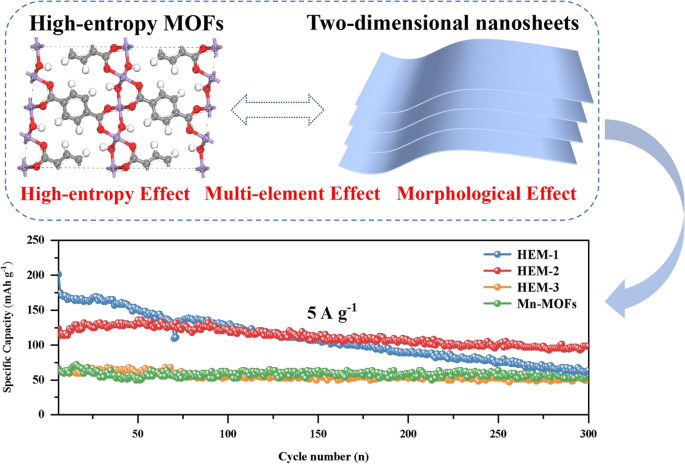



As the demand for high-power, high-safety energy storage surges, the sluggish kinetics and uncontrollable voltage plateau of conventional sodium-host anodes become ever more limiting. Now, researchers from the College of Chemistry and Chemical Engineering at Central South University, led by Prof. Guoqiang Zou and Prof. Xiaobo Ji, have delivered a comprehensive study on two-dimensional high-entropy MOFs that unlock record-fast sodium storage with precisely tunable platform capacity. This work charts a clear path toward next-generation sodium-ion batteries and capacitors that can charge in seconds without sacrificing energy density or safety.
Why High-Entropy MOFs Matter
• Platform Precision: High-entropy MOFs enable atomic-level tuning of voltage plateau and platform capacity, solving the “sloping-voltage” bottleneck of traditional carbon anodes.
• Entropy-Stabilized Kinetics: The configurational entropy effect lowers Na+ adsorption/migration barriers, delivering 89 mAh g-1 at an ultrafast 20 A g-1—far beyond conventional MOFs.
• Safety by Design: A 0.5 V plateau minimizes metallic Na deposition, cutting dendrite-related short-circuit risk and meeting stringent fast-charging safety standards.
Innovative Design and Features
• Material System: Five-metal (Mn-Co-Ni-Cu-Zn) 2D MOF nanosheets (≈1 nm thick) synthesized via one-pot solvothermal route; HE-MOF-74 structure verified by synchrotron XAS and ICP-AES.
• Entropy Engineering: DFT and XPS confirm Co/Ni/Mn participate in reversible redox, while Cu/Zn act as structural stabilizers, creating a synergistic multi-element network.
• Array Architecture: Ultrathin nanosheets self-assemble into porous lamellar electrodes, shortening ion diffusion paths and boosting surface pseudocapacitance (>80 % at 1 mV s-1).
Applications and Future Outlook
• Multi-Level Storage: Tunable Mn fraction (40–80 %) delivers plateau capacities from 0 to 122.7 mAh g-1, enabling high-density yet safe Na-ion full-cells (150 mAh g-1 at 0.1 C, 71 mAh g-1 at 20 C).
• Sodium-Ion Capacitors: Coupled with activated carbon, the device yields 99.4 Wh kg-1 at 200 W kg-1 and retains 33.3 Wh kg-1 even at 20 000 W kg-1—performance on par with state-of-the-art Li-ion capacitors.
• Challenges and Opportunities: The study pinpoints optimal Mn content (~60 %) for balanced capacity and cycling (84.6 % after 300 cycles at 5 A g-1). Future work will scale synthesis, probe long-term calendar life, and extend the entropy strategy to other MOF topologies for solid-state sodium micro-batteries.
This comprehensive investigation provides a materials-by-design roadmap for fast-charging, high-safety sodium storage. It underscores the power of high-entropy engineering in transforming insulating frameworks into elite electrode materials, and opens a new era for sodium-ion technologies. Stay tuned for more groundbreaking advances from Prof. Guoqiang Zou and Prof. Xiaobo Ji at Central South University!
Editor of Nano-Micro Letters, which is an Open-Access, peer-reviewed journal reported papers that have at least one dimension ranging from a few sub-nanometers to a few hundreds of micrometers. The journal is published by Springer Nature and indexed by SCI, EI, SCOPUS, Pubmed, etc. The 2025 JCR Impact Factor is 38.5. The 2025 CiteScore is 58.9.
Follow the Topic
-
Nano-Micro Letters
Nano-Micro Letters is a peer-reviewed, international, interdisciplinary and open-access journal that focus on science, experiments, engineering, technologies and applications of nano- or microscale structure and system in physics, chemistry, biology, material science, and pharmacy.