Ultra-Fast Synthesis of Non-Precious CoNiB₂ Catalysts for Water Oxidation

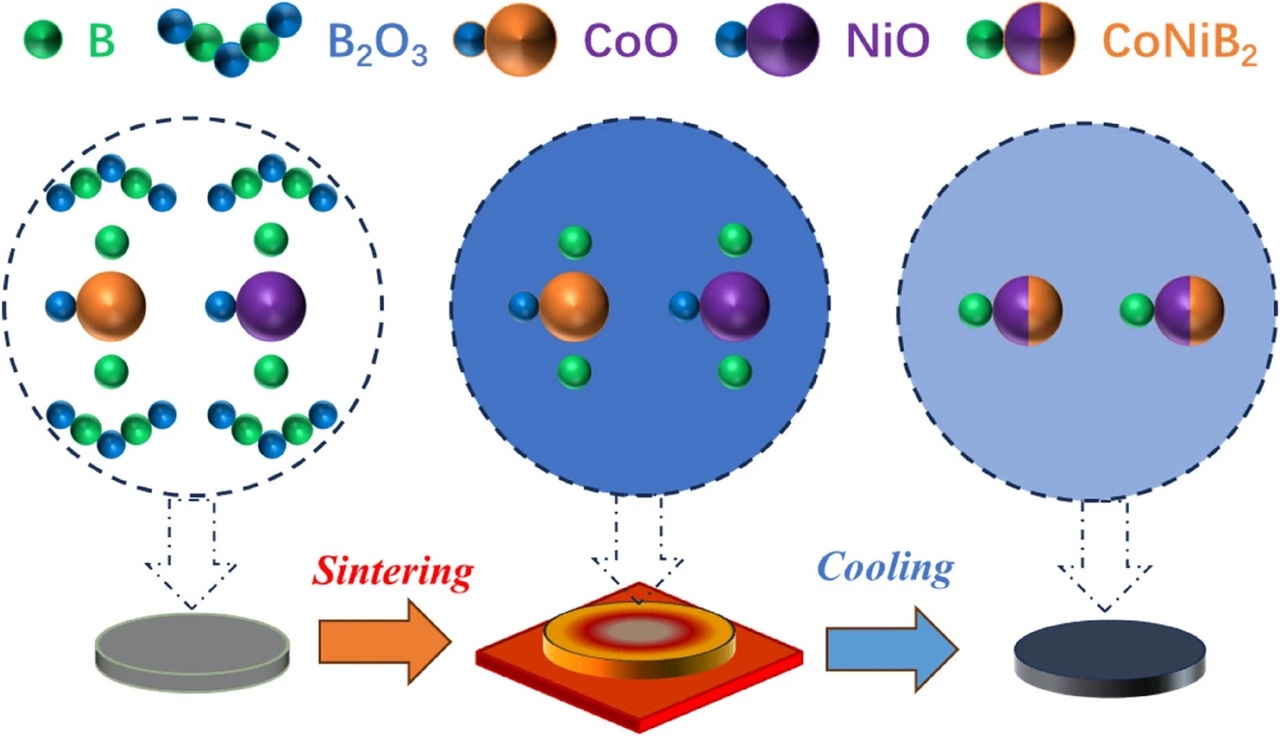
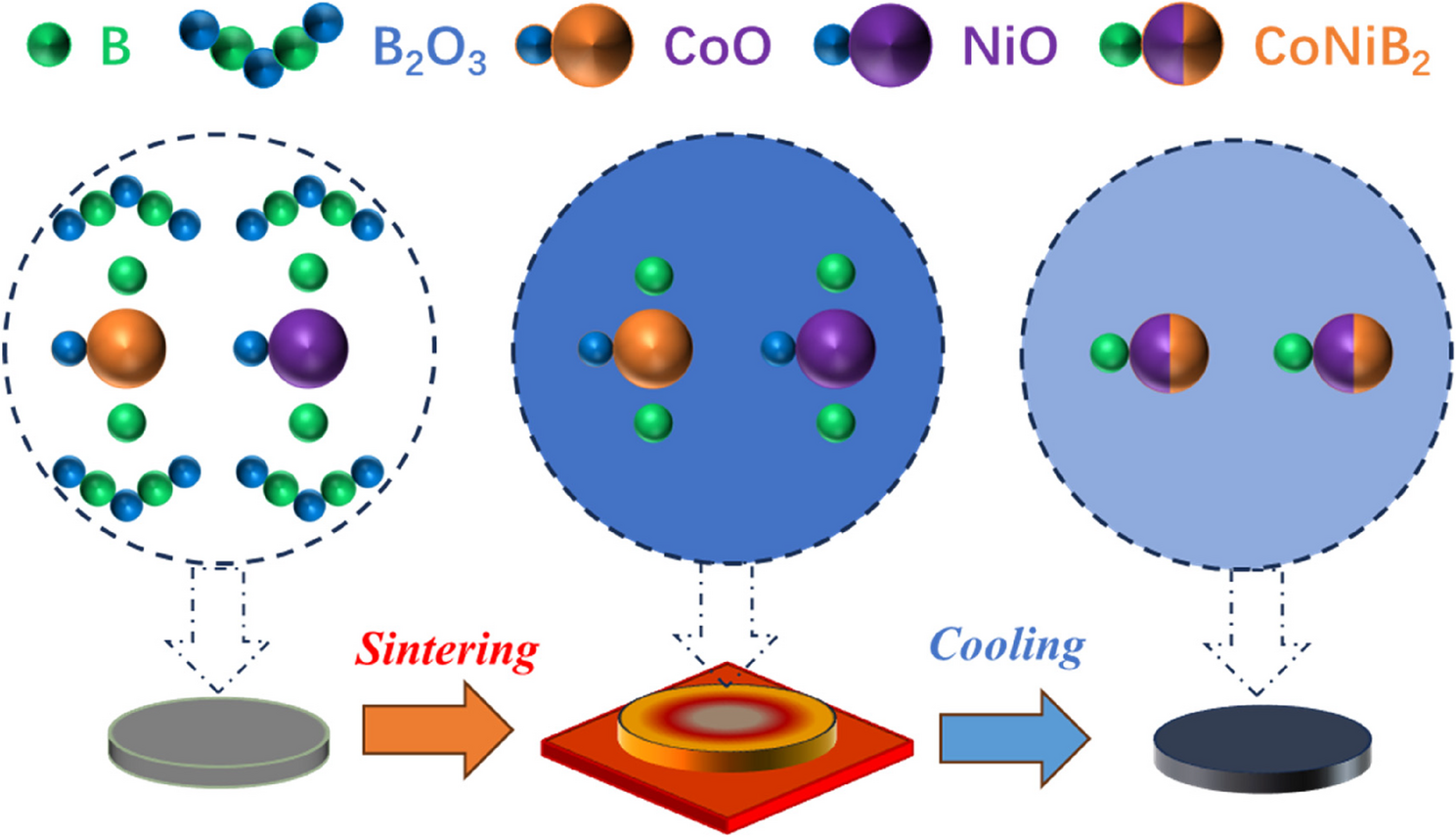

We present a rapid and scalable strategy for constructing a high-performance oxygen evolution reaction (OER) electrocatalyst based on cobalt–nickel boride (CoNiB₂). Using a liquid-phase soaking technology, crystalline CoNiB₂ nanoflowers can be synthesized within seconds from simple oxide precursors. This work demonstrates that efficient, durable and non-precious-metal OER catalysts can be produced through an ultra-fast and versatile synthesis route, offering new opportunities for green hydrogen production.
Key Insights
- Ultra-fast synthesis strategy: We developed a liquid-phase soaking technology that enables the synthesis of crystalline CoNiB₂ in just 20 seconds, showing that high-performance electrocatalysts can be obtained on an exceptionally short timescale.
- Liquid boron oxide as a transient reaction medium: Molten boron oxide acts as a temporary liquid phase that promotes rapid redox conversion of cobalt and nickel oxides into CoNiB₂ while limiting crystal overgrowth, yielding phase-pure products with controlled morphology.
- Nanoflower architecture with abundant active sites: The resulting CoNiB₂ forms nanoflowers composed of folded, edge-rich subunits, greatly increasing the electrochemically active surface area and facilitating efficient charge transfer during oxygen evolution.
- Outstanding oxygen evolution activity: In alkaline electrolyte, CoNiB₂ reaches 10 mA cm⁻² at an overpotential of only 271 mV, outperforming the benchmark RuO₂ catalyst at comparable loading.
- Fast reaction kinetics enabled by bimetallic synergy: A low Tafel slope of 67 mV dec⁻¹ indicates accelerated OER kinetics, arising from the synergistic electronic interaction between cobalt and nickel within the boride lattice.
- Excellent durability under high current density: The CoNiB₂ catalyst maintains stable performance during continuous operation at 100 mA cm⁻² for at least 25 hours, underscoring its robustness under industrially relevant conditions.
- Theoretical insight into performance enhancement: Density functional theory calculations reveal that CoNiB₂ exhibits a much lower energy barrier for the rate-determining step of OER than monometallic CoB, providing mechanistic insight into its superior catalytic activity.
Significance
This study shows that efficient and durable OER catalysts can be synthesized rapidly without relying on precious metals or complex processing routes. The ability to fabricate a high-performance bimetallic boride catalyst within seconds offers a practical pathway toward scalable catalyst production for alkaline water electrolysis and green hydrogen technologies.
More broadly, the liquid-phase soaking approach provides a general strategy for constructing nanoscale borides with tailored morphology and optimized electronic structure. This method can be extended to other boride systems, accelerating materials discovery in electrocatalysis and energy conversion.
Authors and Author Affiliations
Ruifeng Qi†, Junqi Liu†, Xiaohua Qiao, Tianyu Zhang, Qin Liu, Feng Gao, Qingsong Huang*
† These authors contributed equally to this work
School of Chemical Engineering, Sichuan University, Chengdu 610065, China
Tianfu Jiangxi Laboratory, Chengdu 610065, China
Corresponding Author: Qingsong Huang
Email: qshuang@scu.edu.cn
Follow the Topic
-
Catal

Catal is an open access journal covering full spectrum of catalysis critical advances. From biocatalysts to heterogeneous catalysts, it integrates fundamental and applied sciences. Catal offers a primary platform for researchers and practitioners in the field.
Related Collections
With Collections, you can get published faster and increase your visibility.
Bio-Catalysis in Circular Bioeconomy and Green Chemistry
This collection emphasizes the role of bio-catalysis in advancing the circular bioeconomy, focusing on enzymatic transformations and eco-friendly processes that valorize renewable feedstocks. Contributions should highlight innovative applications of bio-catalysis in waste-to-value systems, biorefineries, and green chemical synthesis.
Catal invites research articles, reviews and reports on the topic of the development of enzymes, metabolic engineering, and integration of bio-catalysis into industrial processes, aiming to reduce dependency on fossil-based resources and promote sustainable practices.
Publishing Model: Open Access
Deadline: Mar 31, 2026
Nanocatalysis and Thermocatalysis in Precision Chemical Synthesis
This collection, hosted by Catal, highlights the intersection of nanocatalysis and thermocatalysis in precision chemical synthesis. It aims to disseminate cutting-edge research that drives innovation in catalytic materials, selective processes, and reaction pathways, fostering advancements in the production of fine chemicals and specialty compounds. Aligned with Catal's mission to prioritize impactful catalytic applications, this collection welcomes contributions from established and early-career researchers that advance both theoretical and applied catalysis.
The collection embraces the breadth of Catal’s coverage, including topics such as nanostructured catalysts, thermocatalytic processes, and advanced synthesis strategies. Contributions may explore catalytic mechanisms, computational modeling, or experimental breakthroughs, offering insights into scalable industrial applications and fundamental research. Articles types—original research, reviews, perspectives, and analyses—are all encouraged, ensuring a diverse platform for sharing high-impact advancements in catalysis.
Publishing Model: Open Access
Deadline: Mar 31, 2026


Please sign in or register for FREE
If you are a registered user on Research Communities by Springer Nature, please sign in