Ultrafast Sulfur Redox Dynamics Enabled by a PPy@N‑TiO2 Z‑Scheme Heterojunction Photoelectrode for Photo‑Assisted Lithium–Sulfur Batteries
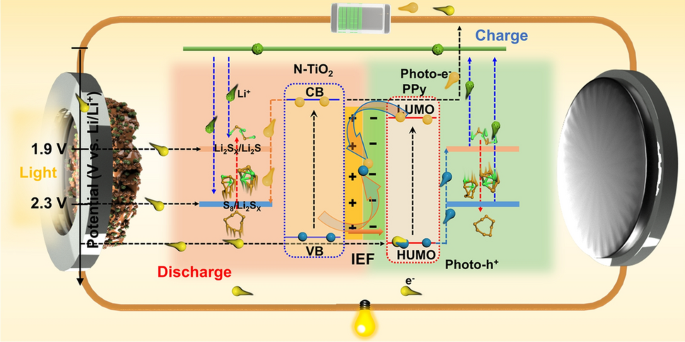
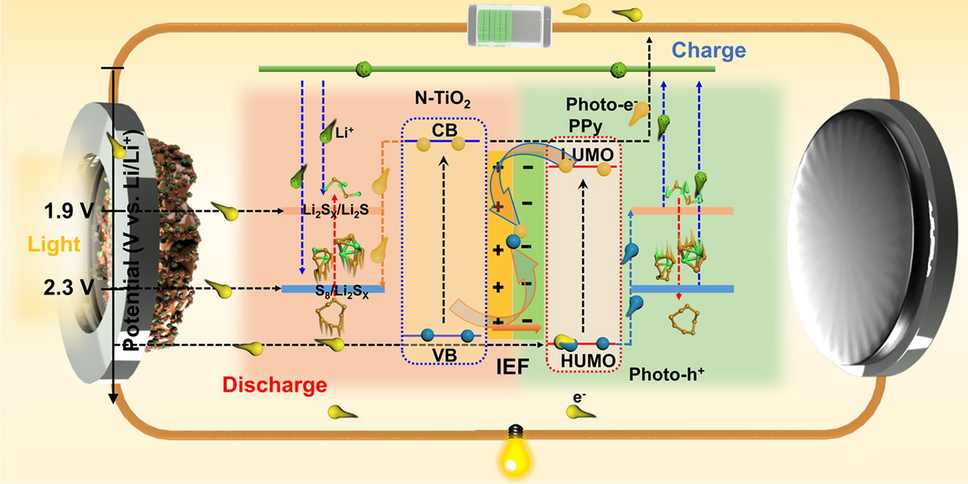

While lithium–sulfur batteries (LSBs) promise 2600 Wh kg⁻¹, the sluggish liquid-solid conversion of polysulfides keeps practical capacities far below theory. Now, researchers at Northwestern Polytechnical University, led by Prof. Yibo He, report a free-standing PPy@N-TiO2/Carbon-Cloth photocathode that harvests sunlight to co-drive sulfur redox, delivering 1 653 mAh g-1 (98.7 % of theory) and 333 mAh g-1 after 5 h of pure photo-charging. Published in Nano-Micro Letters, the work realizes dual-mode energy harvesting in a single cell.
Why Photo-Assisted Strategy Matters
- Polysulfide Bottleneck: Long-chain Li2S6/8 species shuttle and precipitate as electrically insulating Li2S, wasting active mass.
- External-Field Boost: Optical fields lower activation energy via photocatalysis, yet single-semiconductor electrodes suffer wide band-gaps and fast carrier recombination.
- Sun-in-Sulfur Vision: Integrating solar conversion and storage slashes grid demand during charging, ideal for high-altitude or off-grid devices.
Innovative Heterojunction Design
- Z-Scheme p–n Junction: Vapor-phase polymerized polypyrrole (p-type) coats N-doped TiO2 nanorods (n-type), building an internal electric field that separates e-/h+ pairs.
- Band-Engineered Alignment: narrowed gap (2.17 eV) extends visible harvest; CB electrons reduce S8→Li2S while VB holes oxidize Li2S→S8, closing a catalytic loop.
- Free-standing Architecture: 3-D carbon cloth offers 599 mAh g-1 at 4 C and 3.3 mAh cm⁻² under 3 mg cm-2 sulfur, mitigating volume swing and blocking shuttle.
Performance Breakthroughs
- Ultrafast Redox: Tafel slopes drop from 122 → 48 mV dec-1; Li2S nucleation time shortens from 3600 → 3010 s with 17 % higher capacity.
- Dual-Mode Harvesting: 0.33 % solar-to-output efficiency; coin cell powers toy car 288 cm under light vs 212 cm in dark, then 77 cm after 2 h re-charge under ambient sunlight.
- Long-term Stability: 61.7 % retention over 328 cycles at 0.5 C; DRT analysis shows illuminated cell maintains lower RSEI and RPS, suppressing parasitic reactions.
Future Outlook
The plug-and-play photocathode design is scalable through roll-to-roll vapor coating, pointing toward solar-assisted EV packs and stratospheric drones where every photon counts.

Editor of Nano-Micro Letters, which is an Open-Access, peer-reviewed journal reported papers that have at least one dimension ranging from a few sub-nanometers to a few hundreds of micrometers. The journal is published by Springer Nature and indexed by SCI, EI, SCOPUS, Pubmed, etc. The 2025 JCR Impact Factor is 38.5. The 2025 CiteScore is 58.9.
Follow the Topic
-
Nano-Micro Letters
Nano-Micro Letters is a peer-reviewed, international, interdisciplinary and open-access journal that focus on science, experiments, engineering, technologies and applications of nano- or microscale structure and system in physics, chemistry, biology, material science, and pharmacy.