Unlocking "Invisible Modes": How Metamaterials Help Catch the Dielectric Fingerprints of Cancer Cells
Published in Bioengineering & Biotechnology, Electrical & Electronic Engineering, and Materials





From Physics to Medicine
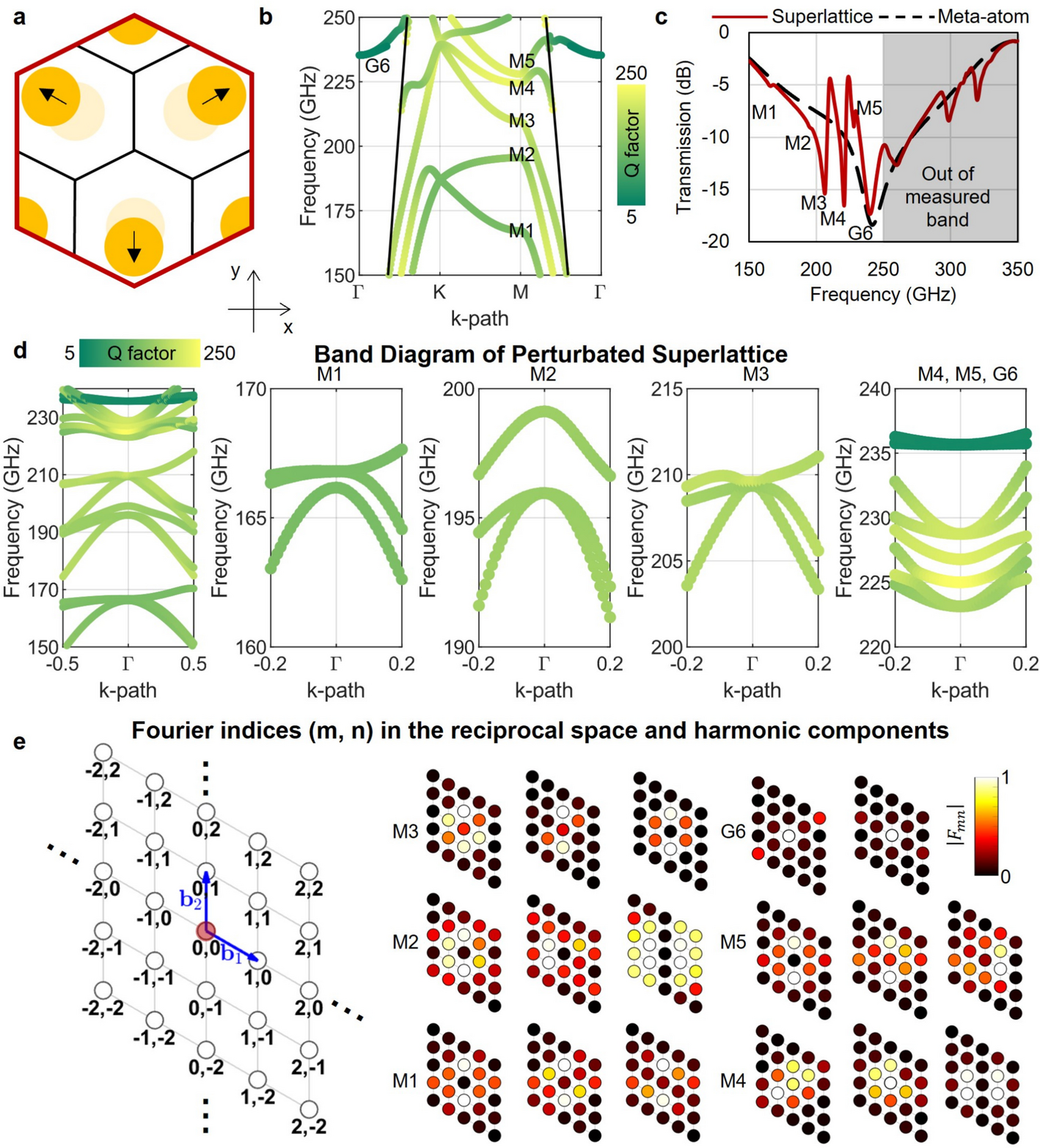
The origin of this research was not strictly biological; it began with a fundamental question in physics. As researchers in the field of electromagnetic metamaterials, Prof. Tie Jun Cui’s team at Southeast University has spent years studying the basic theory and various applications of metamaterials. We were fascinated by a specific phenomenon observed in superlattices: when a periodic structure is subjected to a structural perturbation, "band folding" occurs. In simple terms, modes that are usually "hidden" at the edges of the momentum space and thus invisible to free-space detection are folded back to the center. Suddenly, these invisible modes become radiative and detectable.
The "Aha!" moment arrived during a short conversation with Prof. Yang Shen from the School of Medicine at Southeast University. We were discussing the limitations of current biosensors. Traditional resonant structures typically rely on a single resonance peak to detect changes in a sample. Biological cells are incredibly complex; a single data point often fails to capture the subtle, intricate differences between a healthy cell and a cancerous one. We realized that the traditional sensors were essentially wasting a vast amount of spectral information. We asked ourselves: What if we could apply the physics of band folding to biological sensing? If we could engineer a device that "unfolds" these hidden modes, we could create a high-density multi-resonant platform. This would allow the waves to interact with the cells at multiple frequencies simultaneously, creating a comprehensive "fingerprint" rather than a single blurry pixel.
The Theoretical Hurdle: Predicting the "Bright" Modes
However, translating this concept into a functional device presented a significant theoretical challenge. While we knew that superlattice perturbations could fold bands, we initially struggled to find a suitable analytical method to predict which folded modes would actually be excitable. Not every mode folded to the center of the Brillouin zone becomes "bright" (radiative); many remain "dark" due to symmetry mismatches, making them useless for sensing.
For a time, we were unable to determine the excitability of these modes without running exhaustive and time-consuming full-wave simulations for every design iteration. The breakthrough came when we turned to Fourier series expansion to analyze the Bloch modes.
By decomposing the Bloch-periodic field distribution of the eigenmodes, we established a quantitative link between the mode's field profile and its radiation capability. We focused on the fundamental spatial harmonic (the zeroth-order component). Our analysis revealed that the intensity of this specific harmonic component acts as a direct indicator of the mode's coupling strength with normally incident plane waves. This mathematical tool served as our compass, guiding us to precisely design the structural perturbations that would maximize the radiative coupling of the hidden modes, turning them from invisible to visible.
Enhancing Interaction
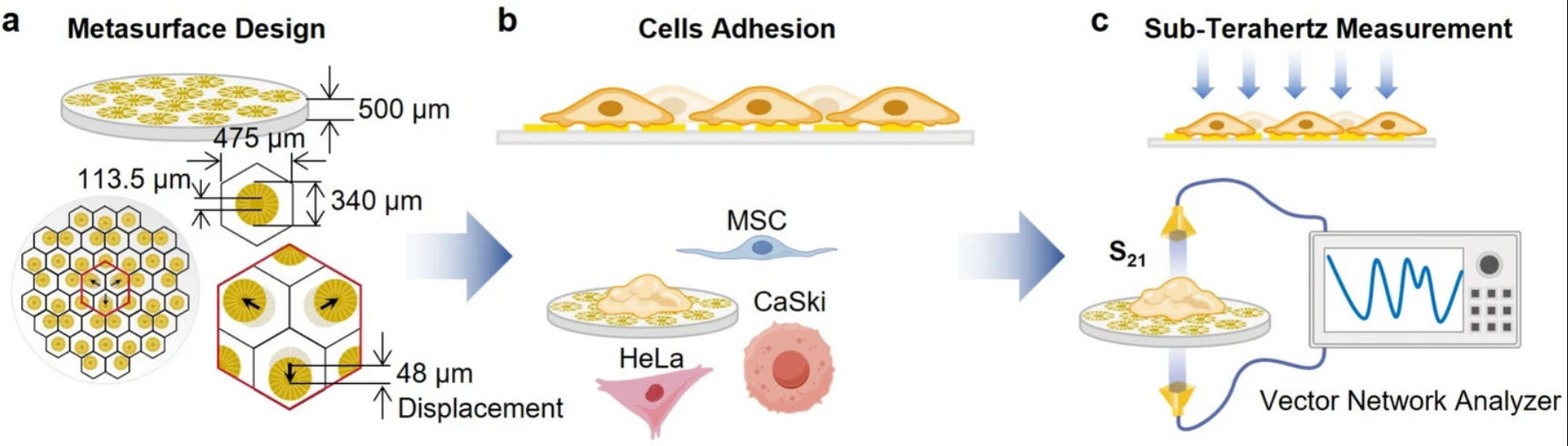
With the design guided by our Fourier analysis, our multi-mode sensor did not just see a shift; it captured a complex spectral signature. The high-density modes allowed for a significantly enhanced interaction between the wave and the cell body. We observed that the CaSki cells, which have the highest malignancy and biomass density, triggered the most distinct dielectric response, followed by HeLa and then the normal MSCs. We had successfully translated the microscopic "weight" of cancer into a macroscopic, readable electromagnetic signal.
This research is a testament to the power of interdisciplinary collaboration. By bringing fundamental physics into the realm of biomedicine, we have created a sensor that sees what traditional devices miss. We are not creating new light; rather, we are unfolding "invisible modes" to create a finer, more sensitive net to catch the elusive signals of early-stage cancer. We hope that this platform will pave the way for high-throughput, label-free phenotypic screening, helping to bridge the gap between benchtop physics and clinical diagnostics.
References to Paper: [1] Xu Z, Hua Y, Kong X, Wu H, Chang J, Wan B, Shen Y, Cui TJ. Band folding unlocks high-density hidden modes for sub-terahertz cancer cell phenotyping. PhotoniX. 2026 Jan 19;7(1):9. https://doi.org/10.1186/s43074-026-00229-3
Follow the Topic
-
PhotoniX
PhotoniX aims to present brave endeavors in promoting X-disciplinary research, latest progress of engineering applications and breakthroughs in scientific discoveries, all enabled by photonics. Original scientific letters, articles, reviews, and technology progress reports are equally welcome.

Related Collections
With Collections, you can get published faster and increase your visibility.
Photonics X Metaverse
Metaverse is a comprehensive concept because it is not a single technology, but an expansive, interconnected framework composed of multiple disciplines. Therefore, to fully realize the metaverse, it is necessary to integrate expertise from traditionally siloed fields. Photonics, among them, is acting as a powerful catalyst, driving waves of innovation across all layers of the metaverse hardware ecosystem. This special Issue aims to highlight the latest breakthroughs and insights at the intersection of metaverse and photonics and to foster continuous, cross-disciplinary dialogue and collaboration.
Scope:
Topic 1: Photonics-powered near-eye displays (magnifiers, birdbaths, waveguides, etc.)
Topic 2: Photonics-powered microdisplays (Micro LED, Micro OLED, LCoS, DMD, laser, etc.)
Topic 3: Photonics-powered three-dimensional displays (holography, light field, etc.)
Topic 4: Nanophotonics-powered lenses (freeform lenses, Fresnel lenses, pancake lenses, metalenses, contact lenses, etc.)
Topic 5: Biophotonics-powered bionics (bionic eyes, retinal implants, etc.)
Publishing Model: Open Access
Deadline: Dec 31, 2026
Solar Light-Matter Interactions: Energy Regulation, Conversion and Its Interdisciplinary Applications
The interaction between Solar Light and Matter constitutes a core foundational topic, covering interdisciplinary fields such as optics, energy science, materials science, environmental engineering, and biomedicine science. More critically, it serves as a pivotal technological breakthrough to address the pressing global energy crisis and mitigate climate change. Spanning from large-scale solar energy utilization (such as photovoltaic and photothermal conversion) to micro/nano-scale photon manipulation and interfacial energy transfer, research in this field has steadfastly embraced the multiple mission of "decoding the inherent laws governing natural energy exchange and empowering human sustainable development and health security." Driven by the rapid advancement of micro/nanofabrication technologies, metamaterial design, photonics theories, and biosensing technology, human understanding of solar light-matter interactions has evolved beyond traditional macro-phenomenon observation to the precise regulation of mechanisms at the atomic, quantum and biomolecular levels. This paradigm shift has spawned a series of transformative advances, including plasmonic enhancement effects, metamaterial-based spectral selective control, directional interfacial energy transfer and cross-scale photobio regulation—innovations that have opened up entirely new technical pathways for high-efficiency solar energy utilization, radiative cooling, environmental remediation, and related fields. Nevertheless, the field still grapples with numerous critical scientific challenges and technical bottlenecks: the multi-physics coupling mechanisms governing underlying solar radiation and energy transfer at the micro/nano scale remain incompletely elucidated; the large-scale fabrication, long-term stability and biocompatibility of high-efficiency energy conversion devices are insufficient to meet practical application demands; and the depth and breadth of interdisciplinary technological integration require further enhancement. This Special Issue aims to systematically synthesize cutting-edge theoretical achievements and technological breakthroughs in this domain, construct a robust bridge between basic research and engineering applications, and assemble top-tier global researchers to collectively tackle core challenges. By providing academic support for technological innovation in key areas such as high-efficiency solar energy utilization, radiative cooling, environmental governance and life and health, it will contribute to green and low-carbon development under the "dual carbon" goals, which holds significant academic value and profound practical implications.
Scope:
Topic 1: Fundamental physical and chemical mechanisms underlying solar light-matter interactions
Topic 2: Design, fabrication, and solar radiation regulation performance of micro/nanostructures (e.g., metamaterials, plasmonic materials, porous materials)
Topic 3: High-efficiency solar photothermal/photovoltaic conversion devices and systems
Topic 4: Daytime radiative cooling materials, devices, and their engineering applications
Topic 5: Applications of solar energy conversion technologies in water treatment, environmental remediation, building energy efficiency, and other related fields
Topic 6: Research on the photothermal dynamic regulation mechanisms between solar light and organisms (including humans and other mammals, etc.)
Publishing Model: Open Access
Deadline: Ongoing