Unmasking Hong Kong's Food Price Puzzle: The Hidden Asymmetry of Oil Shocks
Published in Social Sciences, Agricultural & Food Science, and Economics






The Vulnerability of an Imported Diet
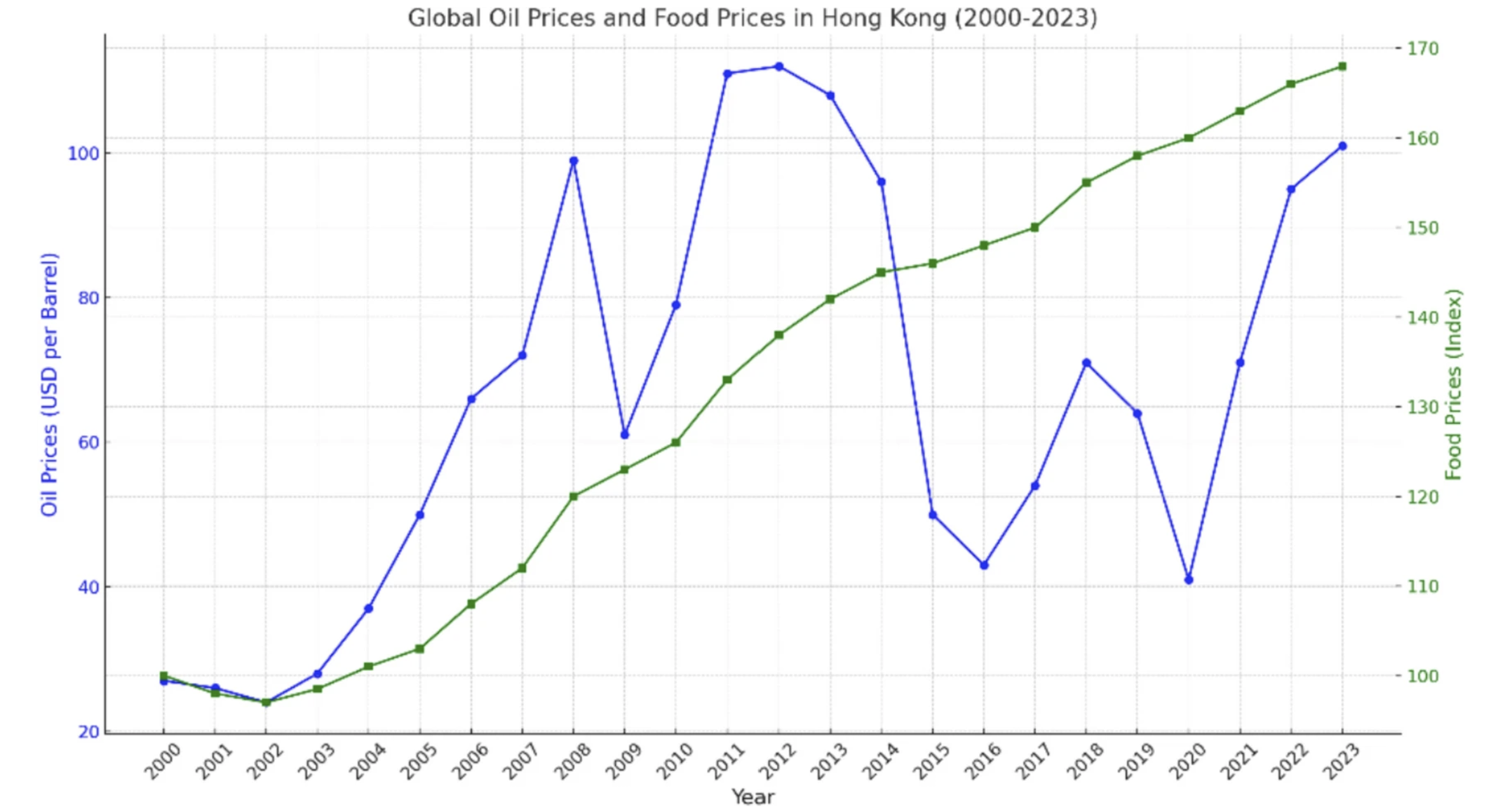
Hong Kong’s near-total reliance on imported food makes it a canary in the coal mine for global supply chain risks. With households spending over 27% of their income on food, even small price fluctuations hit hard. Yet little research existed on how oil volatility—a key driver of transport and production costs—specifically affects such hyper-urbanized economies.
We tackled this gap using Nonlinear Autoregressive Distributed Lag (NARDL) modeling, a method that captures asymmetries traditional models miss. By analyzing 33 years of data (1990–2023), we separated the effects of oil price increases and decreases—something linear approaches can’t achieve.
The Shock That Lingers
Short-term vs. long-term effects
Our most striking finding? Oil price swings barely dent Hong Kong’s food costs in the short term. Why?
- Competitive buffers: Importers absorb shocks through hedging and long-term contracts.
- Logistical agility: Port efficiency delays pass-through to shelves.
But the long run tells a different story:
- +10% oil prices → +0.16% food prices
- -10% oil prices → -0.20% food prices
This asymmetry—where price drops help consumers more than hikes hurt them—stems from:
- Downward rigidity: Retailers resist lowering prices until oil falls significantly.
- Supply chain leverage: Importers renegotiate contracts more aggressively when costs fall.
Beyond Oil: The Hidden Levers
While oil shocks dominate headlines, we found other critical forces:
- Global food prices (+0.39% impact): Directly amplified in local markets due to import dependence.
- Interest rates (-0.09% impact): Higher rates reduce consumer demand, indirectly lowering food costs.
- Fertilizer costs (insignificant): Remoteness from farming dilutes this effect—unlike in agrarian economies.
Policy Insights for Fragile Food Systems
For cities like Hong Kong, our findings demand:
🚢 Diversified import corridors: Reduce vulnerability to single-route oil volatility.
⚡ Energy-efficient logistics: Electrify ports and transport to decouple from oil markets.
📉 Dynamic subsidy triggers: Activate support when oil rises but adjust slowly when it falls (matching the asymmetry).
Why This Matters Globally
As climate change and conflicts disrupt supply chains, urban centers worldwide mirror Hong Kong’s fragility. Our NARDL approach offers a template to:
- Predict which shocks will actually reach consumers.
- Design policies that exploit asymmetric responses (e.g., strategic reserves when oil falls).
Read the full study: Agriculture & Food Security
https://link.springer.com/article/10.1186/s40066-025-00541-4;
https://doi.org/10.1186/s40066-025-00541-4
Follow the Topic
-
Agriculture & Food Security
This is a peer-reviewed open access journal that addresses the challenge of food security.

Related Collections
With Collections, you can get published faster and increase your visibility.
Strategies for Balancing Security and Sustainability of Agri-Food Systems
This collection explores the complex interplay between agri-tech innovation, sustainable resource management, market participation, and multi-level governance frameworks in shaping resilient food systems. It aims to bring together interdisciplinary research examining how regions such as the African Union and the European Union are navigating the transition toward sustainable, digitally enabled agri-food sectors. Central to this collection is the question of how nations and agricultural stakeholders can balance resource efficiency with productivity gains while maintaining environmental integrity and social equity. Emerging technologies, ranging from precision agriculture and biotechnology to digital supply-chain tools, are promising, yet their adoption requires careful consideration of accessibility, scalability, and regional policy environments. The collection also emphasizes the importance of food preparedness, encompassing early-warning systems, risk-mitigation strategies, and adaptive governance structures capable of responding to shocks such as supply disruptions, extreme weather events, and geopolitical pressures. Topics of interest include, but are not limited to:
- Agri-tech innovation for resilient and climate-smart agriculture
- Comparative policy frameworks: African Union and European Union approaches to food security
- Resource efficiency in agri-food systems: water, energy, soil, and biodiversity
- Digital transformation and precision technologies in smallholder and industrial farming
- Food preparedness and early-warning systems for supply-chain disruption
- Governance, regulation, and cross-regional cooperation in sustainable agri-food productivity
- Socio-economic implications of technology adoption and market participation in agriculture
- Integrating circular economy principles into agri-food value chains
- Risk assessment and resilience-building for environmental and market shocks
This Collection supports and amplifies research related to SDG 15: Life on Land.
All submissions in this Collection undergo the journal’s standard peer review process. Similarly, all manuscripts authored by a Guest Editor(s) will be handled by the Editor-in-Chief. As an open access publication, this journal levies an article processing fee (details here). We recognize that many key stakeholders may not have access to such resources and are committed to supporting participation in this issue wherever resources are a barrier. For more information about what support may be available, please visit OA funding and support, or email OAfundingpolicy@springernature.com or the Editor-in-Chief.
Publishing Model: Open Access
Deadline: Jan 29, 2027

