Using Machine Learning to Explore the Impact of Physical Activity on Cancer Development in Golden Retrievers
Published in Cancer, Computational Sciences, and Zoology & Veterinary Science







How many dogs will die from cancer?
Approximately 1 in 4 dogs will die from cancer. For certain breeds, such as Golden Retrievers, that risk increases to about 1 in 2.
Can we prevent this high cancer rate?
That is a multifaceted question, and there is no single or simple answer. Canine cancer develops due to complex interactions involving genetic factors, DNA mutations, environmental exposures, and lifestyle choices made by the owners.
This study focuses on one small—but important—aspect of the lifestyle choices of the owners, the physical activity or exercise that they provide to their Golden Retrievers.
Why did we focus on Golden Retrievers?
A better question is, are you familiar with the Golden Retriever Lifetime Study (GRLS)? Launched in 2012 by the Morris Animal Foundation (MAF), GRLS was the first prospective longitudinal study in veterinary medicine. More than 3,000 Golden Retrievers have been enrolled.
Each year, the enrolled Golden Retrievers receive a yearly physical by a veterinarian and have samples such as blood and feces collected for researchers. Additionally, each year the owners and veterinarians fill out detailed surveys. These surveys and medical records provide a rich source of "big data" that offers researchers the ability to helps researchers explore links between lifestyle, environment, and disease—like cancer.
This incredible dataset had never been analyzed using machine learning, until now.
Who was involved in this project?
As a veterinarian trained in data science and analytics, I believe it’s vital to involve veterinary students in research that uses machine learning, artificial intelligence, and other data-driven methods. One of my goals is to help graduate veterinarians and veterinary students understand the value in learning these techniques and how the techniques can help enhance veterinary care within their veterinary clinics and on a wider-population level.
With this in mind, I recruited Dennis, a second year veterinary student to work on this project. He played a key role in developing the study aims and hypotheses, and received a MAF Veterinary Student Scholarship to support his role in the study.
Why did we focus on physical activity?
The GRLS provides access to numerous datasets derived from the owner surveys and medical records of the enrolled dogs, while we explored the datasets and the canine cancer literature, we noticed a gap: few—if any—studies had explored how exercise might influence cancer risk in pet dogs.
We saw this as an opportunity to investigate this area. Specifically, our hypothesis was that the frequency and duration of activity—especially more intense forms like swimming—would be the strongest predictors of cancer development.
What did we do?
After cleaning, combining and preparing the relevant datasets, we used a Binary Mixed Model (BiMM) Forest, an analysis approach that combines generalized linear mixed models (GLMMs), a classical statistical model, with the random forest machine learning algorithm. This BiMM Forest model classified Golden Retrievers as either having or not having a cancer diagnosis. The model made these classification decisions by looking at "predictors", or in other words, all the different types of physical activity as well as specific information about the physical activity (e.g. frequency of the physical activity).
What did we learn?
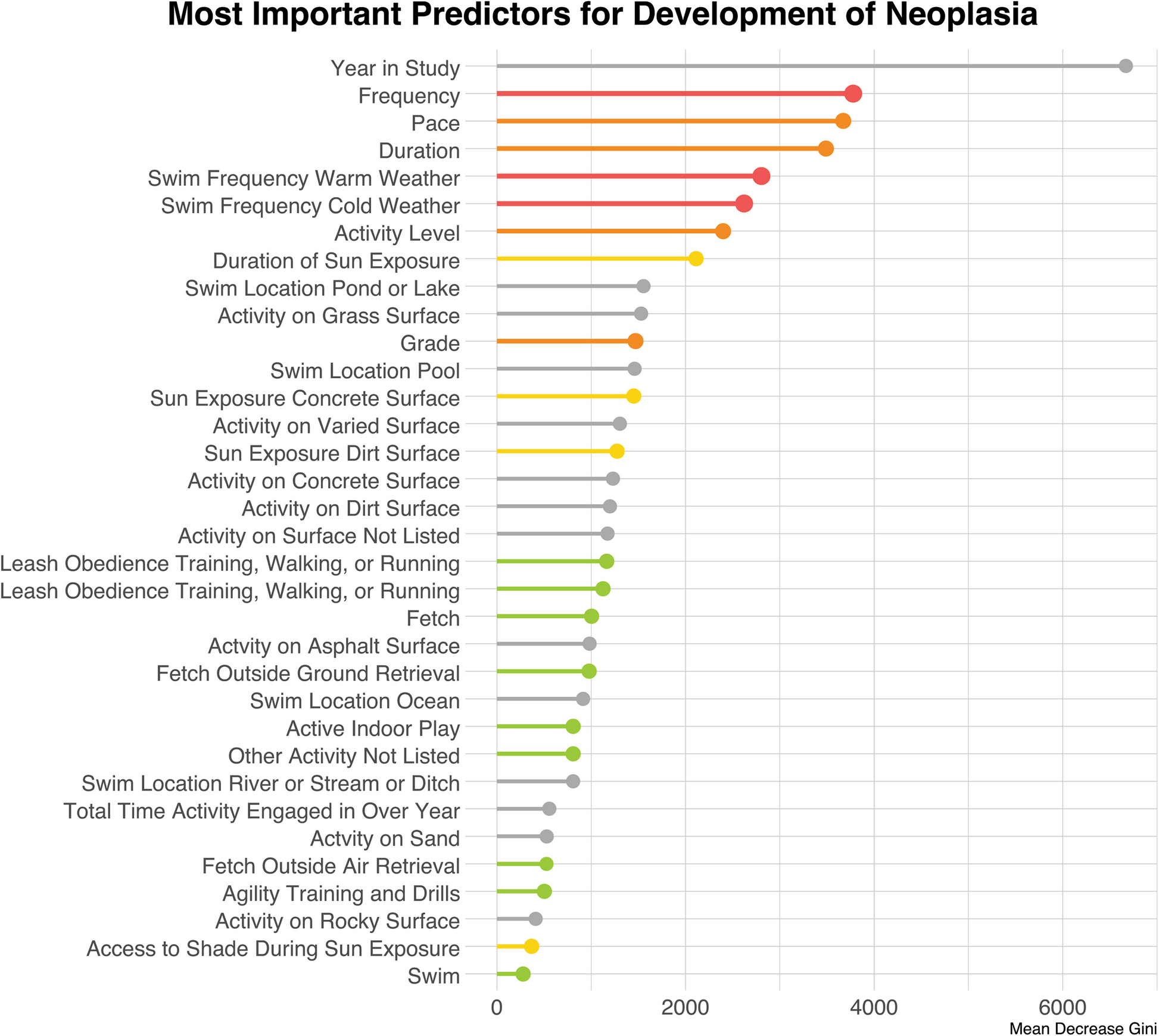
Our findings partially supported the hypothesis. We determined frequency, pace, and duration of physical activity were more important predictors of cancer development than the type of activity or the surface/location where the activity occurred.
Interestingly, dogs diagnosed with cancer tended to have lower activity levels before their diagnosis. After their diagnosis, owners began to increase the frequency of the physical activity, but the duration and pace were decreased. Want to dive deeper into our results? Check out our newly published study in BMC Veterinary Oncology.

Follow the Topic
-
BMC Veterinary Oncology
This journal will aim to cover all aspects of cancer research and clinical management in veterinary medicine. It will focus on the diagnosis, treatment, and prevention of cancer in various animal species, including but not limited to dogs, cats, horses, food animals, wildlife and exotic/zoo animals.