USP43 promotes gemcitabine resistance in bladder cancer by stabilizing E2F1 to regulate cholesterol homeostasis
Published in Cancer and Anatomy & Physiology




Continuing with the challenge of overcoming acquired resistance in BLCA, we discovered that the transcription factor E2F1 is not only highly expressed in GEM-resistant cells but is also directly induced by chemotherapy exposure. Patients with elevated E2F1 expression exhibited poorer prognoses, suggesting that E2F1 stability is a key factor in therapeutic failure.
To date, E2F1 has been primarily studied as a cell cycle regulator. However, the mechanisms by which it modulates lipid metabolism to confer drug resistance have remained elusive. Here, we determine that E2F1 promotes GEM resistance by activating cholesterol biosynthesis and that its stability is tightly controlled by USP43.
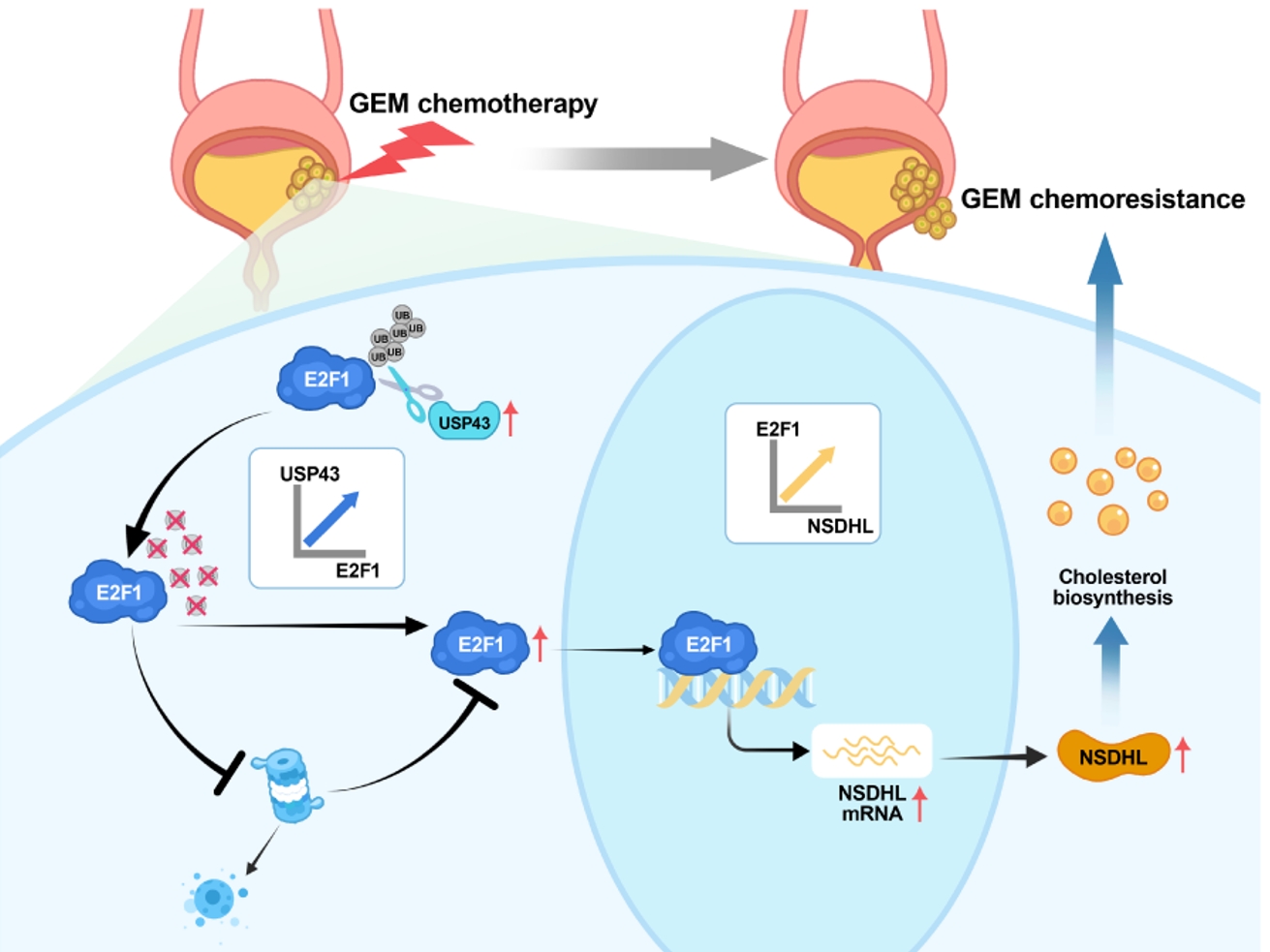
In this study, we further explored the molecular mechanism of USP43 in BLCA. We identified a mechanism by which USP43 regulates GEM resistance mediated by the stabilization of E2F1. Specifically, as shown in the Figure above, USP43 interacts with E2F1 and functions as a deubiquitinase, removing ubiquitin chains to prevent E2F1 proteasomal degradation. The stabilized E2F1 then transcriptionally activates NSDHL, a key enzyme in cholesterol biosynthesis. This leads to intracellular cholesterol accumulation, which subsequently enhances drug efflux via ABC transporters and suppresses ferroptosis.
Finally, a USP43-E2F1-NSDHL axis is established, which accelerates the development of chemoresistance. Overall, our study identifies USP43 as a promoter of GEM resistance via a cholesterol-dependent mechanism and suggests its potential as a therapeutic target for BLCA.
Reference
[1] Li M, Liu T, Shi J, Zhou F, Deng Z, Luo Y, Tu S, Jiang W, Wang G, Qian K, Zhang Y, Xiao Y, Wang X, Liu T, Ju L. USP43 promotes gemcitabine resistance by regulating cholesterol homeostasis through E2F1 stabilization in bladder cancer. J Exp Clin Cancer Res. 2025 Dec 23. doi: 10.1186/s13046-025-03621-2.
Follow the Topic
-
Journal of Experimental & Clinical Cancer Research
Journal of Experimental & Clinical Cancer Research is an online peer-reviewed journal that publishes original research papers, reviews and commentaries in cancer research, from bench to bedside.

Related Collections
With Collections, you can get published faster and increase your visibility.
Insights into the relationship between metabolism and cancer
Cancer metabolism has become one of the most studied aspects of the "hallmarks of cancer." It refers to alterations in how tumor cells process nutrients to fuel their rapid proliferation and spread. These dramatic dysregulations include elevated glucose uptake even in the presence of oxygen (the Warburg effect), dependence on glutamine, and the production of waste products such as lactate, which further support tumor growth and metastasis. Genetic mutations accumulating during cancer progression in metabolic enzymes and cancer-promoting signaling pathways directly affect metabolic changes in cancer cells as well as in the tumor microenvironment [1,2].
A growing number of scientists are developing targeted therapies to exploit these metabolic differences to slow or halt cancer progression. Some therapies aim to block or alter the production of specific metabolites, while several drugs for other pathologies, such as diabetes, are of great interest due to their potential to slow tumor growth by altering systemic metabolic factors such as insulin and glucose levels in a "drug repositioning" strategy [3-7].
Cancer metabolism, involving altered lipid, iron, and amino acid pathways, regulates ferroptosis, an iron-dependent, lipid peroxidation-driven form of cell death. Cancer cells often resist this process, but targeting their specific metabolic vulnerabilities, such as glutathione depletion or iron overload, can trigger ferroptosis to kill tumor cells and overcome drug resistance [8].
Cancer cells can rewire their metabolism when one pathway is blocked, so it is becoming clear that combining metabolism inhibitors with traditional chemotherapy, radiotherapy, or immunotherapy may be an effective therapeutic strategy [8]. While some metabolism-targeting drugs have been successful (e.g., in Acute Lymphocytic Leukemia), targeting cancer metabolism is complex due to its similarity to normal cell processes [9]. Metabolic profiling of patients is helping to identify specific vulnerabilities, leading to more personalized metabolic therapies [10].
Understanding cancer metabolism at a deeper mechanistic level is also essential to improving immunotherapy, as immune cell metabolism changes during therapy administration, contributing to acquired resistance.
KEYWORDS: metabolomics; proteomics, genomics, mitochondrial metabolism, ferroptosis, oxidative stress, inflammation, innovative study models, new translational therapeutic approaches.
In this Collection of the Journal of Experimental & Clinical Cancer Research, we would like to promote studies that further dissect the molecular mechanisms through which cancer cells reprogram their own metabolism and that of cells in the tumor microenvironment, thus driving disease progression. Furthermore, studies that highlight potential metabolic vulnerabilities that could be targeted therapeutically will be of interest.
References
- Finley LWS. What is cancer metabolism? Cell. 2023;186(8):1670-88. PubMed PMID: 36858045. PMCID: PMC10106389.eng
- Guertin DA, Wellen KE. Acetyl-CoA metabolism in cancer. Nat Rev Cancer. 2023;23(3):156. PubMed PMID: 36658431. PMCID: PMC11137663.eng
- Vander Heiden MG. Targeting cancer metabolism: a therapeutic window opens. Nat Rev Drug Discov. 2011;10(9):671-84. PubMed PMID: 21878982.
- Zou W, Han Z, Wang Z, Liu Q. Targeting glutamine metabolism as a potential target for cancer treatment. J Exp Clin Cancer Res. 2025;44(1):180. PubMed PMID: 40598593. PMCID: PMC12210561.
- Formenti L, Abramo F, Dellavedova G, Dematteis V, Decio A, Grasselli C, et al. Impairment of oxidative metabolism compromises Rad51 recruitment and potentiates PARP inhibitor effectiveness in ovarian cancer. J Exp Clin Cancer Res. 2026;45(1):45. PubMed PMID: 41530766. PMCID: PMC12888472.
- Chen T, Xu ZG, Luo J, Manne RK, Wang Z, Hsu CC, et al. NSUN2 is a glucose sensor suppressing cGAS/STING to maintain tumorigenesis and immunotherapy resistance. Cell Metab. 2023;35(10):1782-98.e8. PubMed PMID: 37586363. PMCID: PMC10726430.
- Pillai U J, Ray A, Maan M, Dutta M. Repurposing drugs targeting metabolic diseases for cancer therapeutics. Drug Discov Today. 2023;28(9):103684. PubMed PMID: 37379903.
- Wu Y, Li H, Yue K, Jing C, Duan Y. Ferroptosis in cancer: metabolism, mechanisms and therapeutic prospects. Mol Cancer. 2025;24(1):303.
- Punnasseril JMJ, Auwal A, Gopalan V, Lam AK, Islam F. Metabolic Reprogramming of Cancer Cells and Therapeutics Targeting Cancer Metabolism. Cancer Med. 2025;14(18):e71244. PubMed PMID: 40956032. PMCID: PMC12439291.
- da Silva-Diz V, Herranz D. Unleashing the Full Potential of Metabolic Interventions in T-ALL. Blood Cancer Discov. 2025;6(3):163-7. PubMed PMID: 40111138. PMCID: PMC12050939.
- Benjamin DI, Cravatt BF, Nomura DK. Global profiling strategies for mapping dysregulated metabolic pathways in cancer. Cell Metab. 2012;16(5):565-77. PubMed PMID: 23063552. PMCID: PMC3539740.
Publishing Model: Open Access
Deadline: Feb 28, 2027

Please sign in or register for FREE
If you are a registered user on Research Communities by Springer Nature, please sign in