USPEX 25: giving laptop a supercomputer power


Democratizing Discovery: How USPEX 25 is Transforming Computational Materials Science
For decades, the prediction of crystal structures from chemical composition alone stood as a defining challenge in theoretical chemistry, famously described as a "continuing scandal" in the field. The astronomical number of potential atomic arrangements for even simple compounds rendered brute-force computation impossible. While evolutionary algorithms like USPEX (Universal Structure Predictor: Evolutionary Xtallography) emerged as a powerful solution, their reliance on computationally intensive quantum-mechanical methods preserved a significant barrier: the need for supercomputing resources. The release of USPEX 25 marks a paradigm shift by integrating a state-of-the-art machine-learning force field, it transitions crystal structure prediction from the realm of high-performance computing clusters to the standard researcher's personal computer (under Windows or Linux), thereby initiating a new era of democratized and accelerated discovery.
The Algorithmic Engine: Evolutionary Principles Applied to Atomic Landscapes
At its core, USPEX solves the crystal structure prediction problem through its own sophisticated evolutionary algorithm. The process begins with a randomly generated population of candidate crystal structures for a given chemical composition. Each structure's fitness—its stability—is evaluated by calculating its free energy, traditionally using first-principles methods like Density Functional Theory (DFT). The least stable structures are discarded, while the most stable are selected to produce offspring through operations mimicking heredity and various mutations. This iterative cycle of selection, variation, and fitness evaluation allows the algorithm to efficiently navigate the complex, high-dimensional energy landscape, on the way to the global minimum. This methodology has proven exceptionally reliable, outperforming other prediction techniques in efficiency and success rate.
The Catalytic Leap: Integration of a Deep-Learning Force Field
The transformative advancement in USPEX 25 is the seamless integration of MatterSim, a deep-learning atomistic model. This machine-learning force field is trained on vast datasets of first-principles calculations. It achieves accuracy comparable to quantum-mechanical methods but at a computational cost orders of magnitude lower. Crucially, it is designed to operate across a wide range of realistic conditions, including high pressures.
The integration directly addresses the primary historical bottleneck: energy evaluation. Where previous versions required submitting each candidate structure to external DFT codes—a process demanding significant high-performance computing resources and time—USPEX 25 can now perform these relaxations internally and almost instantaneously on a local CPU. This shift is the key driver behind a dramatic increase in performance, turning calculations that once required supercomputer hours into tasks manageable on a laptop in minutes.
This technical leap manifests in a comprehensive evolution of the software's capabilities. Prior to the 2025 release, USPEX operated primarily on Linux/Unix systems and required a MATLAB runtime, with energy evaluation exclusively dependent on external DFT software. This configuration necessitated access to high-performance computing clusters and computational expertise. In contrast, USPEX 25 offers native support for both Windows and Linux environments and eliminates the MATLAB dependency. Most significantly, it features a built-in machine-learning force field for primary energy evaluation, while retaining optional pathways to external codes for final validation. This architectural change results in a speedup of approximately two orders of magnitude for the structure relaxation cycle, enabling complex global searches to be conducted on a standard personal computer. Consequently, the access model has shifted from being geared towards specialist theorists to a democratized framework described by its developers as being suitable for a vastly broader user base, including experimentalists and students.
Broader Implications: Redefining Accessibility and Collaborative Science
The technical advancements of USPEX 25 translate into profound socio-scientific implications. Firstly, it actively democratizes materials discovery. The tool erases the competitive advantage conferred by exclusive access to supercomputing infrastructure. A researcher or student in an institution with limited resources now possesses the same fundamental predictive capability as one in a world-leading laboratory, shifting the primary currency of discovery from resource allocation to intellectual merit.
Secondly, it bridges the theory-experiment divide. For experimental chemists and materials scientists, USPEX 25 allows for rapid in silico screening of promising synthetic targets, rationalizing experimental results, and guiding high-pressure or high-temperature synthesis campaigns with unprecedented agility. The ability to run predictive calculations on a standard laboratory PC facilitates a truly iterative, conversational dynamic between computation and experiment.
Importantly, USPEX 25 can be used for teaching and learning. By simplifying the input, the barrier for learning to use USPEX 25 is now close to zero, and even schoolkids can use it on their PCs. This gives them a powerful tool for learning chemistry and even pursuing their own curiosity-driven research.
Conclusion: A New Chapter in Predictive Science
USPEX 25 represents more than a software update; it is a re-engineering of the scientific process itself. By solving the critical performance bottleneck through the innovative use of a deep-learning force field, it has decoupled cutting-edge crystal structure prediction from centralized, high-performance computing. The result is a potent, portable, and accessible tool that empowers a global community. It promises to accelerate the discovery of next-generation materials—from high-temperature superconductors and superior catalysts to novel energetic compounds—by unleashing the predictive power of evolutionary algorithms onto the desktops of tens of thousands of researchers. In doing so, USPEX 25 is not just predicting crystal structures; it is actively shaping a more inclusive, efficient, and collaborative future for materials science.
To download USPEX 25, register here.
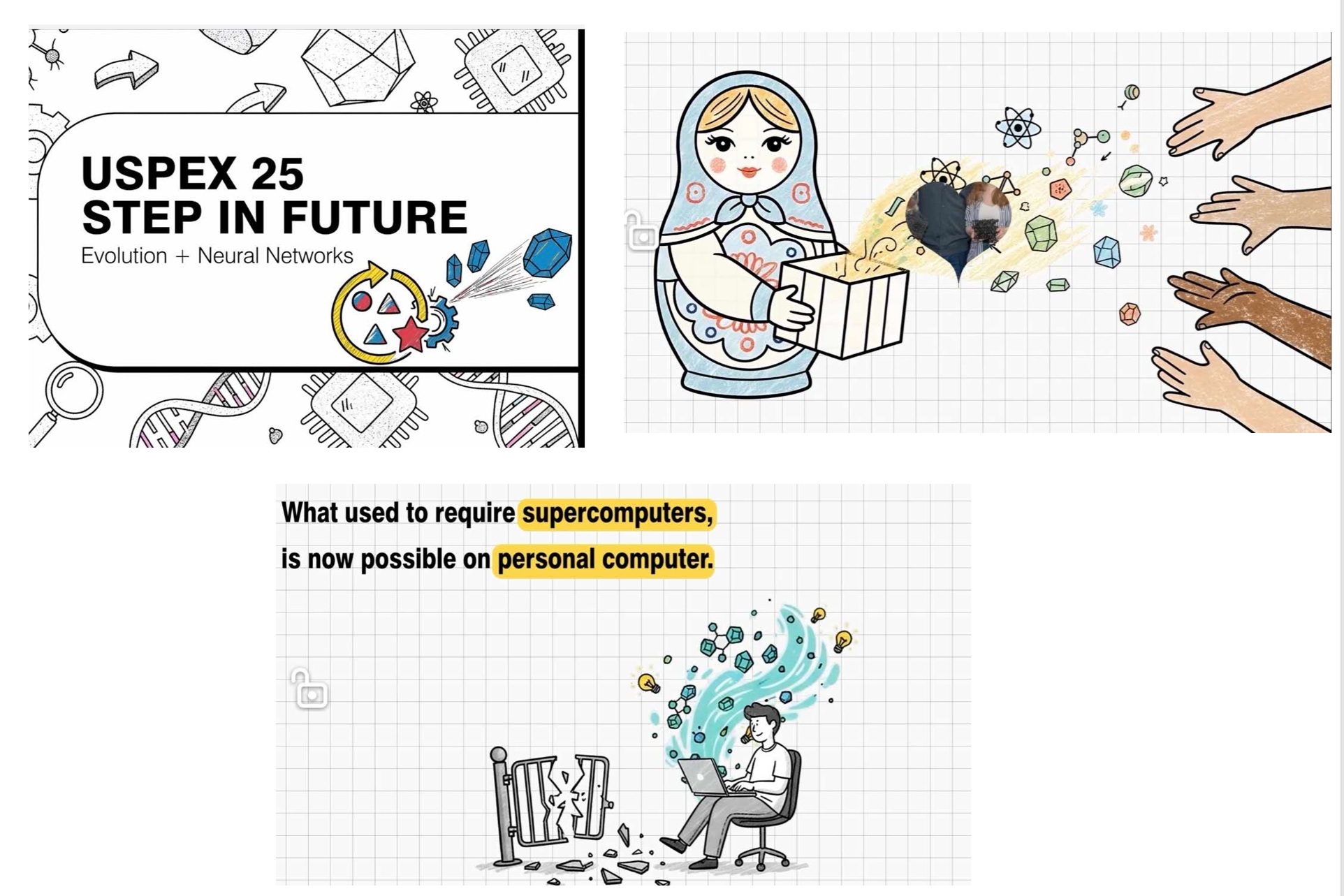
Have fun: AI-generated cartoon about USPEX 25

Please sign in or register for FREE
If you are a registered user on Research Communities by Springer Nature, please sign in
To download USPEX 25, register here: https://uspex-team.org/en/uspex/downloads