Water‑Restrained Hydrogel Electrolytes with Repulsion‑Driven Cationic Express Pathways for Durable Zinc‑Ion Batteries
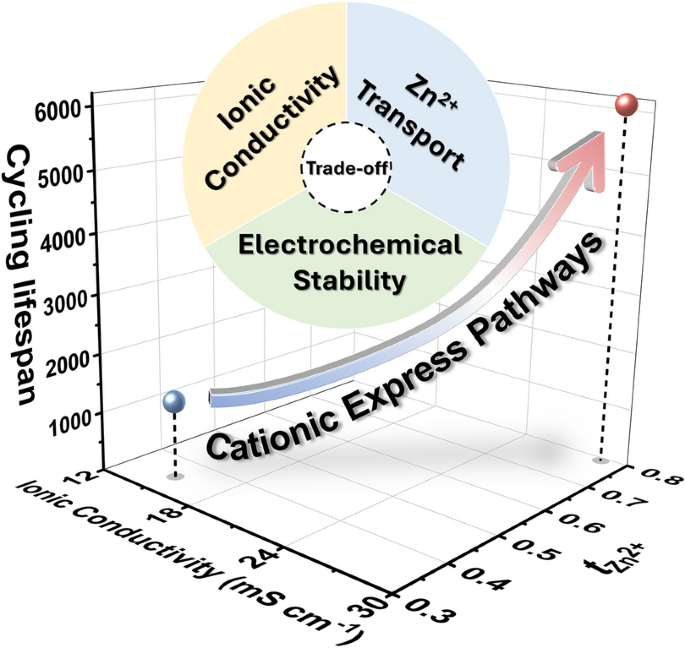
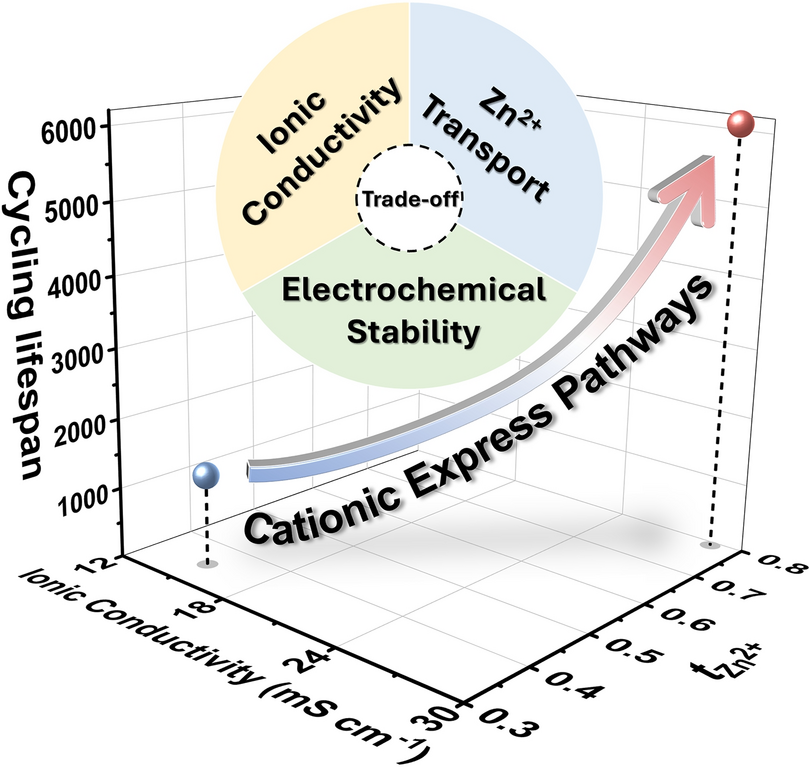

Flexible zinc-ion batteries promise safe, low-cost storage, yet hydrogel electrolytes force a three-way trade-off among high ionic conductivity, fast Zn2+ transport and suppressed water-induced side reactions. Now a CityU–Fuzhou University team led by Prof. Wenjun Zhang, Prof. Guo Hong and Prof. Chengkai Yang unveils PAPTMA, a cationic hydrogel whose quaternary-ammonium branches build repulsion-driven “express pathways” that deliver 28.7 mS cm-1 conductivity and 0.79 Zn2+ transference number while locking water into a low-activity state—yielding > 6000 h reversible plating/stripping and 150-cycle pouch-cell stability under 0–360° bending.
Why PAPTMA Matters
-
Triple-Breakthrough Design
– Long –N+R3side-chains create cationic express lanes: AIMD shows Zn2+–amide distance widens from 1.98 Å (PAM) to 3.84 Å, cutting hopping barriers.
– SO42- immobilisation (Zn–O distance 2.08 Å vs 1.32 Å in PAM) suppresses anion polarization, doubling tZn2+ to 0.79 while maintaining σ = 28.7 mS cm-1.
– Interfacial-bound water (92 % medium H-bond, 19 % strong H-bond) curbs HER: H2 evolution 72 ppm vs 421 ppm in PAM; corrosion current 0.30 mA cm-2 vs 3.36 mA cm-2. -
Mechanical & Interfacial Robustness
– Tensile strength 96 kPa @ 680 % strain; lap-shear adhesion to Zn 50 kPa (2× PAM), leaving gel residue after failure—mechanically pinning the metal surface.
– In-situ optics at 10 mA cm-2 show flat Zn deposits; nucleation overpotential only 23 mV vs 76 mV for PAM. -
Cell-Level Validation
– Symmetric Zn|Zn: 6060 h @ 1 mA cm-2, 1240 h @ 8 mA cm-2, 1000 h @ 71 % DoD—3–6× lifespan of best literature hydrogels.
– Full-cell vs δ-MnO2: 127 mAh g-1 after 1 000 cycles (0.5 A g-1, 76 % retention); 4 × 4 cm2 pouch delivers 206 Wh kg-1 (MnO2 basis) for 150 cycles with zero capacity loss under 360° bending.
Outlook
The team is now scaling 30 µm-thin PAPTMA membranes via roll-to-roll UV curing and validating −15 °C ↔ 60 °C operation for wearable and grid-storage modules. By turning ionic repulsion into a transport engine and bound water into a stability shield, the work offers a universal design rule for long-life, high-rate flexible aqueous batteries.

Editor of Nano-Micro Letters, which is an Open-Access, peer-reviewed journal reported papers that have at least one dimension ranging from a few sub-nanometers to a few hundreds of micrometers. The journal is published by Springer Nature and indexed by SCI, EI, SCOPUS, Pubmed, etc. The 2024 JCR Impact Factor is 36.3. The 2024 CiteScore is 53.1.
Follow the Topic
-
Nano-Micro Letters

Nano-Micro Letters is a peer-reviewed, international, interdisciplinary and open-access journal that focus on science, experiments, engineering, technologies and applications of nano- or microscale structure and system in physics, chemistry, biology, material science, and pharmacy.
Please sign in or register for FREE
If you are a registered user on Research Communities by Springer Nature, please sign in