What can Nubian Levallois cores tell us about Paleolithic human adaptation?
Published in Arts & Humanities

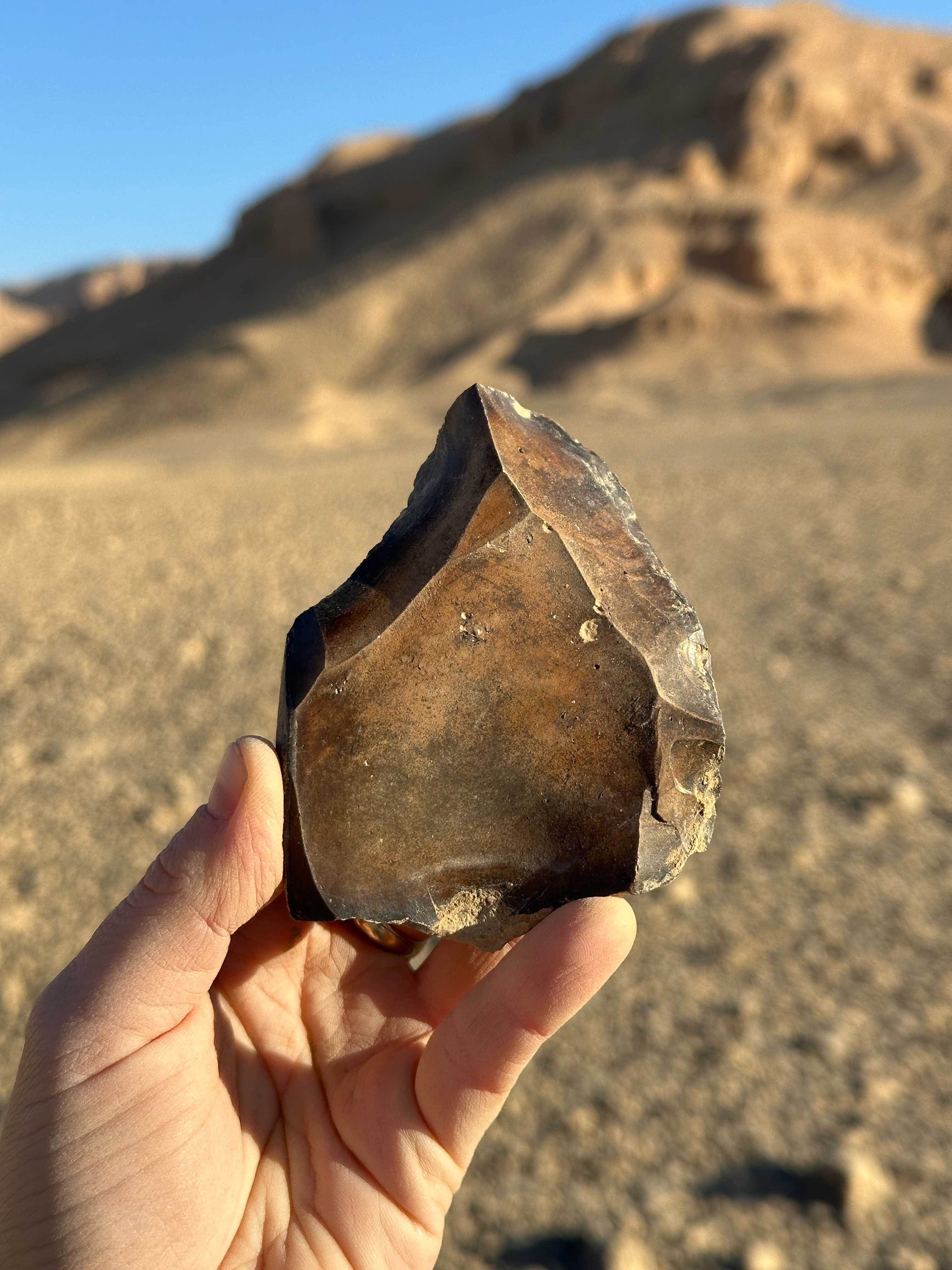



In the early 20th century, a distinctive Paleolithic stone artefact type was identified in North Africa, differing from those described before in Europe. The Nubian Levallois core, a unique form of Middle Stone Age technology, produced pointed artifacts that aided human adaptation. Over time, this method was found beyond Egypt and Sudan, appearing at certain sites in East Africa, the southern Levant, and the Arabian Peninsula during MIS 5 (130 ka - 74 ka). Consequently, Nubian cores have been used as a proxy for understanding modern human dispersal and interactions within and outside of Africa at this time, prompting heated debate. Recently a new scenario of independent invention has been raised by the discovery of identical technology in South Africa during MIS 3 (59 ka - 24 ka), raising new questions: Why was this method adopted despite not being as widespread as other Levallois techniques? What sort of variability do these cores show across time and space?

An early attempt to address these questions involved researching the metric variability of Nubian cores and the spatial distribution of sites during my master’s study in 2022. Recently, in collaboration with Dr. Emily Hallinan , a leading expert in this area , we elevated this research to a higher resolution to explore these questions in more depth for a special volume in the Journal of Paleolithic Archaeology (JPA). Utilizing Hallinan’s new systematic dataset of global Nubian core occurrences, we analyzed the distribution of 84 sites featuring Nubian cores across Africa and Southwest Asia, using modeled Pleistocene conditions for various bioclimatic and topographic variables. We compared this with 81 contemporaneous sites where these cores are absent to address what factors may have driven their adoption. Additionally, we conducted metric analyses of cores from 14 new and previously published sites to better understand patterning in artifact form.
Several studies have examined the impact of environmental factors on aspects of lithic variability at various spatial and temporal scales in Africa. Our study is the first to systematically and quantitatively apply this approach to questions surrounding the distribution and variability of Nubian Levallois technology at an inter-regional scale. The results showed that Nubian cores during MIS 5 were present in areas characterized by aridity, complex topography, and high biomass, whereas for MIS 3, only temperature was a significant predictor. Metric results reveal distinct patterns in both space and time, with the largest and most standardized cores found in Southern Arabia during MIS 5, and the smallest cores in Eastern and Southern Africa during MIS 3.
Follow the Topic
-
Journal of Paleolithic Archaeology
This journal is aimed at all Plio-Pleistocene archaeologists and other scientists researching Paleolithic archaeology.

Related Collections
With Collections, you can get published faster and increase your visibility.
The nature of Nubian: Current global perspectives on Nubian Levallois technology and Middle Palaeolithic cultural dynamics
Publishing Model: Hybrid
Deadline: Ongoing
The Pleistocene occupations of Contrebandiers Cave (Morocco), and the origins of modern human behaviors Les occupations de la grotte des Contrebandiers au Maroc au cours du pléistocène et l'origine du comportement humain moderne استقرار الإنسان بمغارة المهربين بالمغرب خلال البليستوسين وأصل السلوك الإنساني الحالي.
Contrebandiers Cave, a coastal cave site in Morocco, also known as Smuggler’s Cave, provided foundational information on Late Pleistocene occupations of North Africa, but full interpretation was limited by early excavation methods. In a recent project (2007-2011) led by the late Harold L. Dibble and Mohamed Abdeljalil El Hajraoui, modern excavations have shed light on the rich Middle and Later Stone Age deposits. Contrebandiers Cave is one of the key sites in northwestern Africa for understanding early modern human adaptations, yielding Middle Stone Age hominin remains (ca. 110,000 years ago) with associated evidence for early complex behavior (e.g., bone tools and perforated tick shells), as well as evidence for use of fire, and a subsistence record that includes marine shellfish and vertebrate fauna. The Later Stone Age deposits, which accumulated after an occupational hiatus, also were investigated; they represent a later re-peopling of this region. The papers in this special issue will provide a wealth of detail about each of these temporally distinct occupations and their associated paleoenvironments. These data are used to explore variations in adaptations during the Middle Stone Age (“Aterian” and the so-called “Maghrebian Mousterian”) and to compare these behaviors to the Later Stone Age (“Iberomaurusian”) groups, as documented through site use, strategies for obtaining terrestrial fauna and marine resources, lithic technologies and raw material exploitation/use, anthropogenic fire-related deposits, and examination of regionally distinct technologies (bone tools, stemmed pieces, microliths). Finally, these recent excavations at Contrebandiers Cave also have discovered rare, preserved hominin remains of an individual dating to the Middle Stone Age in a well-defined archaeological context.
La grotte de Contrebandiers, une grotte de la côte marocaine, également connue sous le nom de "Smuggler's Cave", a fourni des informations fondamentales sur les occupations du Pléistocène supérieur de l'Afrique du Nord, mais l'interprétation complète était limitée par les premières méthodes de fouille. Dans un projet récent (2007-2011) dirigé par feu Harold L. Dibble et Mohamed Abdeljalil El Hajraoui, des fouilles modernes ont mis en lumière les riches gisements de Middle Stone Age et Later Stone Age. La grotte de Contrebandiers est l'un des sites clés du nord-ouest de l'Afrique pour comprendre les premières adaptations humaines modernes, produisant des restes d'hominidés des Middle Stone Age (il y a environ 110 000 ans) avec des preuves associées d'un comportement complexe précoce (par exemple, des outils en os et de nombreuses coquilles perforées), ainsi que des preuves d'utilisation du feu, et un registre de subsistance qui comprend les coquillages marins et la faune vertébrée. Les niveaux de Later Stone Age, qui se sont accumulés après un hiatus, ont également été étudiés; ils représentent un repeuplement subséquent de cette région. Les articles de ce numéro spécial fourniront une mine de détails sur chacune de ces occupations temporellement distinctes et leurs paléoenvironnements associés. Ces données sont utilisées pour explorer les variations dans les adaptations au cours de Middle Stone Age ("atérien" et le soi-disant "moustérien maghrébin") et pour comparer ces comportements aux groupes de Later Stone Age ("ibéromaurusien"), comme documenté par l'utilisation du site, stratégies d'obtention de la faune terrestre et des ressources marines, technologies lithiques et exploitation/utilisation des matières premières, les dépôts anthropiques liés au feu, et examen des technologies régionales distinctes (outils en os, pièces à tige, microlithes). Enfin, ces fouilles récentes de la grotte de Contrebandiers ont également mis au jour de rares restes d'hominidés conservés d'un individu datant du Middle Stone Age dans un contexte archéologique bien défini.
يعد موقع "كونتربونديي" من بين مجموعة من المغارات المطلة على المحيط الأطلسي لجهة الرباط تمارة، لقد اكتسى استئناف الحفريات من طرف "هارولد ديبل" و"محمد عبد الجليل الهجراوي" بين سنتي 2007 _ 2011 أهمية كبرى، اذ ساعد على معرفة حضارات البليستوسين الأعلى لإفريقيا الشمالية/ اي حضارات العصر الحجري المتوسط والأعلى. تتميز البقايا التي تم العثور عليها بهذا الموقع بتنوع كبير وغنى استثنائي على مستوى الشمال الغربي لإفريقيا. فقد مكنت هذه اللقى الباحثين من فهم أفضل للاستيطان الذي تم خلال العصر الحجري الوسيط (منذ حوالي 110 ألف سنة)، وتستمد مجموعة المخلفات هاته أهميتها من وجود وتزامن عدة مؤشرات ودلائل تطلعنا على السلوك البشري في ذلك العصر. ستشكل مقالات هذا العدد الخاص منجما للمعلومات حول أشكال الاستيطان الفريد من نوعه عبر الزمن لهذا الموقع التاريخي، وأيضا تتيح فهم التغيرات المناخية، وتطور المحيط الطبيعي القديم. نذكر من بين الأثار المكتشفة، على وجه الخصوص، الأصداف المثقوبة والتي من المحتمل أنه قد تم استعمالها كشكل من أشكال الحلي. هناك كذلك الأدوات العظمية، وتدجين النار، وأيضا العديد من الأصداف البحرية وبقايا الحيوانات. لقد سمحت هذه المعطيات المتعددة، بتحديد مختلف العناصر المرتبطة باستيطان الانسان بهذا الموقع التاريخي خلال العصر الحجري المتوسط. تمت أيضا دراسة مستويات العصر الحجري الأعلى، والتي تراكمت بعد فجوة زمنية، فأبانت الأثار الأركيولوجية التي تم استخراجها أن الإنسان القديم استقر بكثافة بهذه المنطقة خلال هذه الحقبة الزمنية. توضح جميع هذه المعطيات المستخلصة انواع الاستراتيجيات المعتمدة من طرف إنسان العصر الحجري القديم من أجل الحصول على النباتات القارية والموارد البحرية، كما تسمح كذلك بمعرفة التقنيات المعتمدة للاستغلال الأقصى للمواد الأولية من أجل إنتاج "أدواته الخاصة" (أدوات من العظام، قطع صغيرة حادة...) يعتبر هذا الموقع بالإضافة إلى ذلك، من بين أنذر المواقع الأركيولوجية التي ضمت بقايا الإنسان "العتيري"، والتي يرجع تاريخها إلى العصر الحجري الوسيط في سياق ستراتيغرافي مضبوط.
Publishing Model: Hybrid
Deadline: Ongoing