When a beneficial plant trait comes with an unexpected climate trade-off
Published in Earth & Environment, Microbiology, and Agricultural & Food Science





Biological nitrification inhibition (BNI) has a compelling story. Some plants naturally release compounds from their roots that suppress nitrifying microorganisms, helping retain nitrogen in soils while reducing emissions of nitrous oxide (N2O), a potent greenhouse gas. This ability has attracted considerable interest as a natural strategy for improving nitrogen use efficiency and reducing the environmental footprint of agriculture.
But as environmental microbiologists, we began to wonder whether the effects of these compounds really stop at nitrification.
The question arose from a well-established biochemical connection. Ammonia oxidation begins with ammonia monooxygenase (AMO), the enzyme targeted by many BNI compounds. Methanotrophic bacteria use a closely related enzyme, particulate methane monooxygenase (pMMO), to oxidize methane. These bacteria constitute the major biological sink for methane and therefore play an important role in regulating emissions of another powerful greenhouse gas.
This raised a simple question with potentially important consequences: Could compounds that plants use to suppress ammonia oxidation also interfere with microbial methane oxidation?
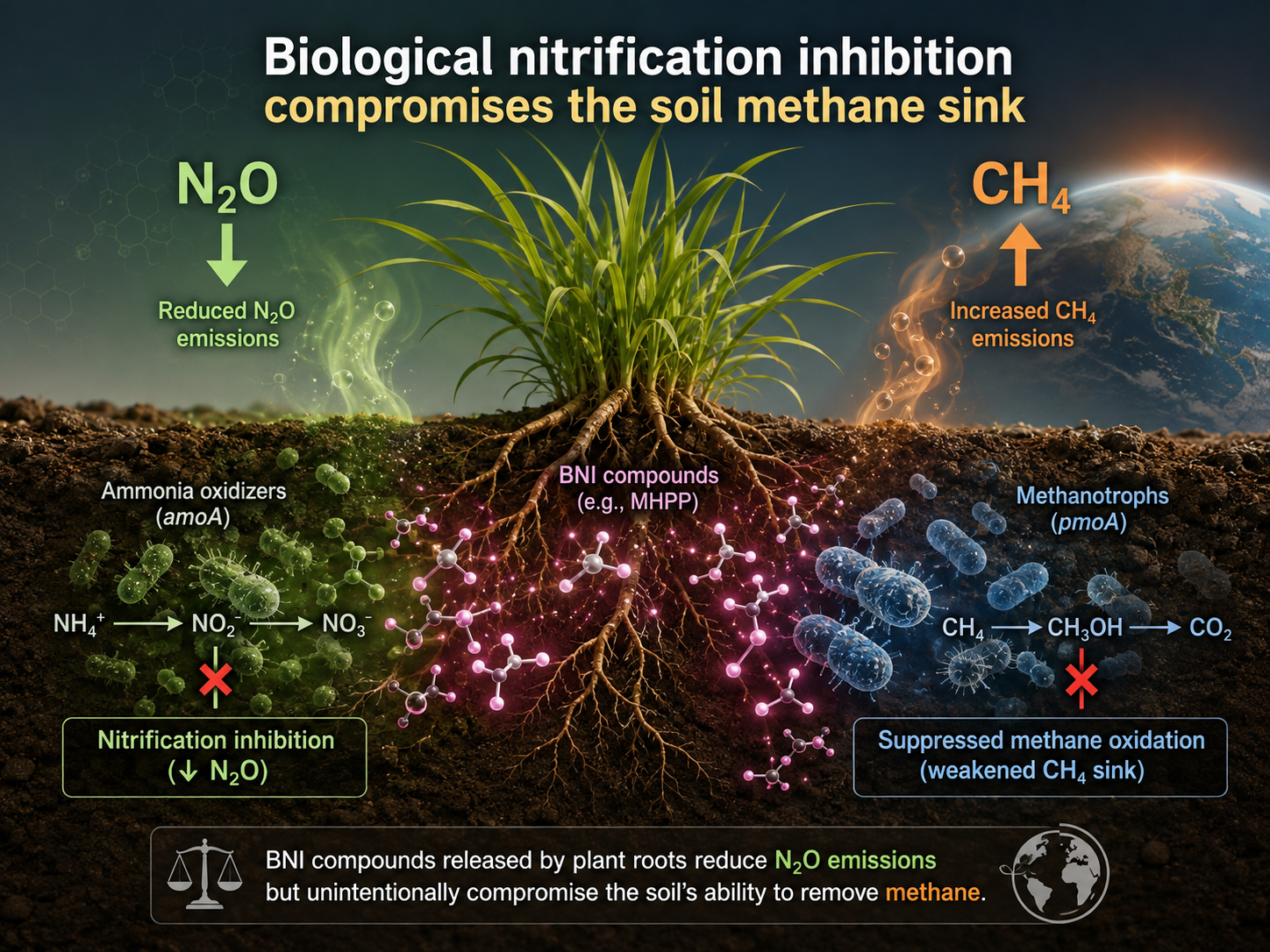
What began as a mechanistic question ultimately revealed an unexpected trade-off. Across plant–soil systems and pure cultures, we found that BNI compounds consistently suppressed methane oxidation. Our experiments further pointed to pMMO as the predominant target and showed that the inhibition was reversible rather than the result of loss of cell viability. Surprisingly, when we compared their inhibitory potency across organisms, some BNI compounds affected methanotrophs as strongly as—or more strongly than—the ammonia oxidizers they are known to inhibit.
The finding changes how we think about BNI. The capacity of plants to suppress nitrification remains potentially valuable for nitrogen retention and reducing N2O emissions. Our results do not negate those benefits. Instead, they show that this plant–microbe interaction reaches beyond the nitrogen cycle. By simultaneously suppressing methane oxidation, BNI may connect the biological regulation of two important greenhouse gases in ways that have largely been overlooked.
This broader perspective may be particularly relevant in environments such as wetlands and rice paddies, where plants, ammonia oxidizers and methanotrophs coexist and jointly influence greenhouse gas fluxes. Determining how strongly this trade-off operates under field conditions will now require moving beyond individual compounds and laboratory systems to understand the combined effects of naturally released BNI compounds in complex soils.
For us, the study was also a reminder that interventions—or naturally evolved processes—that appear beneficial when viewed through a single biogeochemical cycle can look different when considered at the ecosystem scale. Plant–microbe interactions rarely operate within the boundaries we assign to the nitrogen or carbon cycle. Understanding their climate consequences may therefore require looking at both at the same time.

I am an environmental microbiologist interested in how microbial processes and plant–microbe interactions shape biogeochemical cycles and environmental sustainability. My current research focuses on biological nitrification inhibition (BNI) and its broader consequences for nitrogen and methane cycling, including interactions between nitrifying and methane-oxidizing microorganisms.
My research also examines microbial sources and mitigation of greenhouse gases in agricultural systems, including nitrous oxide emissions during forage conservation. More broadly, I am interested in harnessing microbial metabolism for environmental remediation. My previous work has explored the biodegradation of contaminants including bisphenol A and chlorinated compounds, as well as microbial defluorination. Building on this work, I am increasingly interested in the microbial transformation and potential biodegradation of PFAS and other persistent fluorinated contaminants.
Follow the Topic
-
Communications Earth & Environment
An open access journal from Nature Portfolio that publishes high-quality research, reviews and commentary in the Earth, environmental and planetary sciences.

Related Collections
With Collections, you can get published faster and increase your visibility.
Ecological resistance and resilience under global change
Publishing Model: Open Access
Deadline: Apr 07, 2027
Hazards in Mountain Regions
Publishing Model: Open Access
Deadline: Nov 02, 2026