When and how did the Moon become “wet”?
Published in Astronomy and Earth & Environment




For decades, the Moon was considered dry.
The Apollo and Luna missions of the 1970s transformed lunar science and established a prevailing view: the Moon was severely depleted in volatile elements and noble gases. This “dry Moon” concept became a cornerstone of the giant impact hypothesis, suggesting that the Moon formed in the fragments of a high‑temperature collision between the proto‑Earth and a Mars‑sized body.
But, recent cutting-edge analyses and observations of the Moon are challenging such preconceptions.
In recent years, increasingly sensitive laboratory analyses of lunar samples have begun to challenge this long‑held paradigm. Remote‑sensing observations have hinted at volatile species distributed across the lunar surface, while in situ measurements have detected carbon, nitrogen and oxygen in the Moon’s tenuous exosphere.
The Moon, it seems, is not entirely dry after all.
If so, it implies that over billions of years since its formation, the Moon has acquired volatile elements. And because the Moon and Earth have co‑evolved as a coupled system, understanding how volatiles are delivered to the Moon also informs how Earth’s own volatile inventory may have been shaped. Studying the Moon’s volatile cycle is, in a sense, a way of reflecting on the origins of our own planetary environment.
Connecting the microscopic and the macroscopic
For more than 25 years, my research has revolved around a simple question: what can microscopic records preserved in lunar materials tell us about planetary‑scale processes?
In 2007, by performing in situ U–Pb dating of phosphates in the lunar meteorite Kalahari 009, we obtained an age of 4.35 ± 0.15 billion years (Terada et al. Nature 2007). This pushed the onset of mare volcanism back to the earliest stages of lunar differentiation. Yet global observations told a different story: crater chronologies revealed no extensive basaltic plains older than about 4.0 billion years. The apparent discrepancy between microscopic geochronology and macroscopic surface geology pointed to a compelling conclusion — that ancient mare basalts exist, but are buried and hidden from view. Kalahari 009 thus provided the first direct sample‑level evidence for very‑low‑Ti cryptomaria on the Moon.
A decade later, a different microscopic clue — an anomalous oxygen‑isotope component in lunar regolith grains — led us in an unexpected direction. Its isotopic signature resembled that of Earth’s upper atmosphere. Motivated by this observation, we re‑examined plasma measurements from the Japanese lunar orbiter Kaguya and identified 1–10 keV O⁺ ions present only when the Moon traversed Earth’s plasma sheet. The implication was profound: terrestrial oxygen, stripped from Earth’s atmosphere by the solar wind, is transported across space and implanted into the lunar surface (Terada et al. Nature Astronomy 2017). In this sense, the Moon archives aspects of Earth’s atmospheric history.
More recently, chronology again connected scales. Radiometric ages of Copernicus crater ejecta and impact‑glass spherules hinted at a peak around 800 million years ago. By systematically determining the formation ages of 59 fresh lunar craters larger than ~20 km, we found that a subset formed contemporaneously. Coupled with the peculiar orbital distribution of the Eulalia asteroid family, this pointed to the catastrophic disruption of a 100–160 km parent body, triggering an asteroid shower that affected the entire Earth–Moon system. The estimated mass flux implied environmental consequences on Earth far exceeding those of the Chicxulub impact (Terada et al. Nature Communications 2020).
Across these studies, a pattern emerged: microscopic isotopic signatures, nanometre‑scale implantation depths and radiometric ages of tiny glass beads can reveal processes operating over planetary distances and hundreds of millions — even billions — of years.
For me, lunar science has never been about choosing between the microscopic and the macroscopic. It is about allowing one scale to illuminate the other.
A puzzle in the lunar exosphere
Mysteries remained in the Moon's exosphere.
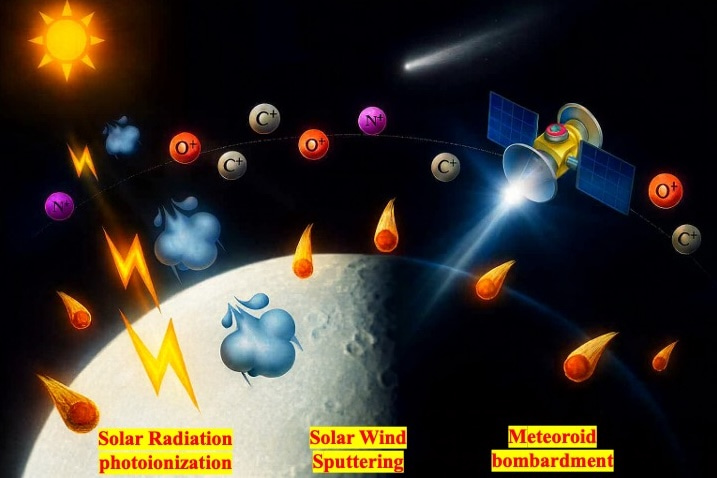
The lunar exosphere contains ions, but these particles survive only seconds to minutes. For the exosphere to persist, there must be continuous replenishment from the regolith. Proposed mechanisms include photoionization, solar‑wind sputtering and micrometeoroid impacts. But disentangling and quantifying their relative contributions has been notoriously difficult.
Our breakthrough came from a simple decision: to stop averaging everything together.
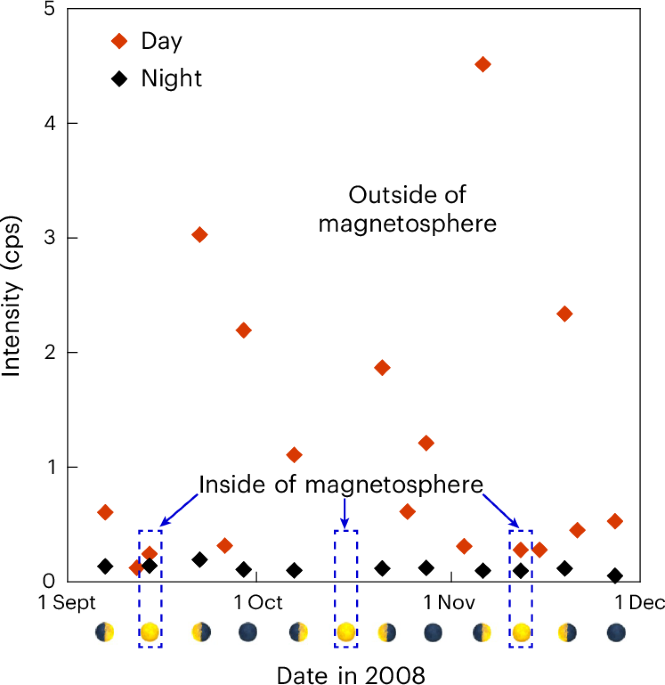
Instead of integrating all data indiscriminately, we sorted years of Kaguya observations by local time and lunar phase. We combined this classification with detailed mass‑spectral peak deconvolution. The key point lies in comparing the interior and exterior of the Earth's magnetosphere. When the Moon traverses the Earth's magnetosphere, it becomes shielded from the solar wind, thereby providing a means to isolate competing ion generation mechanisms.
What the Moon revealed
We found that ion intensities at night and during full Moon (inside the magnetosphere) remain low and relatively stable, whereas dayside intensities outside the magnetosphere vary significantly. Carbon, nitrogen and oxygen ions correlate strongly with solar‑wind proton density, demonstrating that solar‑wind interactions dominate ion production on the dayside.
Then came the surprise.
Following meteor showers, we observed — for the first time — a transient “carbon‑rich” state in the lunar exosphere. This suggests that cometary dust, typically richer in carbon relative to oxygen than asteroidal micrometeoroids, episodically enhances the Moon’s volatile inventory.
Further analysis of N⁺/O⁺ variations revealed at least two distinct source components on the lunar surface: one nitrogen‑rich, and another likely derived from nitrogen‑poor CO or CO₂ species.
Lunar regolith has long been reported to be nitrogen‑rich relative to solar composition (for example, elevated N/C and N/Ar ratios). On asteroid Ryugu, impacts on an airless body have been suggested to produce iron nitrides. A similar process may operate on the Moon: impact‑processed, nitrogen‑enriched regolith could be sputtered by the solar wind, supplying nitrogen‑bearing ions to the exosphere.
Once again, the microscopic and the macroscopic converged.
These subtle signatures would have remained hidden had we simply integrated all daytime data. Only by separating observations according to illumination and magnetospheric conditions did the pattern emerge.
Why this matters
Our results advance our understanding of how life‑essential elements — carbon, nitrogen and oxygen — are supplied to, stored on and released from the Moon.
Perhaps more strikingly, they reveal how dynamic an airless world can be. The Moon — and Earth — are open to space, constantly exposed to solar wind, meteoroid impacts and meteor showers. The lunar exosphere responds on timescales as short as a day–night cycle, and even on the scale of a few days during meteor events. That variability is itself remarkable.
The Moon and Earth have co‑evolved for billions of years. If volatile elements have been delivered to and redistributed across the lunar surface, similar processes must have influenced early Earth. To understand the Moon is therefore to better understand our own planet as a body open to space.
For future lunar exploration and sustained human presence, deciphering volatile cycles is essential. More broadly, this study illustrates how external drivers — solar wind and meteor showers — actively shape the chemical environment of an airless body.
The Moon may once have been labelled “dry.” But it continues to surprise us.
'Daily variations of carbon, nitrogen and oxygen ions in a thin lunar atmosphere'
URL: https://www.nature.com/articles/s41561-026-01933-2

Follow the Topic
-
Nature Geoscience
A monthly multi-disciplinary journal aimed at bringing together top-quality research across the entire spectrum of the Earth Sciences along with relevant work in related areas.