





This story started with something that did not quite make sense. While looking at longitudinal clinical data from people with chronic Pseudomonas aeruginosa respiratory infections, we noticed that mutations in oprD, a gene classically associated with resistance to carbapenem antibiotics, were appearing at time points where no carbapenem treatment had been administered. At first glance, this was puzzling. If these mutations were only relevant for antibiotic resistance, why would they emerge in the apparent absence of the drug?
That simple observation raised a broader question: could these resistance mutations be doing something else during infection?
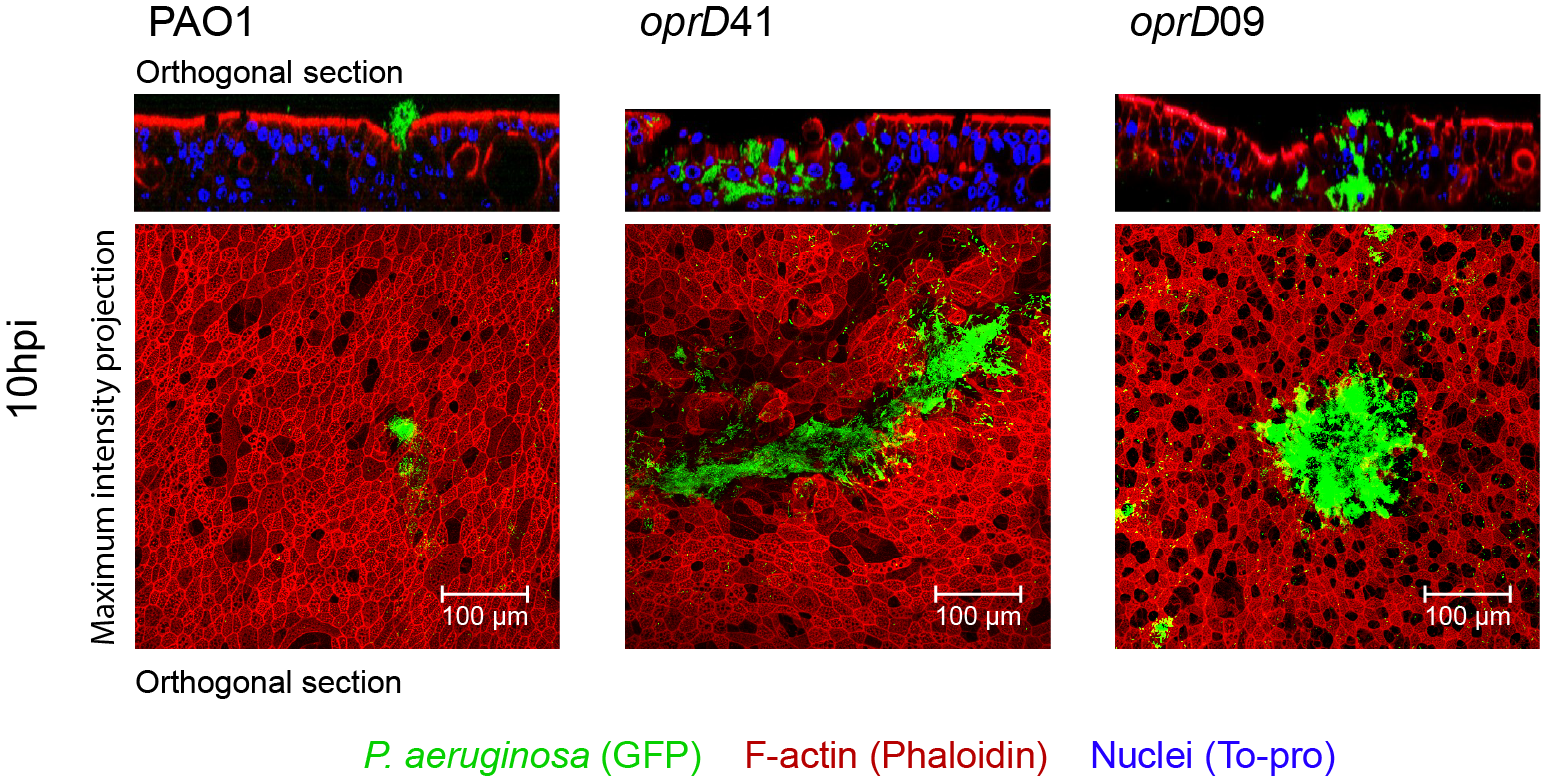
To explore this, we began by reconstructing oprD mutations in the controlled genetic background of a laboratory strain and studying their phenotype in a human airway infection model. We found that the mutants displayed distinct infection dynamics: they attached more efficiently to epithelial cells and crossed the epithelial barrier earlier than the wild-type strain.
At that point, we thought the mechanism might be straightforward to uncover. Our initial intuition was that these differences would be reflected at the transcriptional level. So we turned to transcriptomics, expecting to see clear regulatory changes that could explain the phenotype.
But we found nothing.
No major transcriptional differences, no obvious changes in known virulence pathways. So we went back to phenotyping. After testing multiple traits without a clear lead, one result finally stood out: the oprD mutants showed an unexpected change in susceptibility to colistin, an antimicrobial peptide that interacts with the bacterial surface. This observation shifted our attention to the outer membrane.
From there, the pieces started to fall into place. We found that loss of OprD altered the surface properties of the bacteria, including their net charge. These changes, in turn, affected how the bacteria interacted with mucin, the main component of airway mucus. The mutants adhered less to mucin, which likely reduced their entrapment in mucus and allowed them to reach the epithelial surface more efficiently.
What initially looked just like a resistance mutation was, in fact, reshaping how the bacteria interact with the host environment.
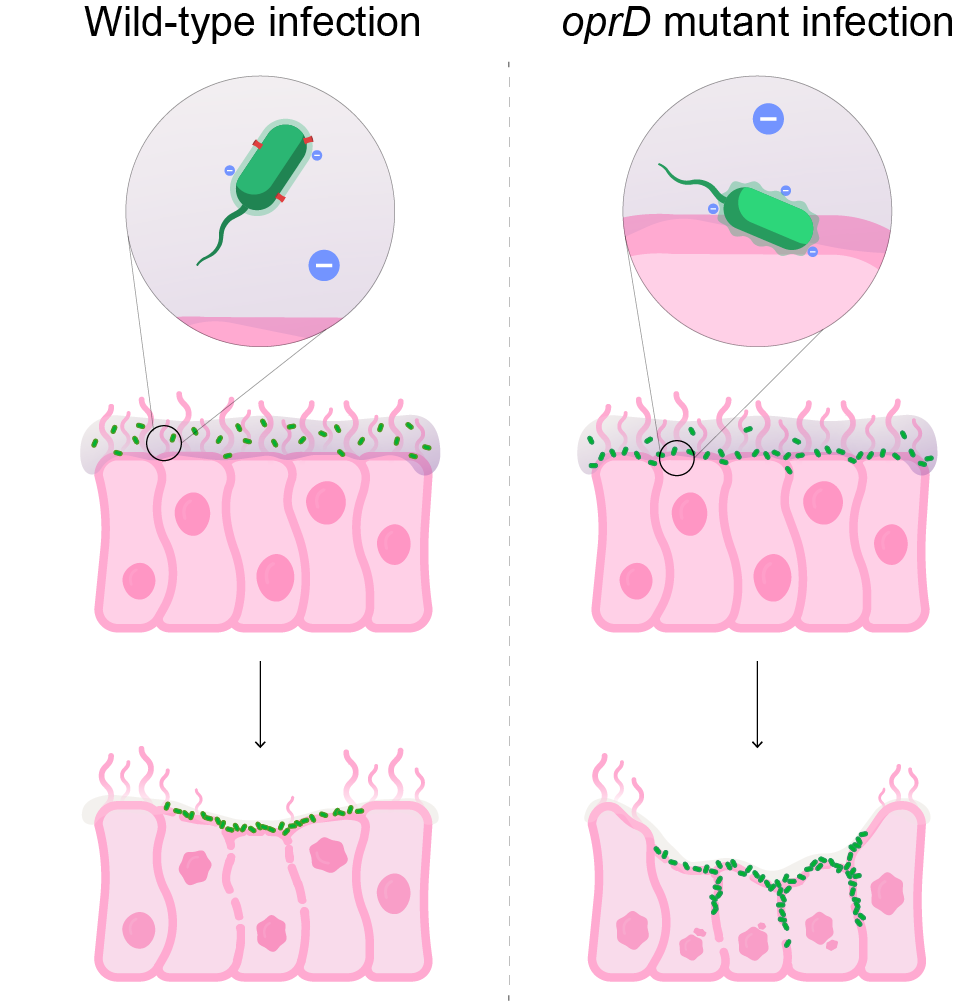
Another key moment came when we tested whether this phenotype held in clinical isolates. Given the genetic diversity of P. aeruginosa in patient infections, we did not know whether the effect would be preserved. However, across distinct clinical backgrounds, the same pattern emerged: oprD mutants consistently showed enhanced epithelial interaction and reduced mucin binding.
However, this was not simply an effect of the broader genetic background. Even in these complex clinical isolates, restoring a functional oprD gene reversed the phenotype, confirming that the effect was directly linked to its loss. Importantly, this pattern was observed across strains with very different infection dynamics, suggesting that it reflects a general mechanism acting at an early stage of host interaction, consistent with the proposed role of mucin binding.
This was both surprising and encouraging. It suggested that what we were observing was not an artefact of a laboratory strain, but a robust and potentially clinically relevant feature.
Taken together, these findings led us to rethink a common assumption. Antibiotic resistance mutations are typically studied only in terms of their impact on drug susceptibility. But our work shows that they can also directly shape bacterial physiology and host–pathogen interactions, influencing infection dynamics in ways that are independent of antibiotic treatment.
In retrospect, what started as a puzzling clinical observation turned out to reveal a broader principle: mutations that we often interpret solely through the lens of antibiotic resistance may, in fact, be shaped by, and contribute to, the complex environment of the host.
In other words, resistance mutations are not just about resistance, they can also be part of how bacteria adapt to the host.
Heading illustration made by Elena Contel Maza (@helen.mushu.science in instagram)

Follow the Topic
-
Nature Communications
An open access, multidisciplinary journal dedicated to publishing high-quality research in all areas of the biological, health, physical, chemical and Earth sciences.

Related Collections
With Collections, you can get published faster and increase your visibility.
Women's Health
Publishing Model: Hybrid
Deadline: Ongoing
Tumor Microenvironment Crosstalk and Therapeutic Implications
Publishing Model: Hybrid
Deadline: Nov 02, 2026